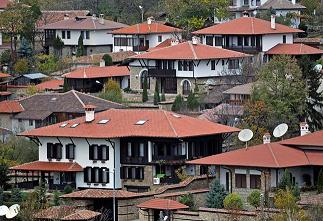
Cobblestones worn smooth by centuries of footsteps guide you through narrow lanes where time seems to have stopped. Arbanasi, perched on a plateau overlooking Veliko Tarnovo, reveals its history through ancient stone walls and hidden courtyards. The Church of the Nativity greets visitors with frescoes so vivid they seem to breathe, each painting telling stories from a Byzantine past preserved in remarkable detail.
In This Article
The History and Churches of Arbanasi
Arbanasi was founded in the 15th century by a Christian community during the Ottoman period. The village was granted significant privileges by the Sultan, including exemption from certain taxes, which allowed it to prosper while other Bulgarian settlements struggled under Ottoman rule. The houses were built with thick stone walls up to 80 centimetres wide, small barred windows on the ground floor, and massive oak doors studded with wrought-iron nails, a defensive design that protected residents from bandits and unwanted attention. The village reached its peak in the 17th and 18th centuries, when wealthy merchants built large homes with hidden compartments in the walls where they concealed valuables during tax inspections. The Church of the Nativity is the oldest and best-preserved church in the village. It was built in three stages, with the earliest section dating from the late 16th century. The interior is entirely covered with frescoes painted between 1642 and 1649, executed in vibrant shades of red, blue, green, and gold. The murals depict scenes from the life of Christ, the Virgin Mary, and various saints, arranged in registers from floor to ceiling following the traditional Orthodox iconographic programme. The painting of the Last Judgment covers the entire narthex wall and is considered one of the finest examples of Bulgarian Renaissance art. The church has no single entrance; it is divided into male and female sections, with separate doors on opposite sides, reflecting Orthodox liturgical tradition. Two other important churches survive: St. Michael the Archangel and St. Athanasius, each with its own distinctive frescoes and carved wooden iconostasis.
Monasteries and Views of Tsarevets Fortress
Two important monasteries lie within walking distance of Arbanasi. The Monastery of the Holy Archangel Michael, built in the 13th century, sits at the very edge of the plateau with spectacular views across the Yantra River valley toward the Tsarevets Fortress. Its church contains well-preserved frescoes from 1630, including a dramatic depiction of the Last Judgment that covers the entire narthex wall. The compositions are crowded with figures, the faces expressive and individualised, and the colours remarkably vivid considering their age. The Monastery of St. Nicholas, a 15-minute walk south of the village, operated as a secret school during the Ottoman period, teaching Bulgarian language and Orthodox theology in defiance of the authorities who had banned Christian education. Its iconostasis, the screen that separates the nave from the sanctuary, dates from 1716 and features intricate wood carving gilded with 22-carat gold. The carvings include vine leaves, flowers, and geometric patterns that demonstrate the extraordinary skill of the anonymous woodcarvers. The iconostasis contains 48 icons arranged in four registers, each painted in the distinctive style of the Tryavna iconographic school. From the monastery courtyard, the view across the valley to Veliko Tarnovo is the best on the plateau. The hilltop fortress of Tsarevets, just 3 kilometres away, served as the stronghold of the Second Bulgarian Empire from 1185 to 1393. The reconstructed palace complex includes a throne room, a bell tower, and the Patriarchal Cathedral of the Holy Ascension of God. A dramatic sound-and-light show is presented each evening from April to October, starting at 9pm. The show uses lasers, coloured lights, and music projected onto the fortress walls to tell the story of the Second Bulgarian Empire.
Traditional Houses, Food, and Wine in Arbanasi
The houses of Arbanasi are architectural treasures unique to this corner of Bulgaria. Built between the 16th and 19th centuries, they follow a design that emphasises both defence and hospitality. The interior layout centres on a large reception hall called the k’shta, with built-in seated alcoves lined with cushions, intricately carved wooden ceilings, and a stone fireplace large enough to roast an entire lamb. The House of Stoyan Hadzhiiliev, now a museum open Tuesday through Sunday from 10am to 5pm, preserves the finest example of this architectural style. It contains original 18th-century furniture, copper kitchenware, traditional woollen rugs, and a wine cellar carved directly into the bedrock below the house. Entry costs 5 euros. Several family-run taverns in the village serve traditional Bulgarian dishes including kavarma, a slow-cooked pork and vegetable stew; banitsa, a flaky cheese-filled pastry; and shopska salad, a refreshing mix of tomatoes, cucumbers, onions, and grated white cheese. Arbanasi is also known for its wine, and several houses offer tastings of local red wines from the Suhindol and Sevlievo wine-producing regions. The village is just 4 kilometres from Veliko Tarnovo, making it an ideal base for exploring both the medieval capital and this quiet enclave of preserved Bulgarian heritage.
Can you hear the quiet of centuries in a village like Arbanasi? 🏘️
Explore all our Bulgaria travel guides, from the Black Sea to the Rila Mountains.
Explore More
If you enjoyed this article, you might also like:

Beautiful part of the world. We spent a week exploring Arbanasi and the surrounding area and it was not nearly enough time. Every road revealed a new stunning view. The local food was fantastic too.