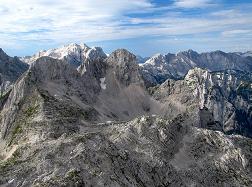
Bovški Gamsovec is one of Slovenia’s best-kept mountain secrets, a spectacular viewpoint at 2,392 metres in the heart of the Julian Alps that delivers an uninterrupted, jaw-dropping panorama of Mount Triglav, Slovenia’s highest peak and national symbol. Far less crowded than the better-known Triglav summit routes, Bovški Gamsovec offers experienced hikers a chance to stand face-to-face with the mighty Triglav North Face, Slovenia’s most iconic mountain vista, without the queues.
In This Article
The Route to Bovški Gamsovec
The most scenic approach to Bovški Gamsovec begins in the Vrata Valley, one of Slovenia’s most dramatic glacial valleys. The route passes the Aljaž Lodge (1,015 metres) and continues towards the Luknja Pass. From Luknja at 1,758 metres, a steep and sometimes exposed path climbs through scree and limestone terrain along the Bovški Gamsovec ridge. The final section involves protected climbing with steel cables and iron pegs, a via ferrata that is manageable for fit hikers with basic skills and equipment. The full hike from the Vrata Valley trailhead takes approximately four to five hours each way, making it a full-day commitment that should be started early in the morning. The reward at the summit is simply one of the best mountain views in Europe. The entire North Face of Triglav fills your field of vision, a 1,000-metre vertical wall of limestone that represents the holy grail of Slovenian mountaineering.
On clear days, the panorama extends across the Karawanks mountain range into Austria and as far as the Dolomites in Italy. Photographers should arrive early in the morning when the light hits the Triglav face directly, creating dramatic contrasts and shadows. Bovški Gamsovec is at an elevation of 2,392 metres, directly facing Triglav’s summit at 2,864 metres. The ridge itself offers multiple excellent viewpoints, and experienced hikers often spend an hour or more at the top, moving between different vantage points to capture the changing light and angles on Triglav’s massive profile. The sense of solitude at the summit, broken only by the wind and the occasional ring of a marmot’s whistle, is a rare commodity in the increasingly popular Julian Alps.
Access and Practical Considerations
There are two main access points for climbing Bovški Gamsovec. The first starts from the Vršič Pass at 1,611 metres, Slovenia’s highest mountain pass, built by Russian prisoners of war during World War I with 50 dramatic hairpin turns. The second begins at the Aljaž Lodge in the Vrata Valley. Both trailheads are approximately 1.5 hours by car from Bled or Kranjska Gora. Alternatively, Bovški Gamsovec can be reached from Pogačnik’s house at the north or from the Luknja saddle at the south. If arriving by car, parking is available in Zadnjica at approximately 700 metres elevation. The best climbing season is July to September, when the ridge sections are snow-free and weather conditions are most stable. Early July still sees some snow patches in the shaded gullies, so microspikes may be useful, while September offers more stable weather and stunning autumn colours in the valley below.
Via ferrata equipment, including a climbing harness, helmet, and via ferrata lanyards with energy absorbers, is essential. Previous via ferrata experience is recommended, as the exposed sections demand confidence and good technique. The climb is challenging, involving steep scree slopes and exposed sections that demand a head for heights. Hikers should check weather forecasts carefully before setting out, as conditions in the Julian Alps can deteriorate rapidly, with afternoon thunderstorms being a particular danger on exposed ridges. Carry sufficient water, food, and warm clothing even in summer, as temperatures at the summit can be 15 degrees Celsius cooler than in the valley. A headlamp is also recommended in case the descent takes longer than planned, as the trail through the Vrata Valley becomes difficult to follow in darkness.
Triglav National Park: Beyond Bovški Gamsovec
Triglav National Park offers many other attractions for visitors who want to explore beyond Bovški Gamsovec. Mount Triglav itself is Slovenia’s highest peak at 2,864 metres, a challenging two-day climb requiring via ferrata skills and considered a national rite of passage for Slovenians. The Vršič Pass, with its wartime history and beautiful Russian Chapel, is worth exploring and offers access to some of the finest hiking trails in the Julian Alps. Lake Bohinj, Slovenia’s largest glacial lake, offers a less touristy alternative to Lake Bled and serves as the gateway to the southern Triglav approaches. Swimming in Bohinj’s clear waters on a warm summer day is a quintessential Slovenian experience. The lake is surrounded by hiking trails of varying difficulty, including the route to the Savica Waterfall, which plunges 78 metres into a rocky amphitheatre. The Soča Valley, with its emerald-green river, world-class whitewater rafting, and the historic World War I battlefields at Kobarid, rounds out a comprehensive visit to this remarkable alpine region. The Kobarid Museum, winner of the Council of Europe Museum Prize, offers a moving and informative account of the brutal battles fought in these mountains. Together, these attractions make northwestern Slovenia one of Europe’s most compelling destinations for outdoor adventure and historical exploration.
View Bovški Gamsovec – amazing view of the highest peak of the Julian Alps, Triglav, Slovenia in a larger map
Have you climbed in the Julian Alps or stood face-to-face with Triglav’s North Face? Share your Slovenian mountain adventures in the comments, I’d love to hear your route recommendations! ⛰️
Explore all our Slovenia travel guides, from Lake Bled to the Julian Alps.
Explore More
If you enjoyed this article, you might also like:
