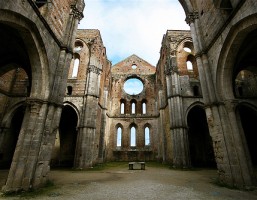
The Abbey of San Galgano is one of Italy’s most atmospheric and romantic ruins, a roofless Gothic Cistercian abbey in the Tuscan countryside near Siena, whose soaring walls and empty window arches frame nothing but sky, and whose nearest hilltop hermitage houses the legendary Sword in the Stone, Italy’s own Excalibur. Abandoned in the 18th century and left to the elements for over 200 years, San Galgano is now one of Tuscany’s most photogenic and spiritually charged destinations, a place of genuine mystery, medieval legend, and breathtaking architectural beauty.
In This Article
Quick Facts: Abbey of San Galgano, Italy
- Best time to visit: April-October; summer evenings for atmospheric golden light through the roofless nave; June/July for the wheat fields surrounding the abbey turning gold
- Top attraction: The Sword in the Stone at the nearby Montesiepi Hermitage, a 12th-century sword thrust into a rock embedded in the chapel floor, scientifically proven to date from the period
- How to get there: ~30 minutes from Siena by car; the abbey is in the Val di Merse near the village of Chiusdino
- Entry fee: ~€5 (abbey); ~€3 (Montesiepi hermitage with the sword)
- Best for: History lovers, photographers, and seekers of off-the-beaten-path Tuscany
The Architecture and History of San Galgano Abbey
The Abbey of San Galgano was built between 1224 and 1288 in the French Gothic Cistercian style, one of the first examples of Gothic architecture in Italy. The Cistercian monks chose this remote valley for its isolation and natural beauty. What makes San Galgano extraordinary today is that the roof is entirely gone, leaving the interior open to the Tuscan sky. The ribbed vaulting collapsed long ago, but the skeletal remains of arches and columns still stand against the changing light. The east end retains its lancet windows through which sunlight pours onto the grassy floor. The lack of a roof has paradoxically enhanced the abbey’s beauty, transforming it into a living space where architecture and nature merge. Wildflowers grow between the stone slabs and birds nest in the upper walls, giving San Galgano a powerful sense of authenticity and timelessness.
The Legend of the Sword in the Stone
According to legend, the knight Galgano Guidotti renounced his violent life in 1180 after a vision of the Archangel Michael. To symbolise his conversion, he thrust his sword into a rock where it miraculously fused, creating a cross. The sword remains embedded in the rock to this day in the circular Montesiepi chapel built over his hermitage. Scientific analysis has confirmed the sword dates to the 12th century and was embedded in the stone, not placed in a pre-cut slot, making it one of the most intriguing medieval relics in existence.
What makes this story so compelling is that it predates the Arthurian legends as we know them today. While the English version of Excalibur was popularised by Thomas Malory in the 15th century, the story of Galgano Guidotti was already well known across Europe by the late 12th century. Some scholars suggest that the Italian sword-in-the-stone legend may have actually influenced the later Arthurian tales, rather than the other way around. Montesiepi Hermitage itself is a beautiful round Romanesque chapel, its dome visible from the abbey below, surrounded by cypress trees on a hilltop. Inside, the sword is displayed behind a glass case embedded in the floor, and visitors can feel the genuine spiritual weight of the place. The hermitage also contains fragments of 14th-century frescoes and a small museum with archaeological finds from the site.
Abbey of San Galgano is located about 30 km west of Siena, in a wild, unspoiled natural area. Galgano Guidotti (1148-1181), son of Guido and Dionysus, was a brave but dissolute young king who renounced the material world and turned to God. When he tried to break the sword on the rock as a symbol of opposition to war, the rock suddenly engulfed it. He built a hut on a hill above the abbey (now the chapel) and died there as a hermit. In 1185 he was declared a Saint by Pope Lucius III. You can still see the sword in the rock.
Visiting San Galgano: Practical Tips
The best time to visit the Abbey of San Galgano is late afternoon, when the low sun streams through the empty window frames and casts long shadows across the nave floor. Summer evenings are particularly magical, with the abbey open until sunset and the wheat fields surrounding the site turning golden. Admission to the abbey costs approximately €5, while the Montesiepi Hermitage is an additional €3. Combined tickets are available. The site is accessible year-round, though winter visits have their own stark beauty with the bare cypress trees and mist rolling across the valley. Getting there requires a car, as public transport is limited. From Siena, take the SP441 towards Chiusdino, then follow the signs. The drive takes about 30 minutes through quintessential Tuscan countryside of rolling hills, vineyards, and olive groves. Parking is free and there is a small cafe near the abbey entrance. Allow at least two hours to explore both the abbey and the hermitage, plus time to simply sit and absorb the atmosphere. Photography enthusiasts will find endless compositions, especially during the golden hour.
View Abbey of San Galgano – the town of secrets and legends in Italy in a larger map
Have you visited the Abbey of San Galgano or seen the Sword in the Stone? Share your Tuscan discoveries in the comments! 🗡️
Explore all our Italy travel guides, from the Dolomites to Sicily.
Explore More
If you enjoyed this article, you might also like:
