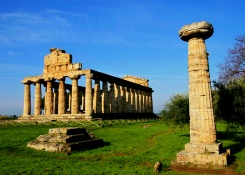
The ancient Greek temples of Paestum rise from the flat plains of Campania with a presence that seems to belong to another age. Three Doric temples, among the best-preserved in the Greek world, stand in a row against the backdrop of the mountains, their honey-coloured limestone glowing in the afternoon light. Paestum was originally a Greek colony called Poseidonia, founded around 600 BCE, before it fell to the Lucanians and later the Romans. The site was abandoned in the early Middle Ages due to malaria and coastal silting, and its existence was largely forgotten until the 18th century, when the temples were rediscovered by travellers on the Grand Tour.
The Three Temples
The Temple of Hera, built around 550 BCE, is the oldest of the three and the best preserved. Its sturdy Doric columns, nine across the front and eighteen along the sides, still support the original entablature and pediment. The Temple of Neptune, actually dedicated to Hera as well, was built around 460 BCE and is considered one of the finest examples of Doric architecture anywhere in the world. Its proportions are more refined than the earlier temple, and nearly all of its columns remain in place with their capitals and architraves intact. The Temple of Athena, built around 500 BCE, is smaller and stands at the highest point of the site, its elegant form visible from almost every angle. Unlike the other two, it features Ionic columns in the inner porch, showing the transition between architectural styles.
The Museum and the City Walls
The National Archaeological Museum of Paestum houses an outstanding collection of finds from the site, including painted Greek vases, bronze armour, and a series of extraordinary tomb paintings. The most famous is the Tomb of the Diver, a 5th-century BCE fresco showing a young man diving from a column into a river, symbolising the passage from life to death. The painting is unique in ancient Greek art and is displayed in a climate-controlled room at the museum. The site itself is surrounded by the original city walls, stretching for almost five kilometres and punctuated by towers and gates that have survived from the Lucanian and Roman periods. A walk along the walls offers excellent views of the temples within and the surrounding countryside.
Practical Information
Paestum is located in the Campania region, approximately 100 kilometres south of Naples and 40 kilometres south of Salerno. Regular trains from Naples and Salerno serve the Paestum station, which is a short walk from the archaeological site. The site is open daily, with hours varying by season. Admission costs approximately 12 euros for adults, with a combined ticket available for the museum and the archaeological area. The best time to visit is spring or autumn, when the weather is pleasant and the crowds are smaller. Summer can be extremely hot, with temperatures regularly exceeding 35 degrees Celsius, so early morning or late afternoon visits are recommended. Allow at least three hours to explore the site and the museum thoroughly.
Have you walked between the ancient columns of Paestum and imagined the city as it was 2,500 years ago? Which of the three temples impressed you most?

Paestum is a major European seaside resort and unforgettable tourist destination. It is also the main objective of the excavations for history lovers. Paestum is located in Campania region, about 40 km south of Salerno and 85 km southeast of Naples. Ancient Greek temples resemble the Athens’ Acropolis, and there is also a museum in which you can enjoy the rare pieces.
It is the most important architectural monument of Greek art on the Italian mainland. Greek colonists lived in Paestum already in the 7th century BC and called the town Poseidonia. archaeological discoveries confirm that the city was an important center of learning, full of temples, roads and rich buildings. It was founded by the Romans around the year 40 BC. At this time Paestum belonged to the prosperous cities of the Roman Empire.
In the Middle Ages Paestum (or Capaccio – as it was called) was abandoned for unknown reasons (historians are leaning toward the theory that it was due to malaria). The archaeological work that was carried out in 18th century (for an initial focus of Pompeii and Herculaneum) again showed this glory to the world and the city has enjoyed rediscovery. On 9th September 1943 the beach at Paestum became a landing place for the 36th American Division. Heavy fighting took place in the city nine days before the German were pushed to the north.
Thanks to archaeological discoveries, Paestum became a frequent tourist destination. Visitors can enjoy history together with a great opportunity to swim in the sea. The real tourist boom occurred after World War II, even though the city has undergone a difficult period of war. The city began to develop a robust tourism industry, which attracted visitors from all over the world. But not only the sea and monuments attracted to Paestum. It is also delicious cuisine and Nature (Paestum is located in the middle of the Cilento National Park).
Paestum has its own atmosphere and charm. You can sit in the numerous restaurants offering fish specialties in pizzerias and cafes. Come to Paestum and see that you will be very nice surprised!
You can also visit nearby Napoli, Pompeii or Capri island.
View Paestum – major Graeco-Roman city in Italy in a larger map
Have you explored the natural wonders and historic treasures described here? Share your favourite European travel memory in the comments below!
Explore all our Italy travel guides, from the Dolomites to Sicily.
Explore More
If you enjoyed this article, you might also like:
