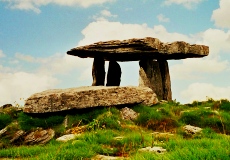
The Poulnabrone Dolmen is one of Ireland’s most iconic prehistoric monuments, a 5,800-year-old Neolithic portal tomb consisting of three massive standing stones capped by a 1.8-metre-long capstone, rising starkly from the limestone pavement of the Burren in County Clare. Older than Stonehenge and the Pyramids of Giza, Poulnabrone is one of the most photographed archaeological sites in Ireland, and also one of the most productive: excavations in 1986 revealed the remains of at least 33 individuals buried there over a period of 600 years.
In This Article
Quick Facts: Poulnabrone Dolmen, Ireland
- Best time to visit: Year-round; dawn and dusk offer the most atmospheric light and fewest visitors; spring and autumn for the Burren’s wildflowers
- Age: Approximately 5,800 years old, built between 3800-3200 BC
- How to get there: Located on the R480 road in the Burren National Park; ~45 minutes from Galway; ~1 hour from Shannon Airport; free access with a small parking area
- Entry fee: Free, the dolmen sits in open farmland adjacent to the road (please respect the grazing livestock)
- Combine with: The Cliffs of Moher (~30 minutes south), the Burren’s unique limestone pavement and arctic-alpine flora, and the nearby Caherconnell Stone Fort
Understanding the Dolmen: Architecture and Purpose
If you are going to Ireland and you are not interested only in big cities, or Guinness, then you must see The Poulnabrone Dolmen – another prehistoric monument that is similar to Stonehenge in England.
More than 5,000 years ago, the early inhabitants of the area, used slabs of limestone to build temples and portal tombs, sometimes called dolmens. Poulnabrone Dolmen is probably the most photographed monument throughout Ireland. It lies on the west of the Ireland, in County Clare, in the Burren karst area. A number of these interesting sites are spread throughout the Burren.
The entire structure of Poulnabrone Dolmen consists of 9 m deep burial chamber whose entrance is turned over to the east. The name “Poulnabrone” itself comes from the Irish “Poll na mBrón,” meaning “the Hole of Sorrows” or “the Hole of the Millstone,” reflecting the folklore that grew up around this ancient monument. The dolmen was constructed by Neolithic farmers who cleared the Burren’s thin soils for agriculture and built this impressive tomb as a focal point for their community. The orientation of the entrance towards the east, aligned with the rising sun on the spring and autumn equinoxes, suggests that the builders possessed astronomical knowledge.
The dolmen sits in a landscape that has changed remarkably little since Neolithic times. The same limestone pavement that surrounds it today was already ancient when the tomb was built, and the thin soils of the Burren have prevented the dense forest cover that would have transformed much of prehistoric Ireland. This means that visitors today see essentially the same view that the builders of Poulnabrone saw nearly 6,000 years ago: a vast, windswept plain of cracked grey limestone, punctuated by wildflowers and the occasional stone monument, stretching to the distant Atlantic horizon.
The Excavations and the Burren Landscape
Archaeological research in 1985 showed that there were 16 to 22 adults and 6 children buried, including their personal things. Found here such as stone axes, bone pendants, ceramic products and weapons. Poulnabrone Dolmen was therefore an important ceremonial site used in the Bronze Age.
The 1986 excavation, led by Dr. Ann Lynch of the Irish National Monuments Service, was prompted by concerns that the dolmen was structurally unstable. The team carefully excavated the burial chamber, revealing a remarkable time capsule of Neolithic life. The remains of at least 33 individuals were found, including both adults and children. Radiocarbon dating showed that the burials occurred over a period of approximately 600 years, from 3800 BC to 3200 BC, indicating that the dolmen served as a communal burial place for successive generations. Among the grave goods were polished stone axes, bone pendants, chert arrowheads, and distinctive Carrowkeel Ware pottery, suggesting wide trade connections.
The dolmen sits in the heart of the Burren, one of Europe’s most extraordinary karst landscapes. This vast limestone plateau, covering approximately 250 square kilometres, was formed during the Carboniferous period when ancient coral reefs were compressed into sedimentary rock. Glacial activity stripped away the soil cover, leaving behind the distinctive cracked limestone pavement. The Burren’s apparent barrenness is deceptive: between the cracks (known as “grikes”) grow an extraordinary variety of plants, with Mediterranean and alpine species growing side by side, creating a botanical phenomenon that attracts naturalists from around the world.
The fact that the dolmen was used for burials over six centuries suggests that Poulnabrone held deep cultural significance for the Neolithic communities of the Burren. It was not merely a tomb but a territorial marker and a ceremonial focal point, a place where successive generations gathered to honour their ancestors and reinforce their connection to the land. Today, standing beside the ancient stones with the wind sweeping across the limestone pavement, it is easy to feel something of that same connection across the millennia.
View The Poulnabrone Dolmen – another Stonehenge in Ireland in a larger map
Have you photographed Poulnabrone Dolmen or explored Ireland’s ancient sites? Share your favourite prehistoric discoveries in the comments! 🗿
Explore all our Ireland travel guides, from Dublin pubs to the Wild Atlantic Way.
Explore More
If you enjoyed this article, you might also like:
