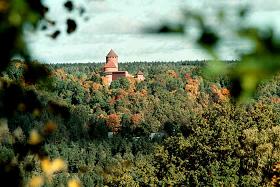
Gauja National Park is Latvia’s largest and oldest national park, a deeply picturesque landscape of the ancient Gauja River valley, Devonian sandstone cliffs, dense forests, and three magnificent medieval castles (Turaida, Sigulda, and Krimulda) scattered across the park’s 917 square kilometres. Known as the “Switzerland of Latvia” for its unusually hilly terrain in an otherwise flat country, the Gauja Valley has been a cradle of Latvian culture and history for millennia, Bronze Age settlements, Livonian crusader castles, and the legendary Gutman’s Cave are all found within the park’s borders.
In This Article
Quick Facts: Gauja National Park, Latvia
- Best time to visit: May–October; summer for hiking and canoeing on the Gauja River; autumn for spectacular colours along the river valley (Latvia’s most beautiful autumn destination); winter for bobsleigh on the Sigulda track and cross-country skiing
- Size: 917 km², the largest protected area in Latvia
- How to get there: ~1 hour from Riga by car or train to Sigulda (the park’s main hub); regular trains from Riga Central Station to Sigulda
- Top attractions: Turaida Castle and Museum Reserve, Gutman’s Cave, the Sigulda cable car across the Gauja Valley, and the Krimulda medieval castle ruins
Turaida Castle: The Red-Brick Jewel of the Gauja Valley
The Turaida Castle (Turaidas pils) is the crown jewel of Gauja National Park and one of the most visited historical sites in Latvia. Built in the 13th century as a Livonian Order fortress, this striking red-brick castle has been meticulously restored and now operates as a museum reserve that brings medieval Latvia to life. Visitors can climb the castle’s main tower for panoramic views of the Gauja River valley, explore the restored castle interiors with their historical exhibits, and wander through the surrounding sculpture park and beautifully maintained gardens. The castle grounds also include a wooden Lutheran church that dates back to the 18th century and is the final resting place of Maija, the legendary Rose of Turaida.
Beyond the castle itself, the Turaida Museum Reserve encompasses several historic buildings, including the old castle guard’s house, the estate manager’s residence, and a collection of traditional Latvian wooden houses that have been furnished to reflect rural life in the 18th and 19th centuries. The reserve regularly hosts historical re-enactments, craft workshops, and seasonal festivals that showcase Latvian folk traditions, music, and cuisine. The park’s location on a hill overlooking the Gauja River makes it one of the most photographed spots in Latvia, particularly in autumn when the surrounding forests explode into brilliant shades of gold, orange, and red.
Sigulda: Adventure Capital of Latvia
The town of Sigulda serves as the main gateway to Gauja National Park and has earned a reputation as Latvia’s adventure sports capital. The town is situated on opposite sides of the Gauja Valley, connected by a cable car that offers breathtaking aerial views of the river gorge, the surrounding forests, and the two medieval castles that overlook the valley. In winter, the Sigulda bobsleigh and luge track hosts international competitions and offers adrenaline-seekers the chance to ride a professional bobsleigh at speeds exceeding 100 km/h. The track is open to the public during the winter season, making Sigulda one of the few places in the Baltic region where you can experience world-class winter sports.
For those seeking adventure in warmer months, the Gauja River offers excellent canoeing and kayaking opportunities, with gentle currents that make it suitable for beginners and families. The river meanders through the heart of the national park, passing beneath the sandstone cliffs and castle ruins that make this landscape so distinctive. Hiking and cycling trails crisscross the park, with well-marked routes ranging from short nature walks to full-day treks. The Krimulda medieval castle ruins, perched on the opposite side of the valley from Sigulda, can be reached on foot via a scenic trail or by the cable car, offering another fascinating glimpse into Latvia’s crusader-era history.
Natural Wonders and Geological Highlights
Gauja National Park is not only a cultural treasure but also a region of significant geological interest. The park’s Devonian sandstone cliffs are among the oldest rock formations in the Baltic region, dating back over 350 million years to a time when much of Northern Europe was covered by a shallow tropical sea. In some places, these cliffs rise to heights of 90 metres above the river, creating dramatic overhangs, caves, and rock formations that have been carved by erosion over millennia. The most famous of these is Gutman’s Cave (Gutmana Ala), the largest erosion cave in the Baltic states, which has been a tourist attraction since the 19th century and is steeped in local legend.
The park’s forests cover approximately 60 per cent of its total area, providing habitat for a rich diversity of wildlife including deer, wild boar, beavers, and over 150 species of birds. Ancient oak, lime, and pine trees can be found throughout the park, with some specimens estimated to be over 400 years old. The Gauja National Park was established on 14 September 1973 as the first national park in Latvia, and today it protects more than 500 monuments of history and culture, including castle mounds, churches, manors, watermills, and archaeological sites that span from the Bronze Age to the 20th century, making it a destination of unparalleled cultural and natural richness.
View Gauja National Park – largest national park in Latvia in a larger map
Have you explored the Gauja Valley or discovered Latvia’s three castles? Share your Latvian adventures in the comments! 🏰
Explore all our Latvia travel guides, from Riga Art Nouveau to Baltic beaches.
Explore More
If you enjoyed this article, you might also like:
