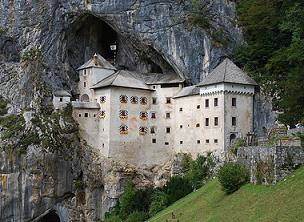
Predjamski Grad (Predjama Castle) is one of the most dramatic castles in the world, a Renaissance fortress built directly into the mouth of a vast limestone cave, 123 metres up a vertical cliff face in the Karst region of Slovenia, where it hangs impossibly from the rock like something from a fantasy novel, complete with secret passages, a network of caves behind the walls, and the legend of the rebellious knight Erasmus who held out here against a year-long siege. The castle in its current form dates from the 16th century, but a fortress has occupied this site since at least 1202. The combination of human architecture and natural cave, the castle literally merges with the rock, the upper rooms warm and dry in winter thanks to the geothermal properties of the cave system behind them, makes Predjama one of the most perfectly integrated structures in Europe, and a strong candidate for the most photogenic castle on the continent.
In This Article
Quick Facts: Predjama Castle, Slovenia
- Best time to visit: Year-round; the castle is at its most dramatic in the golden light of late afternoon when the cliff face glows; July for the Erasmus Knight’s Tournament, a medieval reenactment festival; the cave beneath the castle is accessible as part of a guided tour (advance booking recommended)
- How to get there: ~50 minutes from Ljubljana by car; ~10 minutes from the Postojna Cave (the two are commonly combined, tickets for both are available); bus from Ljubljana to Postojna + local bus or taxi to Predjama. It is a short but steep walk uphill from the car park to the castle entrance
- Entry fee: ~EUR 15 (adult); combined ticket with Postojna Cave ~EUR 35-40
- The legend of Erasmus: In the 15th century, the robber-knight Erasmus of Lueg held out against a year-long siege by the Habsburg army. The besiegers could not understand how Erasmus was receiving fresh food and supplies, until they discovered a secret passage leading from the castle through the cave system to the outside world, which Erasmus had used to resupply. According to legend, Erasmus was finally killed not by the siege but by a cannonball fired while he was in the most vulnerable room of the castle, the toilet
- Combine with: Postojna Cave (one of Europe’s most spectacular show caves, 9km away, it’s practically mandatory to combine the two), and the Lipica Stud Farm (the original home of the Lipizzaner horses, 30 min)
- Best for: Castle enthusiasts, photographers, fantasy fans, and anyone who wants to see a castle clinging to the side of a cliff
Exploring the Castle Interior and Cave System
The castle’s five floors are open to visitors during the summer season, with guided tours leading through 15 furnished rooms and a gallery that showcase the living conditions of the nobility who once resided here. The rooms are surprisingly comfortable, with thick stone walls providing insulation and the cave system behind the castle regulating the internal temperature. The knight’s hall, the kitchen, the chapel, and the living quarters are all furnished with period pieces, giving visitors a tangible sense of medieval castle life. Behind the castle, a network of natural caves extends deep into the cliff, including a vertical shaft that opens to the surface several hundred metres above. This system was used by Erasmus to smuggle supplies during the siege, and parts of it are accessible as part of the guided tour. The cave beneath the castle, known as the Predjama Cave, is a separate attraction that can be visited with a dedicated guide, offering impressive stalactite formations and underground chambers. The castle was built on a high rock in the overhang, creating its dramatic cliffside appearance.
The Legend of Erasmus and the Siege of Predjama
The story of the robber-knight Erasmus of Lueg is the defining legend of Predjama Castle. In the 15th century, Erasmus fell out of favour with the Habsburg monarchy after killing the commander of the imperial army in a quarrel. He fled to his fortress at Predjama, where he was besieged by the Habsburg forces for over a year. The besiegers could not understand how Erasmus continued to receive fresh food and supplies until a local servant revealed the secret: a hidden passage leading from the castle through the cave system to the outside world. According to legend, Erasmus met his end not through starvation but through a moment of carelessness. While using the castle’s toilet, positioned on an external balcony, he was spotted by the besieging forces and killed by a well-aimed cannonball. The toilet has been preserved as a macabre tourist attraction, and the Erasmus Knight’s Tournament, held each July, commemorates the rebellious knight’s colourful story. The castle was originally built in Gothic style and was called Luegg, with the current Renaissance version dating from the 16th century.
Practical Information and Nearby Attractions
Predjama Castle is located just nine kilometres from Postojna Cave, and the two attractions are so commonly combined that a joint ticket is available. The castle is approximately 50 minutes from Ljubljana by car, and public transport connections run from the capital to Postojna, from where a local bus or taxi completes the journey to Predjama. The walk from the car park to the castle entrance is short but steep, and the cliffside location means that the castle is at its most photogenic in the late afternoon, when the golden sunlight illuminates the rock face. The Lipica Stud Farm is a 30-minute drive away. The Škocjan Caves UNESCO site is also within easy reach. After WWII, the castle was nationalized and turned into a museum.
Have you visited the cliff-hanging Predjama Castle or explored Slovenia’s Karst region? Share your cave-castle adventures in the comments! 🏰
Explore all our Slovenia travel guides, from Lake Bled to the Julian Alps.
Explore More
If you enjoyed this article, you might also like:
- Lake Bled – the symbol of Slovenia – Slovenia
- Maribor – the second largest city in Slovenia – Slovenia
- Lake Bohinj – the most beautiful place in Slovenia – Slovenia
