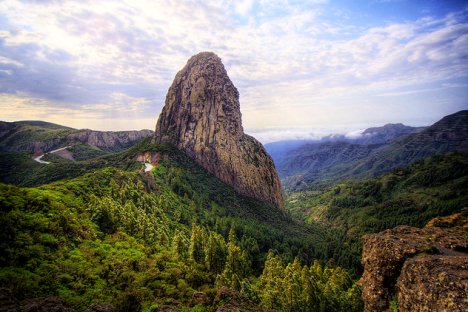
The ferry from Tenerife cuts through Atlantic swells as La Gomera appears on the horizon, green and rugged and older than time. This island does not have sprawling resorts or crowded beaches. Instead it has plunging ravines cloaked in laurel forests where the air smells of damp earth and ancient leaves. A thick layer of cloud often sits on the higher peaks, trapping moisture that feeds ferns and mosses found nowhere else on Earth. The locals still use a whistling language called Silbo to communicate across the valleys. On La Gomera, the landscape demands that you pay attention.
La Gomera is a volcanic island and the second smallest island of the Spanish Canary Islands. One third of the island is a part of the Garajonay National Park (Parque nacional de Garajonay), which was established here in 1981 and is listed on the UNESCO World heritage List. About 40 square kilometres is covered by ancient subtropical laurel forests, which thrive here thanks to the cool and wet climate. With peace and quiet that features this island, it is an ideal place to spend a pleasant holiday away from the crowds and noise of more developed tourist destinations.
Photo licensed under the Creative Commons, created by Till Krech
In This Article
Garajonay National Park and Ancient Laurel Forests
Garajonay National Park includes also the mountain massif Garajonay that reaches an altitude of 1,487 metres and such it is the highest point of the island. From here, during nice weather you can enjoy a beautiful view over the Atlantic Ocean and the other islands of the Canary Archipelago: El Hierro, La Palma, Tenerife, and Gran Canaria. The foot of the mountain is covered by dense forest; on the drier side it is formed by gale and tree heath. These shrubs reach heights over 15 metres. Because of their non-combustible timber, they are used in production of pipes. Laurel forest grows on the northern and northeastern slopes. These trees boast large, solid, shiny green leaves. More than 450 species of plants grow on La Gomera. Some of these species are endemic and cannot be found anywhere else in the world, such as Canarian mahogany and ebony. In the Tertiary period, laurel forests covered an area of northern Africa and parts of southeastern Europe. Their demise was due to temperature fluctuations in the Ice Age and subsequent deforestation. The laurel forest in Garajonay National Park is the last surviving example of those forests, often called a living fossil.
Photo licensed under the Creative Commons, created by Axel Brocke
Climate, Hiking, and Unique Landscapes
The climate on La Gomera is cooler than on the other islands, even though this area is known for its dry climate. Deep green forests provide pleasant relaxation during hot days. The air is usually cool and moist; it rains almost constantly during the summer. This is due to the action of trade winds coming from the northeast, which bring permanent moisture from the Atlantic Ocean. This phenomenon is important in terms of the water regime of the island, because about two-thirds of drinking water is formed by this way. The sunny parts of the forest feature a number of blooming flowers. You can also find almost two metre high fern, which prevents smooth walking through the jungle. The local lush vegetation includes 20 metre high trees densely covered with moss. La Gomera is also home to around 100,000 palm trees, the most of all the Canary Islands. half of them are Canary palms, whose sap is used for production of an edible sweet syrup called palm honey. The island boasts numerous gorges, rock cones, and rocks that descend deep into the sea. Among the most beautiful valleys on the island is Gran Rey with its dramatic cliffs and black sand beaches.
Photo licensed under the Creative Commons, created by Axel Brocke
Culture, History, and Practical Information
Since it is a popular tourist area there are lots of accommodation options of all categories on La Gomera. The beaches are mostly rocky, but there are some small sandy coves, particularly around Valle Gran Rey and San Sebastian. The capital of the island is San Sebastian, which was a popular port of Christopher Columbus. Among the known historical villages are Valle Gran Rey, Chipude, Agulo, and Arure. An interesting feature of the island is that the locals communicate by whistling. This language is called El Silbo or Silbo Gomero and is still used by some people, because they can communicate over long distances (3-4 km). The island of La Gomera was created by volcanic eruption, and the last eruption is dated to the Quaternary period. Volcanic chimneys spewed basalt and ash that settled in layers. Those were then baked by hot lava. Long ago, the island was much larger, but due to erosion it has shrunk by more than half into its present area of 370 square kilometres. Ferries connect La Gomera to Tenerife several times daily, making it easy to visit as a day trip or as part of a longer Canary Islands itinerary.
Could you spend a week on an island where locals whistle across valleys instead of calling out? 🌿
Explore all our Spain travel guides, from Barcelona Gaudí to Andalusia plazas.
Explore More
If you enjoyed this article, you might also like:
