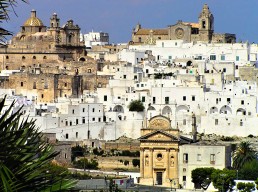
Ostuni is la Città Bianca, the White City, one of the most spectacular hill towns in southern Italy, a dazzling cascade of whitewashed houses, staircases, and alleyways rising from the olive groves of Puglia’s Valle d’Itria whose uniformly white-painted architecture (originally a medieval sanitary measure using lime wash to disinfect the streets, now a beloved aesthetic tradition) creates a blindingly beautiful urban landscape visible for miles across the Apulian plain. Ostuni is the queen of the Itria Valley, living up to every Italian hill-town fantasy, sleeping cats in sun-drenched piazzas, the magnificent 15th-century cathedral with its intricate rose window, and views from the old city walls over the endless silver-green sea of olive trees that stretches all the way to the Adriatic.
In This Article
Quick Facts: Ostuni, Italy
- Best time to visit: April–June and September–October for comfortable exploring temperatures; avoid midday July–August when the white walls reflect heat and the town can feel like an oven, early morning or late afternoon is the time to be out; August is the busiest month with Italian holidaymakers
- How to get there: ~1 hour from Bari Airport by car; ~40 minutes from Brindisi Airport; Ostuni train station is 3km from the old town (bus or taxi up the hill)
- Top experiences: Losing yourself in the labyrinth of alleys in the Centro Storico (the most atmospheric part of the town), the view from the city walls at sunset, and the Saturday morning market, one of the best in Puglia
- Combine with: Alberobello (trulli town, 45 min), Locorotondo (another beautiful white hill town, 25 min), and the beaches of the Costa Merlata (20 min)
Wandering the Whitewashed Centro Storico
The historic centre of Ostuni is a labyrinth of white alleyways, staircases, and tiny piazzas designed for getting lost. The whitewashing tradition dates to the Middle Ages, when lime wash was applied as a sanitary measure during plague outbreaks, and it now creates a town that glows brilliantly against the blue Apulian sky. As you climb the steep streets, you pass pointed arches, narrow passageways, and hidden courtyards with bougainvillea cascading down white walls. The best time to explore is early morning before the heat and tour groups arrive, when the streets are empty and soft light fills the alleyways. Late afternoon offers an equally magical experience as the white walls reflect golden sunset light.
The Cathedral and Other Landmarks
At the summit of the old town stands Ostuni Cathedral, built between 1435 and 1495 in Apulian Romanesque-Gothic style. The facade features a stunning rose window carved from a single stone block, one of the largest in southern Italy. The three Gothic portals lead into an interior with an 18th-century painted wooden ceiling. From the cathedral piazza, views over the Valle d Itria and the Adriatic coastline are breathtaking at sunset. Other landmarks include the Chiesa dello Spirito Santo with its Baroque facade and the Museo di Civilta Preclassiche, which houses the famous Ostuni Venus, a 25,000-year-old figurine discovered in a local cave.
Day Trips from Ostuni: Trulli, Caves and Coast
Ostuni is an excellent base for exploring southern Puglia. A 45-minute drive takes you to Alberobello, a UNESCO site famous for its trulli, conical-roofed stone houses. The Rione Monti district contains over 1,000 trulli. A 25-minute drive leads to Locorotondo, another white hill town with excellent local wine bars serving Locorotondo DOC wine. The Costa Merlata, 20 minutes away, offers stunning coves and beaches, with Torre Guaceto nature reserve being the most unspoiled. The Grotte di Castellana, 40 minutes away, are among Europe most important cave systems, with a guided tour through spectacular karst formations including the Grotta Bianca covered in white calcite crystals.
Ostuni is a town in Puglia, Italy, called “White Town” (“La Città Bianca”). It is built on a hill with a magnificent view of the sea and the surrounding valley, containing a number of rustic white houses. The city looks very vividly and is magically illuminated during the evenings. We recommend walking through the pedestrian zone of the historic center, which is still fully occupied and full of live where you can enjoy narrow streets and romantic cafes.
Do not miss the visit of the Gothic cathedral from the 15th century. Nearby there are the caves of Castellana, which include (besides the Adelsberg cave) the most important cave systems in Europe. Caves that are long 1.2km (with side passages much more) are accessible with a guide and have 2 lifts. Above the caves there is a watch tower and the Cave Museum. In the nearby town of Fasano you can visit Zoo Safari with 600 exotic animals including lions, and the Dolphinarium. This part of Puglia is famous for the unique occurrence of the “trulli” – the dominant form of a circular brick houses with conical roofs in overlapping layers. Best Trulli and other precious relics are in Alberobello, Martina Franca and Locorotondo.
View Ostuni – the White Town – an architectural jewel in Italy in a larger map
Have you got lost in Ostuni’s whitewashed alleys or discovered Puglia’s White City? Share your Apulian hill-town discoveries in the comments! 🤍
Explore all our Italy travel guides, from the Dolomites to Sicily.
Explore More
If you enjoyed this article, you might also like:
