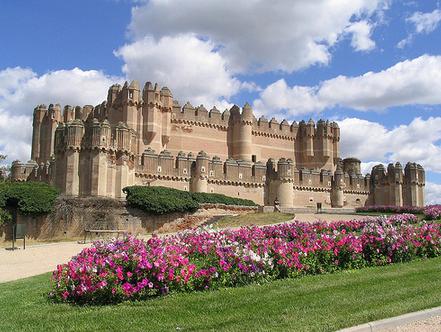
Castillo de Coca is one of the most beautiful medieval fortresses in Spain, a fairy-tale 15th-century Mudéjar castle in the province of Segovia, Castile and León, whose walls and towers are built not of grey stone but of warm red brick decorated with intricate geometric patterns, blind arches, and glazed tiles in the Mudéjar style, the unique Spanish architectural fusion of Islamic and Gothic traditions that flourished under Christian rule. Considered one of the finest examples of Mudéjar military architecture in the world, Coca Castle is less a forbidding fortress and more an exquisite work of decorative architecture, with its double wall, deep moat, and 25 towers creating a silhouette that is at once formidable and breathtakingly beautiful.
In This Article
Quick Facts: Castillo de Coca
- Best time to visit: Year-round; the castle is most photogenic in the golden light of late afternoon when the red brick glows; open daily, check hours before travelling
- How to get there: ~1.5 hours from Madrid by car; ~40 minutes from Segovia; limited bus service from Segovia, a car is recommended
- Entry fee: ~€3 (adult), remarkably inexpensive for a castle of this quality
- Combine with: The Roman aqueduct and fairy-tale Alcázar of Segovia (40 min), and the medieval walls of Cuéllar (20 min)
Castillo de Coca (or Castle of Coco in English) is one of the most beautiful medieval fortresses in Spain. It is situated on the southwestern outskirts of the town of Coca, about 55 km south of the city of Valladolid.
Castillo de Coca is preserved example of medieval architecture in Spain. It is located above the river Voltoya and is protected by a broad and deep moat, which has a length of approximately 560 meters. It was built by Don Alonso de Fonseca, Archbishop of Seville in the 15th century. Besides its advanced defensive system, Castillo de Coca has also very nice interior decoration. Here you find Gothic ribbed vault mosaics and various geometric motifs.
Mudejar Architecture and Design
The architectural style of Castillo de Coca sets it apart from virtually every other medieval fortress in Spain. While most Spanish castles were built from grey stone, Coca’s builders used warm red brick, creating a structure that appears almost organic in its colour and texture. The Mudéjar style, which emerged in Spain after the Christian reconquest of Muslim territories, combined Islamic decorative traditions with Gothic architectural forms. At Coca Castle, this fusion manifests in the intricate geometric brickwork patterns that cover the walls and towers, the blind arches that create rhythm along the facades, and the glazed ceramic tiles that add touches of colour. The castle’s plan is roughly quadrilateral, with a double wall creating an inner and outer defensive circuit. The 25 towers that punctuate the walls are not purely functional but are arranged for aesthetic effect, creating a silhouette that changes dramatically as the sun moves across the sky. The main tower, or Torre del Homenaje, rises above the entrance and is decorated with the coat of arms of the Fonseca family, who commissioned the castle.
strategic Importance and History
Castillo de Coca was built in the 15th century by Don Alonso de Fonseca, Archbishop of Seville and a member of one of the most powerful families in Castile. The castle was part of a defensive network that included the fortresses of Cuellar, Arevalo, and Olmedo, protecting the approaches to the important city of Segovia and the surrounding agricultural lands. Its position above the Voltoya River, combined with its double wall and deep moat, made it one of the most formidable fortifications in the region. Despite its impressive defences, the castle was never taken by direct assault. It was first occupied in 1808 when Napoleon’s army entered Spain, and the French forces used it as a garrison during the Peninsular War. After the war, the castle gradually fell into disuse and was used for agricultural storage before being declared a national monument in 1925. In the 20th century, it housed a forestry school before being opened to the public as a museum.
Visiting the Castle and Nearby Attractions
Castillo de Coca is in the province of Segovia, about 1.5 hours from Madrid by car and 40 minutes from Segovia city. The castle is open daily with a modest entrance fee of around 3 euros. Guided tours are in Spanish, and English information leaflets are available. The interior showcases Gothic ribbed vaults, mosaics, and geometric Mudéjar motifs. The walk around the moat offers the best views of the brickwork and full silhouette. Combine with nearby Segovia, where the Roman aqueduct and Alcázar are must-sees. The nearby castle of Cuellar offers additional Castilian history for keen castle explorers.
View Castillo de Coca, one of the most beautiful medieval fortresses in Spain in a larger map
Castillo de Coca belonged together with castles of Cuéllar, Arévalo and Olmedo to a strategic fortification system. Thanks to the cleverly formed defence the castle was first occupied in 1808 by Napoleon’s army. In recent years, the castle was used as a forestry high school, but it is publicly accessible. Its main attraction is the decoration of the interiors and museum.
View Castillo de Coca, one of the most beautiful medieval fortresses in Spain in a larger map
Photo: karaco1971
Have you visited Castillo de Coca or discovered Castile’s Mudéjar treasures? Share your Spanish castle discoveries in the comments! 🏰
Explore all our Spain travel guides, from Barcelona Gaudí to Andalusia plazas.
Explore More
If you enjoyed this article, you might also like:
