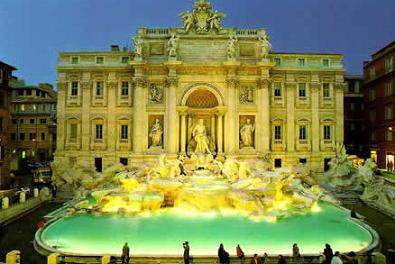
The most beautiful fountain in Rome is undoubtedly the Fontana di Trevi, and with its height of 25.9 m and width of 19.8 m it is also the largest fountain in Rome. This amazing work of art decorated with Baroque marble sculpture is one of the most famous symbols of Rome.
In This Article
The History and Architecture of Trevi
Fontana di Trevi is located at the junction of three waterways, at the place where the aqueduct was in the past that supplied water to Rome. The first fountain was built at this place already in 1453 by Pope Nicholas V. The water was supplied from the Acqua Vergine aqueduct, which was created by Marcus Agrippa in 19 BC. The construction of the current Fontana di Trevi lasted 30 years, from 1732 till 1762. The main architect was Nicola Salvi, who designed it for Pope Clement XII. The name of the fountain is derived from the three narrow cobblestone streets that cross here, “tre vie”, which means three streets. The fountain is carved from marble and in the centre there is Oceanus, the Titan of Water, Seas, Lakes, Rivers, Oceans, Streams and Ponds. The fountain, which stands here now, was inspired by the Arch of Constantine, one of the last great monuments of Imperial Rome. The dominant architectural feature is the high arch called the “Kingdom of the Oceans,” with Oceanus standing in a shell-shaped chariot pulled by two sea horses. One horse is calm and the other is wild, symbolising the changing moods of the sea. The two Tritons flanking Oceanus guide the horses, while allegorical figures above the niches represent Abundance and Healthfulness. On the left side of the arch, a relief depicts Agrippa approving the construction of the Acqua Vergine aqueduct, while on the right another relief shows a young Roman woman pointing to the source of the water, a scene that references the legend of the virgin who revealed the spring to Roman soldiers. The entire composition is a masterwork of Baroque theatricality, designed to be viewed from a single vantage point that maximises the dramatic impact of the flowing water and the sculptural forms.
Traditions, Legends, and the Coins of Trevi
In 1998 the fountain was reconstructed and equipped with circulating pumps. Fontana di Trevi also appeared in the film made by Federico Fellini, La Dolce Vita, in which the protagonists Anita Ekberg and Marcello Mastroianni bathed in the fountain. The scene became one of the most iconic moments in cinema history, and it cemented the fountain as a symbol of Roman glamour and the carefree spirit of the post-war era. The director in this celebrated movie captured the essence of Roman nightlife in the 1950s. The people used to throw coins into the fountain, one coin to fulfil wishes and another for their return to Rome. Another legend says that when you drop a coin into the fountain, you will meet your true love in Rome, and if you drop more, you will have a happy marriage in Rome. The correct technique, according to local tradition, is to throw the coin with your right hand over your left shoulder, standing with your back to the fountain. The amount of money in the fountain is truly great. Tourists throw here approximately 3,000 Euro every day, which adds up to more than one million euros per year. Collecting coins from the fountain is strictly prohibited and the water is patrolled by municipal workers who use long-handled nets to gather the coins each day. Money from the fountain is used for the benefit of the charities Caritas and the Office for the Protection of Monuments. There is also a lesser-known tradition: couples who drink from the small fountain called the Fontanella degli Innamorati, located on the right side of the main basin, are said to be guaranteed eternal love and fidelity.
Visiting Trevi: Practical Tips
The Trevi Fountain is one of the busiest attractions in Rome, and the small square that surrounds it can be packed with visitors from morning until late at night. The best time to visit is early in the morning, before 8:00 am, when the square is relatively quiet and the light is soft for photography. Late evening after 11:00 pm is another good option, when the fountain is beautifully illuminated and the crowds have thinned. There is no entry fee for the fountain, as it is located in a public square. The nearest metro stop is Barberini on line A, about a five-minute walk away. From Termini station, it is a 20-minute walk through the historic centre. Many visitors combine a trip to Trevi with nearby attractions such as the Spanish Steps, the Pantheon, and the Piazza Navona, all within a 10-minute walking radius. gelato shops and cafes line the streets around the fountain, but be aware that prices in the immediate vicinity of the attraction are significantly higher than in the side streets just a few minutes away. For the best views, walk up the stairs on the left side of the piazza to the rooftop terrace of the Galleria Alberto Sordi, which offers an elevated perspective over the fountain and the crowds below. The Trevi district is also home to some of the best traditional Roman trattorias, where you can enjoy carbonara, cacio e pepe, and amatriciana away from the main tourist thoroughfares. A visit to the fountain at night is especially magical, when the floodlights illuminate the marble and the sound of rushing water echoes off the surrounding buildings.
View Fontana di Trevi – the most beautiful fountain in Rome Italy in a larger map
Have you thrown a coin into the Trevi Fountain and made a wish? 🪙
Explore all our Italy travel guides, from the Dolomites to Sicily.
Explore More
If you enjoyed this article, you might also like:
