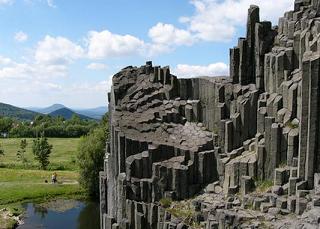
Panská skála (Herrnhausfelsen) is the most famous and most visited geological reserve in the Czech Republic, a striking natural monument of vertical basalt columns near the town of Kamenický šenov in northern Bohemia, formed by the cooling of ancient volcanic lava into perfect hexagonal organ pipes that rise from the landscape like a stone cathedral. This spectacular example of columnar jointing, the same geological phenomenon that created the Giant’s Causeway in Ireland, is one of the most photogenic natural sites in the Czech Republic and a popular film location.
In This Article
Geology of the Stone Organ
Panska skala is a remarkable example of columnar jointing, a geological process that occurs when thick basaltic lava cools and contracts, forming polygonal columns that are usually five or six-sided. The columns reach up to 12 metres in length and rise vertically from the ground like the pipes of a giant organ, which is why the site is often called the Stone Organ. The basalt formed during the Tertiary period approximately 30 million years ago, when volcanic activity in the Lusatian region created extensive lava flows. Over millions of years, erosion removed the softer surrounding rock, exposing the harder basalt columns that visitors marvel at today.
The site was actively mined for basalt until 1948, and the current appearance of the rock face is partly a result of quarrying, which exposed the columns in their full vertical glory. The high-quality basalt was exported to the Benelux countries for use in dam construction. In 1953, Panska skala was declared a National Natural Monument, recognising its exceptional geological and educational value. Similar formations can be found at the Giant’s Causeway in Northern Ireland, Fingal’s Cave in Scotland, and Svartifoss in Iceland, but the accessibility and clarity of the column formation at Panska skala make it one of the finest examples in Europe.
Visiting and Surrounding Attractions
The site is located near the town of Kamenicky Senov in northern Bohemia, approximately 1.5 hours from Prague by car and about 15 minutes from Novy Bor. The site is free to enter and has adjacent parking. A short path leads from the car park to the base of the columns, where a small lake formed in an old quarry pit creates excellent reflective photo opportunities. At the foot of the rock, a Marian Column erected in 1739 commemorates two people who froze to death at this spot.
The summit offers stunning views of the Lusatian Mountains and, on clear days, the National Park of Czech Switzerland. The area is ideal for combining with visits to the nearby glassmaking towns of Kamenicky Senov and Novy Bor, which are the heart of the Bohemian glass industry, and the magnificent sandstone rock formations of Czech Switzerland National Park, just 45 minutes away. Sunrise and sunset provide the most dramatic lighting for photography, and the columns are especially atmospheric in winter with a dusting of snow. The site has also appeared in Czech cinema, most notably in the fairy-tale film The Proud Princess.
Cultural Significance and Film Appearances
Panska skala was declared a National Natural Monument in 1953, recognising its exceptional geological and educational value. It is one of the most visited geological sites in the Czech Republic and attracts geologists from around the world who study the perfect columnar jointing. The site has also appeared in Czech cinema, most notably in the fairy-tale film The Proud Princess, which used the dramatic basalt columns as a backdrop. The local name Stone Organ reflects how perfectly the columns resemble the pipes of a musical instrument, and the sight is particularly striking in the late afternoon when the low sun casts long shadows across the vertical faces.
At the foot of the rock formation, a Marian Column erected in 1739 commemorates two people who froze to death at this spot, adding a layer of historical poignancy to the natural spectacle. A small lake formed in the old quarry pit at the base of the columns provides excellent reflective photo opportunities, particularly in the early morning when the water is calm. The combination of geological wonder, cultural history, and the beautiful surrounding landscape of the Lusatian Mountains makes Panska skala a destination that appeals to both serious geologists and casual day-trippers from Prague.
View Panska skala (Herrnhausfelsen) – best known and most visited geological reserves in the Czech Republic in a larger map
Have you photographed the basalt organ pipes of Panska skala or discovered Bohemia’s geological wonders? Share your Czech rock formation discoveries in the comments! 🧘
Explore all our Czech Republic travel guides, from Prague spires to Moravian wine country.
Explore More
If you enjoyed this article, you might also like:
- Kutná Hora – historic town in Czech Republic – Czech Republic
- Peklo (The Hell) – National Natural Monument in the Czech Republic – Czech Republic
- SkyDive arena in Prague – the only glass wind chamber in the world | Czech Republic – Czech Republic

Panská skála is one of those hidden gems that most tourists drive right past. The hexagonal basalt columns are genuinely fascinating — it feels almost otherworldly. We stopped there on a road trip through the Czech Republic and spent an hour just walking around the formation. Definitely worth the detour if you’re in northern Bohemia.