
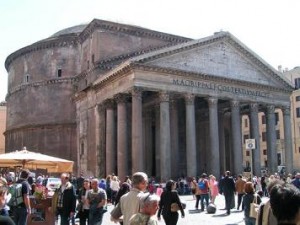
Pantheon (also known as Santa Maria della Rotonda) is a Christian church located in the centre of Rome, in Italy. Pantheon was built by Marcus Agrippa in 27 BC, and was dedicated to three Roman gods, serving as a temple to the planetary deities. Unfortunately in the year 80 AD a big fire destroyed almost the whole building, reducing Agrippa’s original structure to ruins. Just 45 years later, in 125 AD, Emperor Hadrian undertook an extensive reconstruction that gave the building the form we see today, creating an architectural masterpiece that would influence building design for two millennia. Under the reign of Pope Boniface IV the Pantheon became a Christian church, which protected the building from burning and destruction, sparing it the fate that befell many other pagan buildings of ancient Rome, which were quarried for their stone or allowed to fall into ruin.
Architectural Marvel of the Dome and Oculus
The Pantheon is the resting place of Italian kings Vittorio Emanuele II and Umberto I, as well as the Renaissance painter Raphael, whose tomb is marked by a simple but moving inscription. The Pantheon is marked as an ingenious construction, and for good reason. Its most remarkable feature is the massive concrete dome, which remains the largest unreinforced concrete dome in the world, spanning 43.3 metres in diameter, a record that has stood for nearly 1,900 years. In the middle of the dome there is a giant circular opening called the oculus, measuring 8.2 metres across, which is the only source of natural light for the interior. Through this opening, thanks to the building’s unique architecture, rain never falls directly inside due to the way the warm air rises and creates an invisible barrier, and the oculus serves as a sundial, with every noon the sun shining exactly on the front door of the Pantheon. The dome’s coffered ceiling, with five rings of 28 recessed panels each, was designed not only for decoration but also to reduce the weight of the structure, removing mass where it was not needed for structural support. The materials used in the concrete become progressively lighter toward the top, with heavy basalt at the base and light pumice stone at the oculus, a sophisticated engineering solution that has kept the dome standing for nearly two thousand years through earthquakes, fires and the passage of countless generations.
History, Inscriptions and Interior Treasures
The Pantheon has, from an architectural point of view, a truly remarkable ceiling design that has inspired architects from Brunelleschi to Michelangelo. Elements of this architecture appear in the Vatican museums and also in St Peter’s basilica in the Vatican, where the dome designed by Michelangelo echoes the proportions of the Pantheon. On the building facade you can see the same inscription as the original building from 27 BC: “M-AGRIPPA-L-F-COS-TERTIVM-FECIT“, which means “Marcus Agrippa, son of Lucius, Consul for the third time, built this.” This inscription honours the original builder even though the current structure is largely Hadrian’s work, a gesture of humility by the later emperor who chose to credit the original builder rather than himself. Inside the Pantheon, besides the tombs of Italian royalty and Raphael, you will find the tombs of other notable figures including the composer Arcangelo Corelli and the architects Peruzzi and Vignola, making it a place of pilgrimage for art lovers and history enthusiasts alike. The marble interior, with its rich colours and patterns, showcases materials brought from across the Roman Empire, from Egyptian porphyry to Numidian yellow marble, from Phrygian purple to Carystian green, creating a polychromatic display of imperial wealth and reach. The Pantheon has survived for centuries, and today it is the best preserved Roman building, still in continuous use as a church and a major tourist attraction that draws millions of visitors to the heart of Rome each year, a testament to the enduring genius of Roman engineering and design that continues to inspire architects and engineers to this day, proving that great design truly is timeless.
View Pantheon in Rome – best preserved Roman building Italy in a larger map
Have you ever stood beneath the oculus of the Pantheon and watched the rain stay out? 🏰
Explore all our Italy travel guides, from the Dolomites to Sicily.
Explore More
If you enjoyed this article, you might also like:
