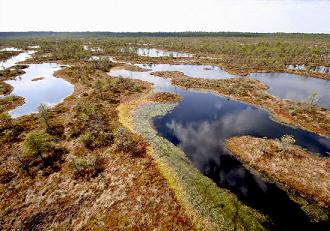
Nigula Nature Reserve is one of Estonia’s oldest and most important bog reserves, a pristine raised bog ecosystem of dark pools, sphagnum moss, and stunted pines in southwestern Estonia that protects some of the most intact wetland habitat in the Baltic region. Established in 1957, Nigula is a Ramsar Wetland of International Importance and a key site for understanding the ecology of northern European peatlands. A wooden boardwalk trail allows visitors to experience the bog’s unique atmosphere without disturbing the fragile ecosystem.
In This Article
Exploring the Boardwalk Trail
The highlight of any visit to Nigula Nature Reserve is the 6-kilometre boardwalk trail that winds its way across the raised bog, offering visitors an intimate experience of this unique ecosystem. The trail begins near the visitor centre and leads through several distinct habitat zones, starting with a transition area of birch and pine forest before opening onto the vast expanse of the open bog. The boardwalk is well maintained and offers a comfortable walking surface, though it can be slippery when wet. Information panels along the route explain the ecology of the bog, the formation of peat over thousands of years, and the remarkable adaptations of the plants and animals that thrive in this nutrient-poor environment.
An observation tower at the far end of the boardwalk provides a panoramic view of the bog landscape, with its dark pools of water, carpets of sphagnum moss in various shades of green and red, and scattered stunted pines that look like natural bonsai trees shaped by the harsh growing conditions. The best time to walk the boardwalk is between May and September. In early summer, the cranberry and cloudberry blooms add splashes of white and pink to the green carpet, while in autumn the entire landscape transforms into shades of rust and amber as the sedges and cottongrass change colour. The bog is particularly atmospheric in the early morning when mist rises from the pools.
Wildlife and Conservation at Nigula
Nigula supports an impressive range of wildlife across its 64 square kilometres of protected land. The bog and surrounding forests are home to numerous bird species, including cranes, black storks, and golden eagles, which nest in the surrounding forest and hunt over the open wetland. The reserve is also an important stopover for migratory waterfowl, with thousands of geese and ducks passing through during spring and autumn migrations. Mammals in the area include moose, roe deer, red deer, and wild boar, as well as predators such as lynx, wolf, and the occasional brown bear, though these elusive creatures are rarely seen by visitors.
The reserve was designated a Ramsar Wetland of International Importance and added to the Natura 2000 network in 2000, recognising its significance for European biodiversity. Peat cores taken from Nigula have provided valuable data on climate change over several thousand years, as the layers of peat preserve pollen grains and other indicators of past environmental conditions. The reserve is located about 2.5 hours from Tallinn by car, near the Latvian border, with the nearest town being Haademeeste. The small visitor centre provides information about the reserve and its inhabitants.
Planning Your Visit to Nigula
The reserve is located about 2.5 hours from Tallinn by car, heading southwest towards the Latvian border. The nearest town is Haademeeste, which provides basic services and accommodation. The reserve is open to visitors throughout the year, though the boardwalk trail is best experienced between May and September when the bog is at its most colourful and the weather is most favourable. An observation tower at the far end of the boardwalk provides a panoramic view of the bog landscape, with its dark pools of water, carpets of sphagnum moss in various shades of green and red, and scattered stunted pines shaped by the harsh growing conditions.
The small visitor centre at the entrance provides information about the reserve’s history, its wildlife, and the conservation work being carried out. Guided tours are available during the summer months and are highly recommended for those who want to learn more about the bog’s ecology and the unique adaptations of the plants and animals that call this fragile ecosystem home. The reserve is part of the Natura 2000 network and has been a Ramsar Wetland of International Importance since 2000. For birdwatchers, early morning visits during the spring migration in April and May or the autumn migration in September and October offer the best chance to see large numbers of waterfowl.
View Nigula Nature Reserve – one of the oldest bog reserves in Estonia in a larger map
Have you walked the boardwalks of Nigula or discovered Estonia’s bogs? Share your wetland encounters in the comments! 🦒
Explore all our Estonia travel guides, from Tallinn old town to Baltic islands.
Explore More
If you enjoyed this article, you might also like:
