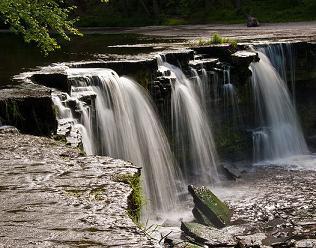
Keila Waterfall (Keila juga) is one of Estonia’s most accessible and photogenic natural attractions, a graceful 6-metre cascade tumbling over the Baltic Klint escarpment in a peaceful park setting just 25 kilometres west of Tallinn. While Keila may not be Estonia’s tallest waterfall, its broad curtain of water, picturesque wooden suspension bridge, and the romantic backdrop of the neo-Gothic Keila-Joa Manor make it the country’s most visited waterfall, and one of the most beautiful places in Estonia for a quick nature escape from the capital.
Photographers should note that the best light for capturing the waterfall and suspension bridge occurs in the late afternoon, when the low sun illuminates the limestone cliffs and the cascade with a warm golden glow.
In This Article
The Geology and Natural Setting of Keila Waterfall
Keila Waterfall is formed where the Keila River drops over the limestone edge of the Baltic Klint, an ancient escarpment that stretches approximately 1,200 kilometres across Estonia and Sweden, marking the boundary between the Cambrian and Ordovician geological layers. This same geological feature creates Valaste Waterfall and Jagala Waterfall further east, but Keila’s setting within a landscaped park makes it the most picturesque. During the spring snowmelt, the waterfall swells to an impressive 60 to 70 metres in width, transforming from a gentle curtain into a thundering cascade that fills the valley with mist and sound.
The area surrounding the waterfall is part of the Keila-Joa Park, a 25-hectare protected landscape featuring over 80 species of trees and shrubs. The park was designed in the English landscape style, with winding paths, romantic bridges, and carefully positioned viewpoints that frame the waterfall and manor house. Mature oaks, lindens, and maples provide dappled shade in summer, while autumn brings spectacular golden foliage reflected in the river pools below the cascade.
Keila-Joa Manor: A Neo-Gothic Masterpiece
The waterfall sits within the grounds of Keila-Joa Manor (Schloss Fall), a striking neo-Gothic castle built in 1833 for the Baltic German nobleman Alexander von Benckendorff. Von Benckendorff served as the chief of the Tsar’s secret police under Nicholas I, and his influence is reflected in the manor’s imposing architecture: pointed arched windows, crenellated towers, and ornate stone carvings that echo the romantic medieval revival style popular across Europe at the time. The manor was designed by the prominent architect A. I. Stackenschneider, who also worked on Saint Petersburg’s Mariinsky Palace.
After decades of neglect during the Soviet era, the manor has been partially restored and now houses a restaurant, a small museum dedicated to the history of the estate, and exhibition spaces for local artists. The park surrounding the manor features a wooden suspension bridge that crosses directly in front of the waterfall, offering the classic Keila photo opportunity. Nearby, visitors can find the remains of a small hydroelectric power station that once harnessed the river’s flow, a testament to the estate’s self-sufficient design in the 19th century.
Seasonal Highlights and Nearby Attractions
Each season transforms Keila Waterfall in a different way. Spring brings the most powerful flow as snowmelt surges down the Keila River, creating a wide curtain of water that thunders into the pool below. Summer offers the most pleasant conditions for exploring the park, with the waterfall providing a cooling mist on warm days. Autumn paints the surrounding deciduous forest in shades of gold, amber, and crimson, reflected beautifully in the slow-moving river upstream. Winter freezes parts of the cascade into stunning ice formations, and on particularly cold days, the entire waterfall can become a frozen wall of blue-tinted ice, a magical sight that attracts photographers from across Estonia.
Keila Waterfall is easily combined with other attractions on a day trip from Tallinn. The nearby town of Keila has a small railway museum and a charming wooden church. For those interested in Estonia’s Baltic Klint, a drive further west leads to the Pakri Peninsula with its dramatic coastal cliffs and the abandoned Soviet military town of Paldiski. The entire region offers excellent cycling routes, and the Keila River hiking trail runs for several kilometres through the park, connecting the waterfall to smaller cascades and scenic river pools ideal for a summer swim.
Have you visited Keila Waterfall or explored the manor park? Share your Estonian nature discoveries in the comments! 🌊
Explore all our Estonia travel guides, from Tallinn old town to Baltic islands.
Explore More
If you enjoyed this article, you might also like:
- 4 Things to Do in Estonia – Estonia
- Estonia – Baltic pearl – Estonia
- Nigula Nature Reserve – one of the oldest bog reserves in Estonia – Estonia
