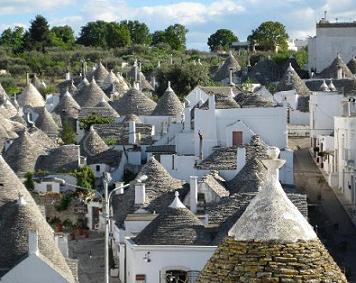
The Trulli of Alberobello are one of the most distinctive architectural sights in Europe, more than 1,500 tiny, conical-roofed white limestone houses with grey stone pinnacles clustered in the narrow lanes of a hilltop town in Puglia, southern Italy, creating a UNESCO World heritage landscape that looks less like an Italian town and more like a village of hobbit houses transported to the heel of the Italian boot. These extraordinary structures, built without mortar using the dry-stone technique traditional to the Itria Valley, were originally designed to be easily dismantled, a tax-evasion strategy by 15th-century peasants who could quickly deconstruct their homes to avoid property taxes levied by the Kingdom of Naples. Today, the Trulli are the symbol of Puglia, one of Italy’s most photographed streetscapes, and increasingly, a unique accommodation option, with many trulli converted into boutique hotels and holiday rentals.
In This Article
The History and Origins of Alberobello’s Trulli
The story of the trulli begins in the 15th century when the Kingdom of Naples imposed heavy property taxes on new settlements. The resourceful inhabitants of the Itria Valley developed a clever workaround: they built their homes using dry-stone construction, meaning no mortar bound the limestone blocks together. When tax inspectors approached, the owners could simply pull a few key stones from the walls, collapsing the structure into a pile of rubble that no longer qualified as a taxable dwelling. Once the inspectors left, the house was rebuilt within days. This ingenious tax-evasion system persisted for centuries, shaping the unique architectural character of the region.
The word “trullo” (plural: trulli) derives from the Greek word “tholos,” meaning dome or cupola. Each conical roof is constructed using overlapping limestone slabs arranged in concentric rings, tapering to a point capped by a decorative pinnacle. The pinnacles are often carved with symbols: a cross for Christian faith, a heart for love, a star for good fortune, or planetary symbols reflecting the owner’s astrological beliefs. Some pinnacles even bear the initials of the master builder who constructed the trullo.
Exploring the Rioni of Alberobello
Alberobello’s trulli are concentrated in two main districts: Rione Monti and Rione Aia Piccola. Rione Monti, sprawling along a hillside, is the larger and more tourist-oriented of the two, with over 1,000 trulli lining steep, cobbled streets. Many of these have been converted into souvenir shops, small museums, and cafes, making it the liveliest area for visitors. The viewpoint from Piazza del Popolo offers a stunning panoramic shot of the conical rooftops spreading across the hillside, a scene that has graced countless postcards and travel magazines.
Rione Aia Piccola, by contrast, feels quieter and more authentic. Fewer shops and more resident-occupied trulli give this district a lived-in atmosphere. The narrow lanes here are less crowded, allowing you to appreciate the craftsmanship and scale of the structures without the bustle. Trullo Sovrano, the only two-storey trullo in Alberobello, is located here and now functions as a small museum. It offers a fascinating glimpse into how families actually lived in these compact stone homes, with period furniture, kitchen tools, and sleeping quarters preserved as they would have been a century ago.
Practical Tips for Visiting the Trulli
The best time to visit Alberobello is during the shoulder seasons of April to June or September to October, when the weather is pleasant and crowds are manageable. Arriving early in the morning, before 9am, rewards you with the golden light illuminating the white stone roofs and far fewer tourists in your photographs. Summer months bring intense heat and peak crowds, but the trulli’s thick limestone walls provide natural insulation, keeping interiors cool even on the hottest days. Evening visits in summer are particularly magical, as the streets empty and the trulli are softly lit.
Getting to Alberobello is straightforward: it is about an hour from Bari by car, and the Ferrovie del Sud Est train connects Bari Centrale station directly to Alberobello in roughly 90 minutes. Parking is available in designated lots outside the historic zone, as cars are restricted in the narrow trulli lanes. For a truly immersive experience, consider booking a night in a converted trullo accommodation. Prices range from budget-friendly studios to luxury five-star trullo resorts, and waking up inside one of these ancient stone dwellings is an unforgettable way to connect with Puglia’s unique heritage.
Have you wandered the trulli lanes of Alberobello or stayed overnight in a cone-roofed house? Share your Puglian discoveries in the comments! 🏘️
Explore all our Italy travel guides, from the Dolomites to Sicily.
Explore More
If you enjoyed this article, you might also like:
