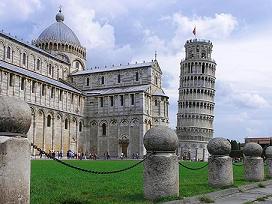

Just few cities in Europe and indeed in the whole world, gained such fame thanks to one building, as the Tuscan city of Pisa. By this building is obviously not meant anything other than the famous Leaning Tower. For a long period of its existence it has become not only a symbol of the city, but also a major tourist attraction throughout Italy. It is similar to the Pyramids of Egypt which almost everyone knows, at least from the television or from photographs. However knowledge of this tower usually ends with its appearance, so I suppose it will not be useless to remind some basic facts.
Leaning Tower of Pisa was built as a freestanding bell tower of the Pisa Cathedral. However in the beginning, the tower stood uprightly like the majority of bell towers. But because of carelessly made bases and soft soil it started to lean. Leaning Tower of Pisa is one of the few cases where thanks to poor work it became popular throughout the world.
The building is approximately 55.9 meters high on the lower side and 56.7 meters on that higher one. To its top you can get by 294 stairs. Construction of the tower began in 1173 and lasted almost 200 years since it was interrupted several times due to the wars with its neighbours (Genoa, Lucca and Florence). Its top with the bells was finished in 1372. However at that time the tower was already inclined, actually since the completion of the first three floors in 1178.
Because the tilt of the tower was constantly increasing and threatening its collapse, the tower was closed to the public in 1990 and rescue works started. In 2001 the tower was finally reopened with the statement that it should be stable at least for the following 300 years.
Although the Leaning tower is the most famous attraction in Pisa, it is not the only one. It stands in a place called Campo dei Miracoli or “Field of Miracles”. We can find here other wonderful architectural gems, such as Duomo, the Baptistery, or monumental cemetery Campo Santo. All the buildings are really beautiful, but in fact, they still attract far less attention than the famous tower.
View Leaning tower of Pisa – a famous landmark in Italy in a larger map
The History and Engineering of the Leaning Tower of Pisa
The construction of the Leaning Tower of Pisa began in August 1173 under the direction of Bonanno Pisano, though the identity of the original architect remains a subject of scholarly debate. The tower was designed as a freestanding bell tower for the adjacent cathedral, part of a grand religious complex in the heart of Pisa. By the time workers had completed the third floor in 1178, the tower had already begun to lean due to the inadequate foundation depth of just three metres on soft, marshy soil composed of clay, sand, and silt. Construction was halted for almost a century as Pisa engaged in military conflicts with Genoa, Lucca, and Florence, a pause that ironically allowed the soil to settle and may have prevented an early collapse. Work resumed in 1272 under Giovanni di Simone, who attempted to compensate for the tilt by building the upper floors with one side slightly taller than the other, resulting in the tower distinctive curved shape. The bell chamber was finally added in 1372 by Tommaso Pisano, completing a construction project that had spanned 199 years across three generations of architects and engineers.
Stabilisation Efforts and Visiting Pisa Campo dei Miracoli
By the late 20th century, the Leaning Tower had reached a tilt of 5.5 degrees, and its southward lean was increasing at a rate of approximately one millimetre per year. In 1990, the tower was closed to the public and an international committee of engineers and geotechnical experts launched a rescue project costing over 25 million euros. The team extracted 70 tonnes of soil from beneath the north side of the foundation, counterweighted the base with lead ingots, and installed steel cables anchored 100 metres away. By 2001, the tilt had been reduced to 4 degrees, and engineers declared the tower stable for at least the next 300 years. The Campo dei Miracoli, or Field of Miracles, where the tower stands alongside the Cathedral, the Baptistery, and the Camposanto Monumentale, is one of the most remarkable architectural ensembles in Europe. The Cathedral, consecrated in 1118, features a stunning Byzantine-influenced facade with blind arcades and bronze doors. The Baptistery, the largest in Italy at 54.8 metres in height, is renowned for its exceptional acoustics. The Camposanto is a monumental cemetery containing Roman sarcophagi and a remarkable cycle of 14th-century frescoes. Visitors should allow at least three hours to explore the entire complex, climbing the 294 steps to the top of the tower for panoramic views of Pisa and the Arno valley.
Explore all our Italy travel guides, from the Dolomites to Sicily.
Explore More
If you enjoyed this article, you might also like:
