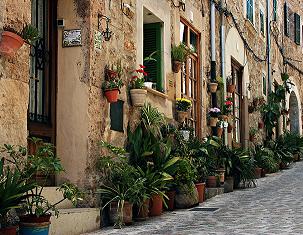
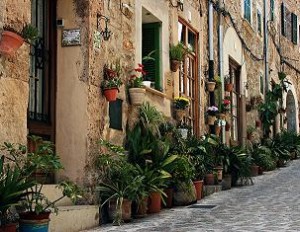
Valldemossa is a picturesque mountain town on the Spanish island of Mallorca. It lies on the western part of the island, near the town of Soller. Valldemossa is situated in the middle of a wide green valley, protected by the Sierra de Tramuntana. This mountain area is rich in rainfall, so the city is surrounded by terraced fields with growing fruits and vegetables. The air is fresh and carries the scent of pine and lemon trees, and the pace of life here is measured by the seasons rather than the clock. The stone houses with their terracotta roofs and wrought-iron balconies create an atmosphere that has attracted artists, writers, and musicians for centuries.
In This Article
The Royal Charterhouse: Chopin, George Sand, and the Preludes
The most important monument in Valldemossa is the Royal Charterhouse, or Real Cartuja, a former Carthusian monastery founded in the 14th century. The building combines Gothic, Renaissance, and Baroque elements, reflecting the different periods of its construction and renovation. After the monks were expelled in 1835 during the Mendizabal disentailment, the monastery cells were rented out to visitors. In the winter of 1838, the Polish composer Frederic Chopin and the French writer George Sand arrived. They took up residence in cells number 2 and 4, and Chopin, who was already suffering from tuberculosis, completed his Preludes, Op. 28 in the monastery’s quiet cloisters. The famous Raindrop Prelude, number 15 in D-flat major, is said to have been inspired by the steady drip of rain on the monastery roof during the unusually wet winter. Sand wrote a memoir titled “A Winter in Mallorca” that describes both the beauty of the island and the difficulties the couple faced during their stay. The local villagers, afraid of Chopin’s tuberculosis, shunned them, and the couple struggled to find adequate food and medical care. Despite these hardships, Chopin produced one of the most important cycles of piano works ever written. Today, visitors can see the original pianos on which Chopin composed, rare manuscripts of his scores in his own hand, and Sand’s manuscript of her memoir. The Charterhouse also includes a historic pharmacy with beautifully decorated ceramic jars, a library of rare books, a museum of contemporary art, and the Royal Palace used by the medieval kings of Mallorca. Every summer, the Valldemossa Chopin Festival brings international pianists to perform in the monastery cloisters, continuing the town’s musical tradition.
Exploring Valldemossa: Streets, Church, and Hiking Trails
The town itself is a delight to explore on foot. The winding streets are lined with stone houses whose wrought-iron balconies overflow with bright red geraniums. The main square, the Placa de la Cartuja, is shaded by plane trees and surrounded by cafes and restaurants. The Church of Sant Bartomeu, dating from the 13th century, dominates one side of the square. The interior is dedicated to Saint Catalina Thomas, who was born in Valldemossa in 1533 and is the patron saint of Mallorca. Her preserved body lies in a glass reliquary, and the annual feast day in July attracts pilgrims from across the island. The Valldemossa Gardens offer a quiet place to rest, with manicured hedges and a viewpoint looking across the valley toward the sea. For hikers, trails start directly from the town and climb into the Tramuntana range. The route to the top of the Son Moragues natural park takes roughly three hours and rewards those who make the effort with 360-degree views across the entire western coast of Mallorca. A shorter walk leads to the Ermita de la Trinitat, a hermitage perched on a cliff edge, which takes about 45 minutes each way. Local cafes serve the traditional horchata de almendras, a sweet almond milk drink that is refreshing after a walk, and coca de patata, a potato-based pastry sprinkled with sugar that is unique to Valldemossa.
Getting to Valldemossa and Where to Stay
Valldemossa is 17 kilometres north of Palma, and the drive takes approximately 25 minutes along the MA-1110 road, a winding ascent through olive groves and limestone outcrops. The TIB bus route 200 connects Palma’s Placa d’Espanya with Valldemossa, Soller, and Deia, running hourly from 7am to 9pm. The journey takes 35 minutes and costs around 5 euros. Accommodation in Valldemossa ranges from rural hotels converted from 17th-century manor houses to simple guesthouses. Hotel Valldemossa, located in the town centre, offers comfortable rooms with views of the monastery and a restaurant that serves traditional Mallorcan cuisine. For a more secluded option, the Posada del Marques, a restored nobleman’s residence just outside town, provides a garden swimming pool and direct access to hiking trails. The best times to visit are spring, when the almond trees are in full blossom and the valley is carpeted with white and pink flowers, and autumn, when the crowds thin out but the weather remains mild and sunny.
Explore all our Spain travel guides, from Barcelona Gaudí to Andalusia plazas.
Explore More
If you enjoyed this article, you might also like:

Valldemossa is like stepping into a painting. The cobbled streets, the stone houses covered in flowers, and that monastery perched above the valley — it’s no wonder Chopin and George Sand spent a winter here. We went in April when the almonds were in blossom and the whole valley smelled incredible. Mallorca at its most romantic.