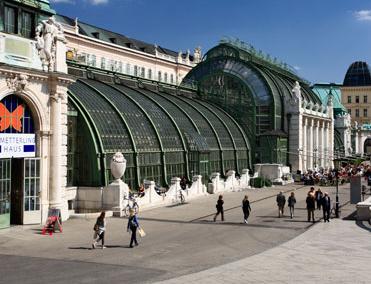
The stable temperature reaching 26 °C, humidity 80 percent, tropical plants and colorful butterflies. It is not Equatorial Africa, but the center of Vienna. In the Butterfly House, located in a complex of former emperor’s private gardens between Hofburg Palace and Vienna Opera, you can spend a few hours in the tropical rainforest and admire here more than one hundred kinds of exotic butterflies. The building itself is the Palmenhaus, a historic greenhouse built in the early 20th century with a wrought-iron and glass structure that allows natural light to flood the interior. It is a masterpiece of Art Nouveau architecture, with soaring arched windows and delicate metalwork.
In This Article
Life Inside the Butterfly House
The climate inside the Butterfly House is precisely controlled to mimic a tropical rainforest. The temperature stays at a constant 26 degrees Celsius, humidity hovers near 80 percent, and misting systems release fine sprays of water at regular intervals to maintain the damp conditions that tropical butterflies require. The space covers 280 square metres and is densely planted with tropical species including banana trees, bougainvillea, hibiscus, lantana, and passion flowers, all of which provide nectar for the butterflies and create the layered canopy they prefer. This carefully engineered environment allows the butterflies not only to survive but to breed, and visitors can observe the entire life cycle. Information boards placed throughout the house explain each stage of development. Butterflies lay eggs on specific host plants, the eggs hatch into caterpillars that feed voraciously on the leaves, the caterpillars form chrysalises, and after a period of days or weeks the adult butterflies emerge. The emergence of a new butterfly from its chrysalis is one of the most magical moments in the house, and staff can often predict when a particular chrysalis is about to open. The house is home to approximately 400 butterflies at any given time representing about 100 different species. The butterflies come from specialised farms in Thailand, Belize, Costa Rica, the Philippines, and Malaysia, all of which operate sustainably by raising butterflies in protected netted enclosures.
What You Will See: Notable Species and Visitor Tips
Among the species visitors can expect to see are the Blue Morpho, whose iridescent wings flash electric blue as it flies, creating one of the most striking visual experiences in the natural world. The Owl Butterfly is named for the large eyespots on its wings that resemble the eyes of an owl, a clever evolutionary adaptation that scares away predators. The Paper Kite, a delicate black-and-white butterfly from Southeast Asia, is one of the most graceful flyers in the house. The Atlas Moth is one of the largest lepidopterans in the world, with a wingspan reaching 30 centimetres, though the adult moth has no functioning mouthparts and lives only for about two weeks. The butterflies are free to fly around the greenhouse and frequently land on visitors, especially those who wear bright colours or stand still near the feeding stations. Staff place slices of overripe fruit, mainly oranges and papayas, on small trays throughout the house, and butterflies gather around these to feed. The feeding stations are also where photographers get their best shots, as the butterflies are comparatively still while eating. The Butterfly House is suitable for visitors of all ages and is particularly popular with families. Children are fascinated by the butterflies landing on their shoulders, and the educational displays provide enough information to satisfy curious young minds. The entire visit takes approximately 45 minutes to an hour.
Practical Information: Hours, Tickets, and Location
The Butterfly House is located in the Burggarten, a public park between the Hofburg Palace and the Vienna State Opera, approximately 200 metres from the Opera House. It is open every day of the year, including public holidays, from 10:00 to 16:15 in winter (November to March) and until 18:00 in summer (April to October). The admission fee is 7 euros for adults, with reduced rates of 5 euros for students and seniors and 3.50 euros for children under 16. A family ticket covering two adults and up to three children costs 18 euros. Combined tickets are available that include entry to the nearby Haus des Meeres aquarium, offering good value if you plan to visit both attractions. The greenhouse is fully accessible by wheelchair, with ramps and wide paths inside. Photography is permitted without the use of flash, which can disturb the butterflies. The closest public transport stops are Karlsplatz (served by U1, U2, and U4 metro lines), Stephansplatz (U1 and U3), and the tram lines 1, 2, 71, and D at the Ringstrasse stop. Several cafes and restaurants in the Burggarten and along the Ringstrasse offer convenient options for a meal or coffee before or after your visit.
Explore all our Austria travel guides, from Vienna coffeehouses to Alpine peaks.
Explore More
If you enjoyed this article, you might also like:

The Butterfly House in Vienna is a lovely escape from the city. It is right next to the Hofburg Palace and easy to miss. Stepping inside feels like walking into a rainforest — warm, humid, and butterflies land on you if you stand still long enough. Not a full-day attraction but a wonderful hour or two, especially with kids.