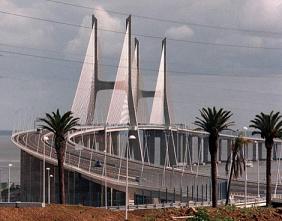

Vasco da Gama is very popular bridge in the world since it is the longest bridge in Europe. The construction works started in 1995 and have been completed in 1998. The beauty of the bridge is that it has six road lanes, with a speed limit of hundred kms per hour.
This has been built on the river Tagus, close to Portugal’s capital: Lisbon. The traffic was heavy here and people were suffering from traveling from one place to another one.
The length of the Vasco da Gama Bridge is about 17 kilometers and it is the 9th longest bridge in the world. It took only about three years to complete the bridge. Cable-stayed and viaducts technologies have been used to construct this bridge. Normally, it would take about twenty minutes to cross the bridge and it would surely be a pleasant experience for all the travellers.
In This Article
Construction, Design, and Engineering Feats
The bridge was opened to public service in 1998 to celebrate the 500th anniversary of the invention of the route from Europe to India. By the way, Vasco da Gama was one of the most successful Portuguese explorer and the commander of the first ships to sail directly from Europe to India. Special aspect of this bridge is that it has been built within 18 months with over three thousand workers and should survive for at least 120 years. A 40 years long contract has been given to a private company to take care of the cost so the government did not have to spend money for the project. Though only six lanes are available at present, there is enough space to convert it into eight lanes bridge, when it is required. The bridge is divided into several distinct sections: the 828-metre cable-stayed main bridge over the river channel, the 12-kilometre northern viaduct crossing the marshlands of the Tagus nature reserve, and a 4.8-kilometre southern viaduct that connects to the Expo 98 site. The main span of 420 metres is supported by two V-shaped concrete piers rising 155 metres above the water. The deck sits 14 metres above the river to allow shipping passage, and the alignment curves slightly to follow the topography rather than forcing a straight route through protected wetlands.
environmental Considerations and the Tagus Nature Reserve
The bridge crosses the Tagus Estuary Nature Reserve, a protected area of international importance for migratory birds. To minimise ecological disruption, engineers modified the alignment during construction to avoid the most sensitive marsh zones. The northern approach viaduct was built using balanced cantilever methods that required no temporary supports on the riverbed, protecting the feeding grounds of black-tailed godwits, spoonbills, and flamingos. An environmental monitoring programme ran throughout construction and continues today, tracking water quality, fish populations, and bird nesting activity. The bridge piers incorporate fish passage channels at their bases, allowing aquatic species to migrate upriver during spawning season. The lighting system uses shielded fixtures that direct illumination onto the road surface rather than spilling into the night sky, reducing light pollution for nocturnal wildlife. Since opening, the bridge has carried over 20 million vehicles per year, diverting traffic away from the historic 25 de Abril Bridge in central Lisbon and significantly reducing congestion in the capital.
Crossing the Bridge: Tolls, Views, and Nearby Attractions
Driving the full 17-kilometre length of the Vasco da Gama Bridge takes approximately 20 minutes at the posted speed limit of 100 kilometres per hour. The toll for a standard car is 2.85 euros each way, payable by electronic toll collection or at the payment stations located at the southern end. The bridge offers spectacular views of the Lisbon skyline to the west, the Tagus estuary stretching toward the Atlantic, and the Cristo Rei statue standing guard on the south bank. For cyclists and pedestrians, a separate path runs along the eastern edge of the bridge, though the 17-kilometre distance makes it a serious ride. At the southern end, the Parque das Nacoes district houses the Lisbon Oceanarium, the Vasco da Gama Tower with its panoramic restaurant, and the FIL exhibition centre. If you are a Technical Monuments lover and already visited Paris with Eiffel Tower, now you should go more to the south and try driving across this technical gem.
View Vasco da Gama Bridge – the longest bridge in Europe Portugal in a larger map
Explore all our Portugal travel guides, from Lisbon hills to the Algarve coast.
Explore More
If you enjoyed this article, you might also like:
