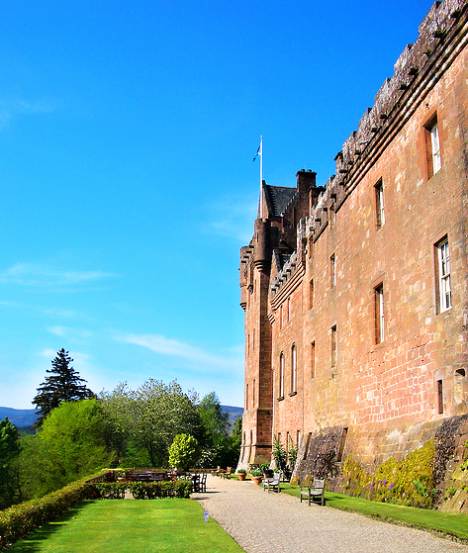
Brodick Castle is one of the most important historic fortresses in Scotland, a magnificent red sandstone castle on the Isle of Arran whose strategic position commanding the Firth of Clyde has made it a seat of power for over 800 years, from Viking stronghold to royal Stewart residence to the ancestral home of the Dukes of Hamilton. Today, Brodick offers a rare combination of grand Victorian interiors, extraordinary gardens, and spectacular views of Goat Fell mountain and the sea, all on one of Scotland’s most accessible and beautiful islands.
\n\n
In This Article
Quick Facts: Brodick Castle, Scotland
\n
- \n
- Best time to visit: April-October (castle and gardens open); May-June for the rhododendron collection in full bloom; autumn for spectacular woodland colours
- Top attraction: The Victorian interiors, the woodland garden with one of Britain’s finest rhododendron collections, and the views of Goat Fell
- How to get there: Ferry from Ardrossan (Ayrshire coast) to Brodick on the Isle of Arran (~55 minutes); the castle is a 10-minute walk or 2-minute drive from Brodick ferry terminal
- Entry fee: ~£15 adult (National Trust for Scotland); gardens only ~£10
- Combine with: Climbing Goat Fell, exploring Arran’s standing stones and stone circles, and the Arran Distillery
\n
\n
\n
\n
\n
\n\n
800 Years of Scottish History
\n
The site’s strategic importance was recognised as early as the 5th century by Irish settlers, and a Viking fortress likely occupied the position by the 9th century. The first stone castle was built in the 13th century by the Stewart family, and the castle was besieged, captured, and rebuilt several times during the Wars of Scottish Independence. The current castle largely dates from extensive Victorian remodelling in 1844, creating the baronial mansion visible today. Scottish Castle Brodick is located on the island of Arran and is one of the oldest Scottish fortresses. Its history dates back to Viking times when the castle served as a defense against their attacks. Fort was built by the English Duke of Hamilton, and over the centuries, has been rebuilt into a castle. In 1957, the last heir of Hamilton’s gave up Brodick Castle and such the seat opened to the public. In addition to the large art collection, the castle is interesting also for the world-famous collection of rhododendrons.
\n\n
The Woodland Gardens and Rhododendron Collection
\n
The woodland garden, set within a sheltered microclimate on the east coast of Arran, contains one of the most important collections of rhododendrons in Britain, including species brought back from 19th-century Himalayan expeditions, alongside magnolias, camellias, and rare conifers. The garden benefits from the Gulf Stream’s warming influence, which creates an almost subtropical microclimate that allows exotic plants to flourish in what would otherwise be a challenging Scottish environment. The rhododendron collection reaches its spectacular peak in May and June, when the hillside erupts into a riot of colour with blooms in shades of pink, purple, red, and white. Beyond the rhododendrons, the walled garden offers a more formal landscape with herbaceous borders, a working kitchen garden, and a beautiful summer house. The wider castle grounds encompass over 65 hectares of woodland and shoreline walks, with well-marked trails that offer stunning views of Goat Fell and the Firth of Clyde.
\n\n
The Isle of Arran Experience
\n
It is just at the sea and includes wonderful gardens with a great view of surrounding hills and majestic mountain of Goatfell. The Isle of Arran is often called “Scotland in miniature” because it contains all the key elements of the Scottish landscape in a compact, accessible island. Visitors can easily spend several days exploring the island, combining a visit to Brodick Castle with a climb up Goat Fell, the island’s highest peak at 874 metres. The Arran Distillery in Lochranza produces a renowned single malt Scotch whisky, and tours of the distillery offer a fascinating glimpse into Scotland’s most famous export. The island is also home to prehistoric standing stones and stone circles, including the Machrie Moor standing stones, which date back over 4,000 years and provide a haunting connection to Scotland’s ancient past.
\n\n

\nPhoto licensed under the Creative Commons, created by Saskia Heijltjes
\n\n
View Brodick Castle one of the oldest Scottish fortresses United Kingdom in a larger map
\n\n
Have you visited Brodick Castle or explored the Isle of Arran, “Scotland in miniature”? Share your island adventures in the comments! 🏰
\n
Explore all our United Kingdom travel guides, from London landmarks to the Scottish Highlands.
Explore More
If you enjoyed this article, you might also like:
- Culture and Art in London 2012 – United Kingdom
- Tower of London – Royal Palace, fortress, prison, place of execution, arsenal, Royal Mint, Royal Zoo and jewel house | United Kingdom – United Kingdom
- Top sights to see in London – United Kingdom – United Kingdom
