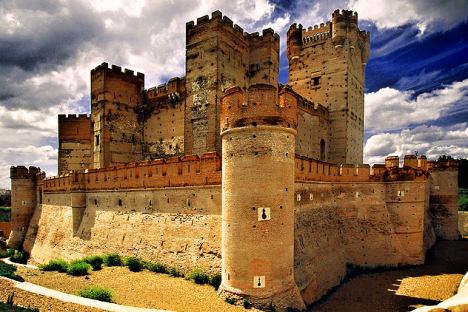
Castillo de la Mota is one of the most beautiful medieval fortresses in Spain, a magnificent 15th-century castle in the town of Medina del Campo, Valladolid province, Castile and León, built from the region’s distinctive red brick in the Mudéjar style and considered one of the finest examples of military architecture in the Kingdom of Castile. The castle’s strategic position on a raised mound (the “mota” of its name) dominates the surrounding plain and served as a royal residence, treasury, prison, and the headquarters of Isabella the Catholic during the crucial early years of her reign.
In This Article
Quick Facts: Castillo de la Mota
- Best time to visit: Year-round; the red brick walls are at their most beautiful in the golden light of late afternoon
- How to get there: ~1.5 hours from Madrid by car (A-6 motorway); ~30 minutes from Valladolid; Medina del Campo has a railway station with connections from Madrid and Valladolid
- Entry fee: ~€6 (adult)
- Combine with: The historic town of Tordesillas (20 min) and the castles of Coca and Cuéllar
The History of a Royal Fortress
La Mota Castle, or Castillo de La Mota is a renovated medieval fortress named after the hill, where it stands, La Mota. It is located in the town of Medina del Campo, in Spanish province of Valladolid, approx. 150km from the capital city of Madrid. The castle is a great dominant of the whole area. The fort has been protected by the state since 1904, first as a national monument, and later as a place of cultural interest. The castle itself was rebuilt in the 20th century. It was built of red bricks which is typical for that area. During the reign of Isabella the Catholic, the castle served as a vital stronghold in the war against the Kingdom of Portugal and was used to secure the border with the neighbouring kingdom. It also famously held Joanna the Mad (Juana la Loca) as a prisoner after her death, following her prolonged confinement at nearby Tordesillas. The castle’s role as a prison continued through the centuries, housing political prisoners and nobles who had fallen from favour.
Exploring the Castle Today
Castillo de la Mota has two main parts, its own citadel of three massive stone towers guarding the original Muslim town, and the dilapidated abbey of Santa Maria Mayor. Here we find the Gothic church of Iglesia San Miguel with a Renaissance facade and painting by El Greco and a mosque rebuilt in 1341 to the Church of Santo Domingo de Silos. If a hot weather is not a problem for you, you could climb to the tower of the fort where you can enjoy a beautiful view of the whole neighbourhood and the ancient town walls. The main tower, known as the Torre del Homenaje, rises to an impressive 40 metres and is considered one of the finest examples of Castilian military architecture. Inside, visitors can explore the restored rooms and halls, including the grand hall with its Mudéjar coffered ceiling, the chapel, and the underground dungeons that once held prisoners. The walk along the battlements offers excellent views of the surrounding Castilian plains, which stretch for miles in every direction.
Medina del Campo and the Castilian Countryside
The town of Medina del Campo itself has a rich history as one of the most important commercial centres of medieval Spain, hosting one of the largest trade fairs in Europe during the 15th and 16th centuries. Today, visitors can explore the town’s historic Plaza Mayor, its many Renaissance palaces, and the Colegiata de San Antolín, a beautiful Gothic church that houses a notable collection of art. The surrounding region of Castile and León is rich in historic castles, making it an excellent destination for castle enthusiasts. The nearby castle of Coca, built in the same distinctive red brick Mudéjar style, is another masterpiece of Spanish military architecture, while the castle of Cuéllar offers a different but equally impressive example of medieval fortification. The region is also known for its excellent wines, particularly the Ribera del Duero appellation, and many bodegas offer tours and tastings that pair perfectly with a day of castle exploration.

Photo licensed under the Creative Commons, created by MANUEL ZALDÍVAR
View Castillo de la Mota beautiful medieval fortress in Spain in a larger map
Have you visited Castillo de la Mota or explored Castile’s Mudéjar fortresses? Share your Spanish castle experiences in the comments! 🏰
Explore all our Spain travel guides, from Barcelona Gaudí to Andalusia plazas.
Explore More
If you enjoyed this article, you might also like:
