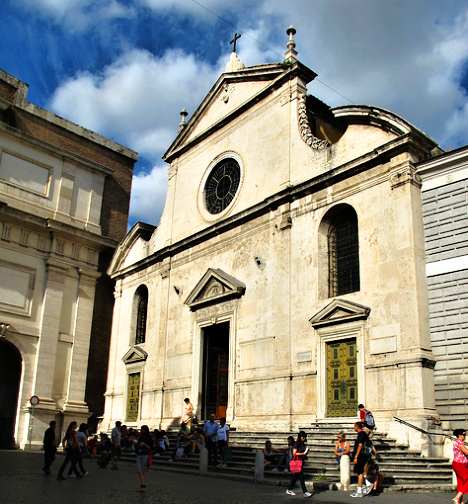
The Piazza del Popolo opens before you, a vast oval of cobblestones framed by twin Baroque churches and dominated by the 3,600-year-old Egyptian obelisk at its centre. On the northern edge of this square, tucked against the ancient Aurelian Wall, stands the church of Santa Maria del Popolo. From the outside it appears modest, a simple Renaissance facade of travertine stone. Inside, it holds two of the most important paintings of the Italian Renaissance. The Cerasi Chapel contains Caravaggio masterpieces, the Crucifixion of St Peter and the Conversion of St Paul, painted between 1600 and 1601. The Chigi Chapel, designed by Raphael, is one of the finest examples of High Renaissance architecture in Rome.
On the edge of a Roman Piazza del Popolo you can find a Renaissance church of Santa Maria del Popolo. The square and the church was named after the parish, which stood here in the Middle Ages. The interior of the church hides real treasures, therefore you should include also this church into your tour through the streets of Rome.
Photo licensed under the Creative Commons, created by ho visto nina volare
The church was founded in 1099 over the alleged tomb of Emperor Nero. This place was chosen in order to sanctify this place which was defiled by the pagan tyrant. For many years, allegedly haunted spirit of the emperor in the form of ravens.
Its recent appearance the church finally received during reconstruction works in the 16th and 17th century, which involved architects Bramante and Bernini. The church has elements from the Renaissance and Baroque periods. The interior is decorated with the works of prominent artists of this time – Caravaggio, Raphael and many others.
Inside there are chapels of many well-known families. The most precious treasure within the church is the Capella Chigi of 1513, which was ordered at Raphael by banker of Siena Agostino Chigi. Its interior is decorated by altar painting “Birth of the Virgin Mary” by Sebastian del Piombo, and sculptures by Bernini and Lorenzetti.
Santa Maria di Montesanto and Santa Maria dei Miracoli (photo by admin)
You can see also other masterpieces here such as paintings by Caravaggio, frescoes by Pinturicchio located behind the main altar or two tombs by Andrea da Sansovino in the presbytery.
In the church of Santa Maria del Popolo are hidden additional beautiful chapels, for example the Cappella della Rovere or Cappella Ceraso with the paintings by Caravaggio. Stained glass windows in the church are one of the oldest in Rome.
Porta del Popolo (photo by admin)
Piazza del Popolo was designed by Valadier at the beginning of the 9th century and today is considered one of the best urbanistic solutions in the city. In the middle of this great area is the second largest Roman obelisk, brought here by the emperor Augustus and placed at the local fountain. In addition to the church of Santa Maria del Popolo, there are two other churches at the square – Santa Maria di Montesanto and Santa Maria dei Miracoli. Another characteristic feature of this large square is the Porta del Popolo, which used to be the most important approach to Rome.
View Santa Maria del Popolo – notable Augustinian church in Rome Italy in a larger map
View Santa Maria del Popolo – notable Augustinian church in Rome Italy in a larger map
In This Article
The Caravaggio Masterpieces in the Cerasi Chapel
The Cerasi Chapel, the second chapel on the left side of the nave, was acquired by Tiberio Cerasi, the treasurer of Pope Clement VIII, in 1600. Cerasi commissioned Caravaggio, who was already famous for his revolutionary use of chiaroscuro, to paint two large canvases for the side walls. The Crucifixion of St Peter shows the saint being nailed to the cross upside down, his body twisted in a pose of resignation. The Conversion of St Paul depicts the moment of Saul enlightenment on the road to Damascus, with Paul lying on his back, arms outstretched, blinded by the divine light that pours from above. The paintings were completed in 1601 and represent the full maturity of Caravaggio artistic style. The dramatic lighting, the realistic treatment of the human figure, and the emotional intensity of the scenes caused a sensation when they were unveiled. The chapel ceiling painting, the Coronation of the Virgin, is by Annibale Carracci, Caravaggio contemporary and rival, creating a dialogue between the two dominant artistic currents of the Roman Baroque. The paintings are lit by a small window in the chapel that directs natural light onto the canvases, enhancing the dramatic effect. The chapel is protected by a wrought-iron gate that allows viewing from the outside during opening hours. Photography without flash is permitted. The best time to view the paintings with minimal obstruction is early morning when the church opens at 7.30am, before the tour groups arrive.
The Chigi Chapel by Raphael
The Chigi Chapel, the second chapel on the right side of the nave, was commissioned by the wealthy Sienese banker Agostino Chigi and designed by Raphael between 1512 and 1516. The chapel is a masterpiece of High Renaissance architecture, following a centralised plan with a square base, a drum, and a dome. The dome mosaics, designed by Raphael but executed by the Venetian mosaicist Luigi da Pace, show God the Father surrounded by planetary symbols, reflecting Chigi interest in astrology and Neoplatonic philosophy. The statues of Jonah and Elijah were carved by Lorenzetto based on Raphael designs, though they were completed after both Raphael and Chigi had died. The pyramid-shaped tombs of Agostino Chigi and his brother Sigismondo, located on either side of the altar, are unusual for a Christian church and reflect Chigi humanist interests. The chapel was restored in the 17th century by Gian Lorenzo Bernini, who added two statues of Daniel and Habakkuk and the central altarpiece of the Virgin and Child. The chapel was completed in 1667, more than 150 years after it was begun. The bronze balustrade and the floor inlays of coloured marble complete the decorative scheme. The Chigi Chapel is considered one of the most beautiful private chapels in Rome and represents the transition from the High Renaissance to the Baroque. Entry to the chapel is free as part of the church, and visitors can walk up to the wrought-iron gate for a close view of the details.
The History and Architecture of Santa Maria del Popolo
Santa Maria del Popolo has stood on this site since 1099, when the first chapel was built over the supposed tomb of Nero the emperor whose ashes were scandalously said to lie beneath a walnut tree on this spot. The church was rebuilt by Pope Sixtus IV in 1472 and given a Renaissance facade that contrasts with the earlier Romanesque campanile. The interior features a Latin cross plan with a single nave, side chapels, and a dome over the crossing. The vaulted ceiling is decorated with coffered panels and the coat of arms of Pope Sixtus IV. The church has 10 side chapels, each commissioned by wealthy Roman families, including the Cybo Chapel, the Della Rovere Chapel, and the Costa Chapel. The Della Rovere Chapel features frescoes by Pinturicchio, painted in 1489. The apse contains a 15th-century polyptych of the Coronation of the Virgin by the Sienese painter Sassetta. The church is located adjacent to the Porta del Popolo, the northern gate of the Aurelian Wall, which has been the main entrance to Rome from the Via Flaminia since ancient times. The gate was redesigned by Bernini in 1655 to welcome Queen Christina of Sweden. The church is open Monday to Saturday from 7.30am to 12.30pm and 4pm to 7pm, and Sundays from 8am to 1.30pm. Entry is free, and the church is a 5-minute walk from the Flaminio metro station on line A.
Have you ever walked into a modest church and discovered world-changing art inside? Tell us about your discovery.
Explore all our Italy travel guides, from the Dolomites to Sicily.
Explore More
If you enjoyed this article, you might also like:
