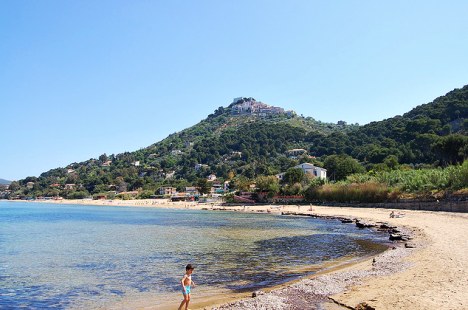
The coastline of the Cilento National Park stretches for 100 kilometres along the Tyrrhenian Sea, a sequence of cliffs, coves, and sandy beaches that rivals the Amalfi Coast but draws a fraction of the crowds. Inland, the mountains of the Cilento rise to over 1,800 metres, covered in forests of chestnut, oak, and beech. The Parco Nazionale del Cilento, Vallo di Diano e Alburni is the second largest national park in Italy, covering 181,000 hectares across three distinct regions. Ancient Greek temples stand among olive groves, medieval hilltop villages cluster on rocky spurs, and the Mediterranean diet was born in the kitchens of this very landscape.
\n\n
Cilento and Vallo di Diano National Park is a reservation that is full of contrasts and contradictions, as well as Italy itself. It is located in the southern part of Italy, in the region of Campania, south of the city of Salerno. It is a great example of untouched nature, but also European and African culture. Here you can forget about any boundaries and enjoy nature at its best.
\n
\nPhoto licensed under the Creative Commons, created by giovanna.alborino
\n
In these beautiful Italian coast you can spend a day or a week. It is only up to you how much you want to learn about this place. If you plan to do the trip to Cilento and Vallo di Diano National Park during your holidays in Italy, just get in the car and go. Probably the easiest way how you could get here, is flying to Napoli, then continue by bus or train. The park is located just 100km from Napoli. The park is easily accessible on foot, but do not forget to take the proper shoes with you.
\n
View Cilento and Vallo di Diano National Park – paradise for lovers of the sea and nature Italy in a larger map
\n
Gateway to the National Park is an ancient town of Agropoli. Its historic centre, built at the top of a rock outcropping, dominates the whole surroundings. In the medieval town of Castellabate you can relax in one of the nice port restaurants with a view of the mountain and further medieval villages.
\n
The diverse landscape and culture of Cilento and Vallo di Diano National Park remained almost unchanged until now. It is due to inaccessible mountains and uncomfortable roads, so the tourists could not get here. Thanks to this you can now see a national park in its original beauty. Coast is full of rocky cliffs and remote sandy beaches, dotted with medieval watchtowers, which are just proving the turbulent history. Massive rocks alternate with grassy plateaus, full of olive orchards and their grandeur will really amaze you. The area is also known as Dolomiti del Mezzogiorno (southern Italian Dolomites).
\n
\nPhoto licensed under the Creative Commons, created by giulio nepi
\n
In Cilento and Vallo di Diano National Park you find kilometres of marked trails that take you through all the corners of the park. The dominant of the whole coast is a rocky cape Palinuro, a mythical place of Roman legends. The massif of the cape hides 35 different caves that you can visit with several diving centers. A few kilometres below you find the small town of Marina di Camerota, where you can enjoy Italian coffee with true Neapolitan cake, or you can go to the original Marina village, which lies high in the mountains. If you will still have some free time, you can go to the bay Infreschi or to the Gulf of Policastro.
\n
Cilento and Vallo di Diano National Park has finally received a major award in 1998. It was declared a unique cultural monument and inscribed to the UNESCO World heritage Site. This national park between the sea and earth, definitely worth visiting.
\n
View Cilento and Vallo di Diano National Park – paradise for lovers of the sea and nature Italy in a larger map
\n
\n
In This Article
The Greek Temples at Paestum and Velia
\n
The ancient Greek city of Paestum, Poseidonia in Greek, was founded around 600 BC by Greek colonists from Sybaris. The archaeological site contains three of the best-preserved Greek temples in the world, all built in the Doric order between 550 and 450 BC. The Temple of Hera, also known as the basilica, dates from 550 BC and is the oldest of the three, with 9 columns across the front and 18 along the sides. The Temple of Neptune, actually dedicated to Hera as well, was built around 450 BC and is the largest, measuring 60 metres by 25 metres, with 6 columns on the facade and 14 on each side. The Temple of Ceres, built around 500 BC and dedicated to Athena, stands on the highest ground and was later converted into a Christian church. The site museum, the Museo Archeologico Nazionale di Paestum, displays the Tomb of the Diver, a 480 BC frescoed tomb showing a diver plunging into the sea, the only surviving example of Greek wall painting with a secular theme. The nearby Greek city of Velia, Elea in Greek, was founded around 540 BC and was the home of the Eleatic school of philosophy, including Parmenides and Zeno. The archaeological area includes the Porta Rosa, a 4th-century BC arch that is one of the earliest true arches in the Western world. Combined entry to Paestum and Velia costs 12 euros as of 2026. The site is located 5 kilometres from the coast and is accessible by train from Naples in 45 minutes.
\n
The Medieval Hilltop Villages
\n
The Cilento National Park is dotted with medieval hilltop villages that have changed little in the last 500 years. Castellabate, a UNESCO World heritage site, perches on a hill 280 metres above the sea and is dominated by the 12th-century castle built by the Abbot of Cava. The village was used as a filming location for the 1994 film Il Postino. The historic centre is a maze of narrow streets and arched passageways, with the Church of Santa Maria a Mare displaying a 14th-century wooden crucifix. The village of Acciaroli, on the coast at the foot of Castellabate, was a favourite destination of Ernest Hemingway, who wrote part of The Old Man and the Sea while staying here. The village of Pollica, 8 kilometres inland, hosts the MedEatResearch centre dedicated to the study of the Mediterranean diet. The village of San Mauro Cilento contains the Certosa di San Lorenzo, a 14th-century Carthusian monastery that was one of the most important in Italy before its suppression in 1807. The monastery complex covers 5,000 square metres with a Baroque church, two cloisters, and monks cells. The village of Camerota, on the southern coast, sits above the Cala Bianca and Cala Fortuna beaches, two of the most beautiful coves in the park. Each village has its own festival, usually in August, featuring local food, music, and religious processions. Accommodation in the villages ranges from agriturismi to small boutique hotels, with prices significantly lower than on the Amalfi Coast.
\n
The Mediterranean Diet and Local Products
\n
The Cilento region is the birthplace of the Mediterranean diet, a term coined by the American physiologist Ancel Keys after studying the eating habits of the local population in the 1950s. Keys lived in the village of Pioppi for decades and published his landmark study showing that the local diet of olive oil, vegetables, whole grains, and fish produced remarkably low rates of heart disease. The Pioppi Diet, as it was later called, has been the subject of ongoing nutritional research. The local olive oil, Olio del Cilento DOP, is produced from the Rotondella, Olivella, and Pisciottana olive varieties, with a distinctive fruity flavour and a peppery finish. The Cilento also produces high-quality buffalo mozzarella, made from the milk of water buffalo raised on the plains near Paestum. The mozzarella di bufala campana DOP is sold within 48 hours of production and has a creamy texture and sweet flavour. The local figs, fichi del Cilento DOP, are dried and filled with almonds before being dipped in chocolate. The Aglianico and Fiano grapes produce robust red and aromatic white wines that pair with the local cuisine. Cooking classes are offered in many of the villages, teaching the preparation of handmade pasta including cavatielli and fusilli, salted anchovies from the coastal towns, and the traditional dessert of mostaccioli, honey-spiced biscuits. The Cilento National Park visitor centres provide maps, guided hike schedules, and information about local producers who offer tastings.
\n\n
Would you choose a week on the Cilento coast or a week on the Amalfi Coast? Which one sounds like your kind of Italian escape?
\n
Explore all our Italy travel guides, from the Dolomites to Sicily.
Explore More
If you enjoyed this article, you might also like:
