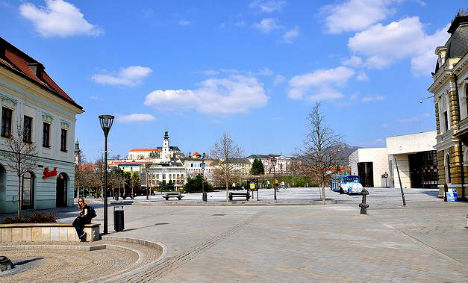
The castle hill of Nitra rises from the plains of western Slovakia, crowned by a cathedral that has watched over this city for over a thousand years. Nitra is the oldest city in Slovakia, with continuous settlement dating back to the 5th century and written records mentioning it as early as 828. The city was the capital of the Principality of Nitra, one of the earliest Slavic states, and later the seat of the first Christian bishopric in what is now Slovak territory. The castle complex, perched on a 60-metre limestone hill, combines Romanesque, Gothic, Baroque, and Renaissance architectural styles in a single fortified compound. The city below spreads across the banks of the Nitra River, its modern centre a mix of socialist-era blocks and carefully preserved historic buildings.
Nitra is the oldest and currently the fifth largest city in the Slovak Republic (82,661 inhabitants). It is a modern city with a rich cultural and business life.
Photo licensed under the Creative Commons, created by Janos Korom Dr.
The largest and most visited monument and landmark of the city is Nitra castle (Nitriansky hrad) built on a rocky hill over the Nitra river. It is a huge building and was the seat of many princes and bishops. Today, visitors can admire its newer form, because it has undergone frequent repairs, the last of which changed its look to a Renaissance-Baroque style. Nitra castle contains of the cathedral, the episcopal residence and a system of fortifications. The interior is full of paintings from the 18th century, there are also the tombs of bishops, marble altar and baptismal font. Nitra Castle is currently the seat of the bishop’s residence and the Archaeological Institute of Slovak Academy of Sciences.
The so-called Lower Town (Dolné mesto) is now a lively center of Nitra. From the Theatre of Andrej Bagar which is located at Svätopluk’s Square leads the pedestrian zone. You can find here also a Romanesque St. Stephen’s Church from the 12th century, the Baroque Piarist monastery and the church of St Ladislav from the 18th century. On the hill in the southern part of the city you can walk up to Nitra’s Calvary and enjoy a nice view of the Old city.
Botanical Garden in Nitra is currently a place of Slovak University of Agriculture and its competence is a research and cultural-educational activities. The garden was founded in 1982 as a facility of the Agricultural University in Nitra. The actual area of the Botanical Garden has an irregular shape in the middle of which is an artificial lake and several walking paths.
It boasts over 6,400 kinds of tropical plants. There are over 2,000 botanical species and 3,000 orchids, which come from all tropical regions of the world.
Besides the major attractions and institutions in the city like Nitra’s Public Gallery, museum of Nitra, Slovak Agricultural Museum, and others, tourists can also visit many places in the neighbourhood. Nitra is also the starting point for the tours around Ponitrie Protected Landscape Area, where is the network of marked hiking trails.
Directly from Nitra you can take the first part of cognitive Zobor pavement with 8 stops with a length of almost 4 km. The trail leads along the ruins of Zobor castle, Svorad’s cave and spring, which proves the presence of St. Svorad in this area.
In almost all parts of Nitra and its surroundings you will find a wide range of accommodation.
View Nitra – the oldest city in Slovakia in a larger map
In This Article
Nitra Castle and the Cathedral of St Emmeram
Nitra Castle, the dominant landmark of the city, has been the seat of the Slovak bishops since the 9th century. The castle complex is entered through a Baroque gate from 1721 and consists of three main structures: the Bishop Palace, the upper Church, and the Lower Church. The Cathedral of St Emmeram is actually a group of three churches connected within the castle walls. The Romanesque Church of St Emmeram, built in the 11th century, is the oldest surviving church in Slovakia, with a single nave, a semicircular apse, and narrow windows typical of the Romanesque style. The Gothic upper Church, built in the 14th century, features ribbed vaulting and a stone altar. The Baroque Lower Church was added in the 17th century. The castle walls, originally built in the 13th century and reinforced in the 16th century against Turkish attacks, enclose a courtyard where an open-air theatre hosts summer performances. The castle houses a diocesan museum displaying artefacts from the Nitra region including Gothic chalices, medieval manuscripts, and the Nitra Gospel, a 12th-century illuminated manuscript. The castle is open from April to September, with guided tours costing 5 euros. The climb to the castle offers views across the old town to the surrounding agricultural landscape of the Nitra region. The castle park, located below the fortifications, provides shaded walking paths and a small botanical garden.
The Old Town and Svätopluk Square
The old town of Nitra centres on Svätopluk Square, named after the 9th-century prince of Great Moravia. The square is dominated by the Baroque column of the Holy Trinity, erected in 1739 to commemorate the end of a plague epidemic. The column stands 20 metres tall and is decorated with statues of saints. The surrounding buildings include the Town Hall, a Neoclassical structure from 1834, and several 18th-century burgher houses with painted facades. The pedestrian street of Kupecká links the square to the Piarist Church of St Ladislaus, a Baroque building from 1701 with a single nave and a richly decorated interior. The church houses a copy of the Black Madonna of Czestochowa, a popular pilgrimage destination. The Andrej Bagar Theatre, named after the Slovak actor, hosts drama, opera, and ballet performances in a modern building completed in 1972. The Synagogue of Nitra, built in 1911 in the Moorish Revival style, is one of the few surviving Jewish buildings in the city and now serves as a cultural centre and exhibition space. The Jewish community of Nitra numbered over 4,000 before the Second World War and was almost entirely destroyed in the Holocaust. The surrounding pedestrian zone offers cafes, restaurants serving Slovak cuisine including bryndzove halusky, potato dumplings with sheep cheese and bacon, and shops selling local crafts and souvenirs.
The Nitra Region and Agrokomplex
The Nitra region is the agricultural heartland of Slovakia, known for its vineyards, orchards, and fertile plains that produce wheat, corn, and sunflowers. The Nitra wine region, part of the larger Slovak wine country, produces white wines from the Veltliner, Riesling, and Sauvignon Blanc grape varieties. The wine cellars of the surrounding villages offer tastings and tours, with the village of Svätý Jur being particularly well known. The Agrokomplex, the largest agricultural exhibition centre in Slovakia, hosts the annual Nitra Agricultural Fair every August, attracting over 100,000 visitors to see livestock displays, agricultural machinery, and food products from across the country. The exhibition centre also hosts concerts, trade fairs, and cultural events throughout the year. The nearby Tribeč Mountains, 15 kilometres east of Nitra, offer hiking trails through oak and beech forests to the ruins of Gýmeš Castle, a 13th-century Gothic fortress destroyed by fire in 1870. The Topoľčianky Castle, a 30-minute drive north, is a Renaissance manor house set in an English-style park, once owned by the Habsburg family and now a national cultural monument. The Nitra River offers kayaking opportunities with sections suitable for beginners. The city is connected to Bratislava by train with a journey time of 90 minutes, making it an easy day trip from the capital. The local airport, Nitra Airport, handles general aviation and charter flights but has no scheduled commercial service.
Have you ever visited a thousand-year-old city that feels undiscovered by mass tourism? Which one was it?
Explore all our Slovakia travel guides, from the High Tatras to Bratislava charm.
Explore More
If you enjoyed this article, you might also like:
