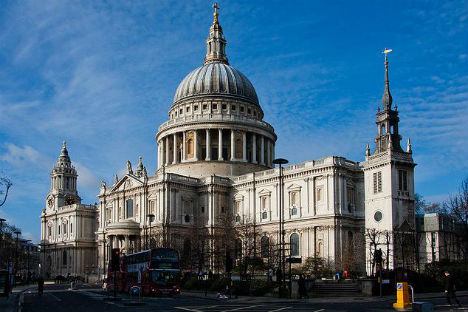
The dome of St Pauls Cathedral rises above the London skyline, a landmark that has defined the city silhouette for over 300 years. From the steps of the west front, the view down Ludgate Hill opens toward the City of London, where the glass towers of modern finance surround one of the greatest buildings of the English Baroque. The cathedral was built to replace the medieval Old St Pauls, destroyed in the Great Fire of London of 1666. Sir Christopher Wren designed the current structure, and it took 35 years to complete, from 1675 to 1710. The building survived the Blitz of the Second World War intact while the surrounding neighbourhood burned, a symbol of British resilience that became iconic when the photograph of the dome surrounded by smoke was published in newspapers around the world.
St. Paul’s Cathedral is one of the major landmarks of the British capital of London and has a completely sovereign status among the all church buildings. It is also the second largest religious building in the United Kingdom (after Liverpool Cathedral), whose unmistakable dome inherently belongs to the eastern part of the city skyline.
Photo licensed under the Creative Commons, created by Garry Knight
The cathedral rises on a Ludgate Hill, offering a beautiful view not only of the roofs of surrounding houses, but also on the nearby River Thames. The place where the cathedral stands, belonged to the church purposes from time immemorial, and so St. Paul’s Cathedral is the fifth church that was built here. The first wooden church has already been here in the 7th century. However it took many centuries until the present cathedral was built here. The former buildings were destroyed especially by numerous fires. Churches have always been newly refurbished and underwent many modifications, especially during the Middle Ages.
The worst time in the history of the cathedral was the September 2nd, 1666, during London’s Great Fire, when the four fifths of the former metropolis were completely destroyed, including the cathedral.
Photo licensed under the Creative Commons, created by Steve Cadman
The creation of a new model of church is credited with one of the greatest masters of that time – Sir Christopher Wren. Construction started in 1675 and was completed many years later – in 1710. Once the cathedral was completed, it was the third longest church in Europe with a length of 181m, and boasted a 149 m high tower.
Today, St. Paul’s Cathedral is the most beautiful old building in London, still used for regular worship, but also to the extraordinary and monitored events worldwide. In 1965 it became the scene of the funeral of Prime Minister and Nobel Prize winner for literature, Sir Winston Churchill, who is considered one of the leading statesmen of the 20th century. His funeral was at the same time the show of the world political figures, which has been overcome by the funeral of Pope John Paul II. in 2005. In July 1981, the cathedral was a place of the marriage of Princess Diana and Prince Charles.
View St. Paul´s Cathedral – one of the major landmarks of London United Kingdom in a larger map
Cathedral impresses every visitor especially its western facade, which is well-illuminated in the evening. The cathedral is heavily decorated with numerous architectural features. The most richly decorated part is the altar area, where you can see spectacular, sophisticated gilded mosaics with images of birds, fish, animals and nature. In the south aisle of the cathedral there is a unique and even the only completely preserved statue from the old St. Paul’s Cathedral. The statue is a portrait of the poet John Donne, who was a preacher and Dean of St Paul’s Cathedral.
The cathedral is easily accessible by subway Central.
View St. Paul´s Cathedral – one of the major landmarks of London United Kingdom in a larger map
In This Article
The Dome and the Golden Gallery
The dome of St Pauls Cathedral is one of the largest cathedral domes in the world, with a diameter of 34 metres and a height of 111 metres from the cathedral floor to the lantern cross. It is actually three domes in one: an outer lead-covered timber dome visible from the outside, a middle brick cone that supports the stone lantern above, and an inner masonry dome decorated with frescoes that is visible from the nave. The inner dome paintings, known as the Thames and London series, were executed by Sir James Thornhill between 1715 and 1719 and depict scenes from the life of St Paul in eight panels. The Whispering Gallery runs around the base of the inner dome at a height of 30 metres, accessible by 257 steps. The gallery gets its name from the acoustic property that carries a whisper from one side of the circular wall to the other, a distance of 34 metres. The Stone Gallery at 53 metres offers an external viewing platform with views across the City of London. The Golden Gallery at 85 metres, reached after 528 steps in total, is the highest external viewing gallery and offers a panoramic view of London that extends to the London Eye, the Shard, and the Canary Wharf towers on clear days. The climb requires a reasonable level of fitness, and the steps become narrower and steeper as you ascend. The combined cathedral and gallery ticket costs 21 pounds for adults as of 2026. The cathedral offers free guided tours of the main floor, which last 90 minutes and cover the history and architecture of the building.
The Crypt, the Great Model, and the Quire
The crypt of St Pauls is the largest in Europe, extending beneath the entire cathedral floor and containing the tombs of some of Britain most celebrated figures. Admiral Lord Nelson, who died at the Battle of Trafalgar in 1805, is buried here in a marble sarcophagus originally intended for Cardinal Wolsey. The Duke of Wellington, victor of the Battle of Waterloo in 1815, lies in a massive granite tomb on the opposite side of the crypt. The painter Sir Joshua Reynolds, the architect Sir Christopher Wren, and the poet John Donne, who was a dean of St Pauls, are also buried in the crypt. Wren epitaph, written by his son, reads in Latin: Reader, if you seek his monument, look around you. The crypt also houses the Treasury, displaying liturgical silver and plate, and the OBE Chapel, dedicated in 1965 to the Order of the British Empire. The Great Model, displayed in the crypt, is an 18-foot-long wooden model of the original design proposed by Wren in 1673, which he considered his best design but which was rejected by the church authorities as too radical. The Quire, the eastern section of the cathedral where services are held, features carved oak stalls by Grinling Gibbons, the master woodcarver of the English Baroque. The organ case above the quire, designed by Wren, houses a 4,500-pipe organ built by Father Smith in 1695. The organ is used for daily services and regular concerts. The high altar, a Baroque marble structure surmounted by a baldachin, frames the great east window.
Visiting St Pauls Cathedral and the Surrounding Area
St Pauls Cathedral is open to visitors Monday to Saturday from 8.30am to 4.30pm, with the final entry at 4pm. The cathedral is closed to tourists on Sundays, though services are open to worshippers. The best time to visit is immediately after opening at 8.30am, when the morning light fills the dome and the crowds are thin. Photography is permitted inside without flash or tripod. The cathedral offers multimedia guides in 11 languages, included in the ticket price. The evensong service at 5pm on weekdays is a highlight of the London cultural calendar, with the cathedral choir performing the Anglican choral tradition in a setting that has been continuous since 1700. The service is free to attend and lasts approximately 45 minutes. The Millennium Bridge, the pedestrian suspension bridge that crosses the Thames directly south of the cathedral, offers the classic view of the dome rising above the river. The Tate Modern gallery, housed in the former Bankside Power Station on the south bank, is a 10-minute walk across the bridge. The Museum of London, 15 minutes north, traces the history of the city from prehistoric times to the present. The Bank of England Museum, on Threadneedle Street, explains the history of British banking and displays a real gold bar that visitors can lift. The surrounding streets of the City of London offer historic pubs including the Old Bank of England and Ye Olde Cheshire Cheese, which dates from 1667 and counts Charles Dickens among its former patrons. The nearest Underground station is St Pauls on the Central line, with Mansion House and Blackfriars stations also within walking distance.
Which London landmark leaves you feeling most awestruck: the dome of St Pauls, the towers of Westminster Abbey, or the view from the London Eye?
Explore all our United Kingdom travel guides, from London landmarks to the Scottish Highlands.
Explore More
If you enjoyed this article, you might also like:
- Riding High! – Convents, Cathedrals, Monasteries and More | UK – United Kingdom
- Lulworth Cove – beautiful natural attraction at Jurassic Coast, Dorset, England – United Kingdom
- Tower of London – Royal Palace, fortress, prison, place of execution, arsenal, Royal Mint, Royal Zoo and jewel house | United Kingdom – United Kingdom
