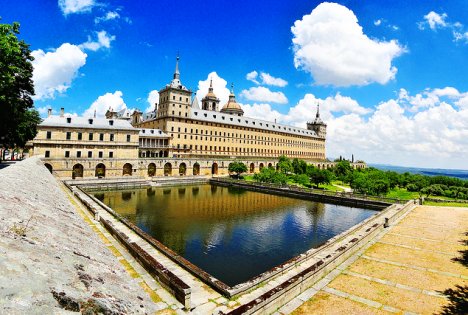
The Monastery of San Lorenzo de El Escorial rises from the foothills of the Sierra de Guadarrama, a colossal granite complex that Philip II of Spain built as a royal palace, monastery, library, and mausoleum all in one. Completed in 1584 after just 21 years of construction, the Escorial is one of the most impressive Renaissance buildings in Europe, a monument to Spanish power at the height of its empire. Its design, in the shape of a gridiron, is said to commemorate the martyrdom of Saint Lawrence, who was roasted alive on a gridiron, and the scale of the complex is staggering: it covers 33,000 square metres, with 16 courtyards, 88 fountains, and over 4,000 rooms.
In This Article
The Royal Pantheon
Beneath the high altar of the basilica lies the Royal Pantheon, the final resting place of most of the Spanish monarchs from Charles I to the present day. The octagonal chamber, lined with dark marble and lit by a single chandelier, contains 26 marble sarcophagi arranged on shelves around the walls. The effect is both solemn and magnificent, a reminder of the continuity of the Spanish monarchy across the centuries. Adjoining the main pantheon is the Pantheon of the Infantes, where the children of the royal family are buried. The remains of Philip II, the builder of the Escorial, are interred in a simple tomb beneath the floor of the basilica, close to the altar he could see from his bedroom in the palace.
The Library and the Art Collection
The Royal Library of the Escorial is one of the most important libraries in the world, housing over 40,000 volumes and 4,000 manuscripts. The library’s collection includes many of the most precious works of the Spanish Golden Age, including the notebooks of Leonardo da Vinci and the Aztec codices brought from the New World. The library’s reading room is a masterpiece of Renaissance design, with a barrel-vaulted ceiling painted with allegorical frescoes representing the seven liberal arts. The Escorial also contains an impressive art collection, with works by Titian, El Greco, Velázquez, and Hieronymus Bosch. The chapter houses display a remarkable series of religious paintings, while the palace apartments are decorated with Flemish tapestries and period furniture.
Visiting the Escorial
The Escorial is located approximately 45 kilometres northwest of Madrid, easily reached by train from Atocha station or by bus from Moncloa interchange. The journey takes about an hour. The complex is open Tuesday through Sunday, with reduced hours on Mondays. Admission costs approximately 12 euros for adults and includes access to the palace, the basilica, the pantheon, the library, and the museum. The best time to visit is early morning or late afternoon, when the tour groups are smaller. The valley of the Fallen, the controversial monument and basilica carved into a mountain about 10 kilometres from the Escorial, can be visited on the same day. Allow a minimum of three hours to explore the Escorial complex thoroughly. The nearby town of San Lorenzo de El Escorial offers restaurants and cafes for lunch.
Have you walked through the halls of the Escorial and felt the presence of Philip II’s ambitious vision? What part of this extraordinary complex impressed you most?
>
A Monument to Spanish Power
El Escorial, officially the Royal Site of San Lorenzo de El Escorial, is one of the most significant Renaissance complexes in Europe. Built between 1563 and 1584 under the orders of King Philip II, it was conceived as a multifaceted institution: a monastery, a royal palace, a library, a school, and the burial place for Spanish monarchs. The design by Juan Bautista de Toledo and his successor Juan de Herrera defines the Herrerian architectural style, characterised by its stark geometry and lack of ornamentation that gives the building its distinctive austere appearance.
The complex covers 33,000 square metres and contains 16 courtyards, 86 staircases, 1,200 doors, and over 2,600 windows. Its floor plan is said to resemble a gridiron, referencing the martyrdom of Saint Lawrence, to whom the site is dedicated. Philip II reportedly chose the location 50 kilometres northwest of Madrid for its proximity to the capital and its cooler climate, which provided respite from the Castilian summer heat.
Explore all our Spain travel guides, from Barcelona Gaudí to Andalusia plazas.
Explore More
If you enjoyed this article, you might also like:
