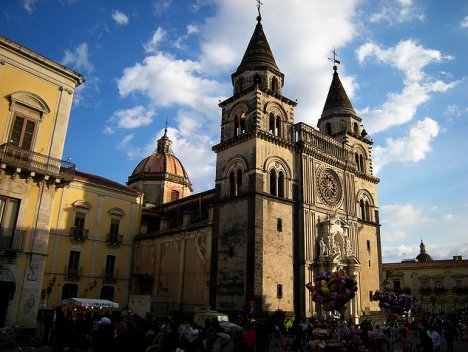
Baroque facades in black volcanic stone line the streets of Acireale, a town perched on the eastern coast of Sicily where the lava flows of Mount Etna meet the Ionian Sea. The cathedral, dedicated to Saints Peter and Paul, displays intricate carvings and a campanile that rises high above the surrounding rooftops. But Acireale’s most famous moment comes during Carnival, when elaborate floats roll through the streets, each one a masterpiece of papier-mache and satire. Masked performers dance among the crowds, and the air fills with confetti and music. Beyond the festival, the town offers thermal baths, a dramatic coastline, and views of Etna’s smoking summit.
The city of Acireale (Aciriali in Sicilian) is located on the terraced slopes of volcanic origin, between the last foothills of Mount Etna and the Ionian coast, in the province of Catania. It has 52,000 inhabitants. It is well-known mainly for its thermal springs, also of volcanic origin, thanks to which the city grew up into a modern spa. The thermal waters of Acireale are rich in minerals and have been prized since Roman times for their therapeutic properties. Several public baths and spa hotels in the town offer treatments ranging from simple thermal soaks to full wellness programmes.
Photo licensed under the Creative Commons, created by Leandro Neumann Ciuffo
In This Article
Acireale Cathedral and Baroque Architecture
The main feature of the town is Acireale Cathedral. It dates from the 16th and 17th centuries, however it was rebuilt in the 18th century. The facade is from the 17th century, which is the work of Giambattista Basile and has a beautiful portal of marble and alabaster (17th century). The majestic interior has a dome and is richly decorated with frescoes created in the 18th century. The city’s heart is the Piazza del Duomo, where this cathedral is situated. There is also the Palazzo Comunale, a building from the second half of the 17th century built in a typical Catalonian Baroque style. The basilica dei Santi Pietro e Paolo from the 17th century boasts a beautiful architectural design with ornamental decoration. Walking through the streets of Acireale, you will notice the distinctive dark volcanic stone, known as pietra lavica, that gives the town its unique character. This material, harvested from the slopes of Mount Etna, has been used in local construction for centuries and lends the Baroque architecture a dramatic, sombre beauty that contrasts with the ornate white stone details.
The Famous Carnival of Acireale
Acireale is also known for a famous Carnival, which attracts people from around the world. It is considered the most beautiful carnival in Sicily. For 2012 it was planned from the 4th to 21st of February. The Carnival of Acireale is distinguished by its elaborate papier-mache floats, which can reach impressive heights and are crafted by local artisans who work on them year-round. Unlike other Sicilian carnivals that focus on allegorical floats, Acireale’s version is known for its satirical and political themes, with grotesque masked figures parading through the streets. Music fills every corner of the old town, with live bands, street performers, and costumed dancers creating an atmosphere of joyous celebration. The festival culminates in a grand fireworks display over the Piazza del Duomo, and the final day features the traditional burning of the carnival king, a symbolic cleansing that marks the beginning of Lent. The city has two patrons – St. Venera (celebrated on the 26th of July) and St. Sebastian (celebrated on the 20th of January).
Photo licensed under the Creative Commons, created by Leandro Neumann Ciuffo
Natural Beauty and Day Trips
You should also visit the public gardens and Villa Belvedere. Here you can enjoy a beautiful panoramic view of Mount Etna and the sea. You can then take a pleasant walk through beautiful scenery and exciting surroundings, along the steep slopes of the natural reserve La Timpa and get to the picturesque fishing village of Santa Maria la Scala. The volcanic coastline offers dramatic cliffs, hidden coves, and clear waters perfect for swimming. The nearby towns of Catania and Taormina are easily accessible for day trips, and the slopes of Mount Etna offer hiking opportunities through lunar-like landscapes of solidified lava flows. A particularly rewarding excursion is the drive up to the Rifugio Sapienza on Etna’s southern slopes, where you can take a cable car and then a 4×4 bus to within walking distance of the summit craters. The views from the top, with the Sicilian coastline stretching away on one side and the smoking volcanic vents on the other, are truly unforgettable.
Have you ever experienced a famous carnival? Which one was your favourite? 🎭
Explore all our Italy travel guides, from the Dolomites to Sicily.
Explore More
If you enjoyed this article, you might also like:
