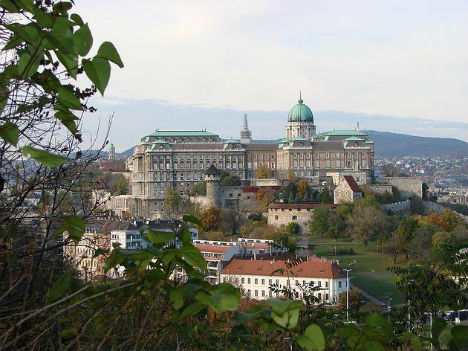
The castle complex rises on Castle Hill above the Danube, a sprawling Baroque palace that dominates the Budapest skyline. From the Fisherman’s Bastion terrace the view stretches across the river to the Parliament building, the Chain Bridge, and the hills of Pest. The castle was first built in the 13th century, destroyed, rebuilt, bombed, and restored again. Its grand halls now house the Hungarian National Gallery and the Budapest History Museum. The cobbled streets of the old Buda Castle district wind past tiny courtyards, medieval ruins, and café terraces where locals sip wine and watch the city lights blink on at dusk.
The complex of the Buda Castle and its related temples is a prominent feature of Budapest and one of the symbols of Hungary. The entire site has been added to the UNESCO World heritage List already in 1987. Castle Hill, rising 60 metres above the Danube, has been continuously inhabited since medieval times, and the layers of history are visible in every corner of the district – from Roman ruins to Gothic arches, from Ottoman baths to Habsburg Baroque facades. The view from the castle ramparts across the Danube to the Hungarian Parliament building is one of the most photographed scenes in Central Europe, particularly striking at sunset when the buildings are lit with golden light.
Photo licensed under the Creative Commons, created by Adam Jones
In This Article
A Rich and Turbulent History
Buda Castle is situated on a 60 m high ridge known as Castle Hill, overlooking the city since the 13th century. The first written mention dates from 1255, when Béla IV built a fortified castle here. Around 1356 Ludwig I began to build a Royal Castle on the southern slopes of Castle Hill. With the advent of the year 1400, the Holy Roman Emperor Sigismund of Luxembourg built a Gothic palace here, which was in 1458 rebuilt into a Renaissance style. The palace was constantly besieged since the beginning by Turks and the Habsburgs, and was almost destroyed and then rebuilt to a smaller one. After the conquest of Buda in 1541 by Turkish troops the palace served as stables and storage of gunpowder. Its expansion was issued later by Maria Theresa, who changed it into a palace with 203 chambers. The Habsburgs made a reconstruction of the palace in the 18th century by which they rebuilt it into a huge palace. During World War II, the castle was heavily damaged once again, and the post-war reconstruction took decades, finally being completed in the 1980s. The final rebuilding was a monumental effort that involved extensive historical research and traditional craftsmanship to restore the palace to its former glory.
Photo licensed under the Creative Commons, created by Benjamin Vander Steen
Museums and Cultural Institutions
Buda Castle includes several major institutions such as the Hungarian National Gallery, the Budapest History Museum, and the National Széchényi Library. The Hungarian National Gallery is housed in the main wing of the palace and features an extensive collection of Hungarian art spanning from medieval times to the present day. Visitors can explore works by Hungarian masters such as Mihály Munkácsy and József Rippl-Rónai, as well as Gothic altarpieces and Renaissance sculptures. The Budapest History Museum, located in the southern wing, traces the city’s development from prehistoric settlements through the Roman era, the Middle Ages, and the Turkish occupation to modern times. The museum’s medieval collection includes the original Gothic statues that once decorated the castle, as well as the complete furnishings of a medieval merchant’s house discovered during excavations beneath Castle Hill. The museum also features a fascinating exhibit on the 1956 Hungarian Revolution, which saw significant fighting in the castle district.
The National Széchényi Library and Castle District
The library was founded in 1802 by Count Ferenc Széchenyi. It consisted of 15,000 books and 2,000 manuscripts. Now the collection includes five million prints – everything that has ever been issued in Hungary. Among the most valuable gems are the Corvinus manuscripts, collections of old books and manuscripts which formerly belonged to King Matthias Corvinus. This collection formed one of the largest libraries in Renaissance Europe. The surrounding Buda Castle district is a UNESCO World heritage site in its own right, with cobblestone streets, medieval houses, and charming squares. The funicular railway connects the castle hill to the Chain Bridge below, offering one of the most scenic approaches to this magnificent complex. The Sándor Palace, the official residence of the Hungarian President, also stands within the castle district, and visitors can watch the changing of the guard ceremony at noon each day. The nearby Matthias Church and Fisherman’s Bastion are also must-see attractions within easy walking distance of the castle.
Which view of Budapest captures your heart? 🌇
Explore all our Hungary travel guides, from Budapest baths to the Great Plain.
Explore More
If you enjoyed this article, you might also like:
