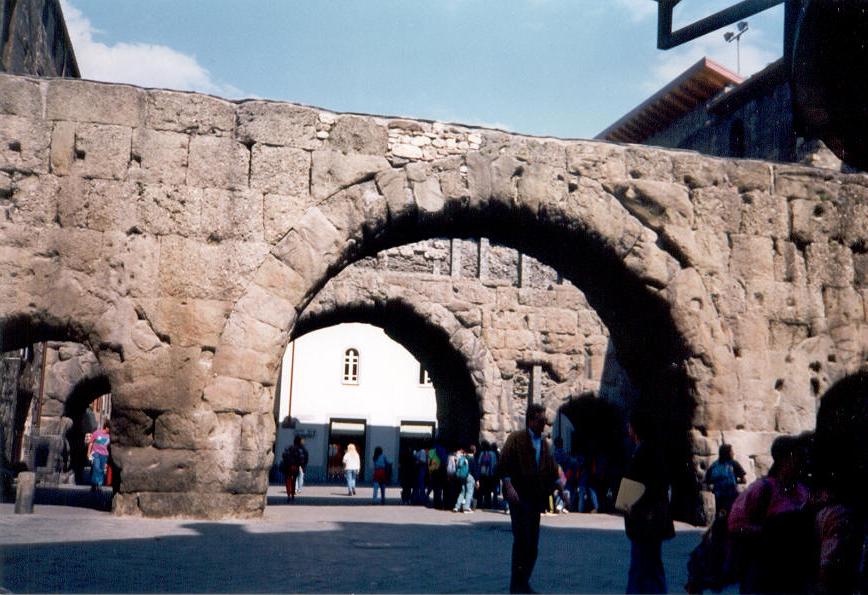
High in the Italian Alps, surrounded by some of Europe’s tallest peaks, lies a city that began as a Roman military camp. Aosta is often called the Rome of the Alps, and the comparison is justified. The Arch of Augustus still stands proudly at the edge of the old town. The Roman Theatre remains an open-air performance venue. The Cryptoporticus, a vast underground gallery, hints at the scale of the original settlement. Above the Roman ruins, the medieval and modern city lives on. The mountains press in from every side, offering skiing in winter and hiking in summer. Aosta is a rare place where ancient history and Alpine adventure meet.
In This Article
Roman Foundations of Aosta
The city of Aosta was founded as Augusta Praetoria Salassorum in 25 BC, after the Roman victory over the local Salassi tribe. The colony was designed as a retirement settlement for Roman veterans, with a layout that followed the classic Roman grid system. The original town measured 725 by 751 metres, enclosed by sturdy walls that featured four gates and twenty towers. Much of this Roman layout remains visible today, making Aosta one of the best-preserved Roman towns in northern Italy.
The most iconic Roman monument is the Arch of Augustus, built in 35 BC to commemorate the victory over the Salassi. This triumphal arch stands at the eastern entrance to the old town and is remarkably well preserved. Nearby, the Roman Theatre retains its 22-metre southern wall and once held up to 4,000 spectators. Today, it is still used for performances during the summer months, continuing a tradition of live entertainment that spans more than two millennia.
The Cryptoporticus is one of the most impressive Roman structures in Aosta. This vast underground gallery, formed by three parallel corridors with barrel-vaulted ceilings, once supported the forum above. Visitors can walk through these subterranean passages and appreciate the engineering skill of the Roman builders. The Porta Pretoria, the ancient eastern gate, still marks the entrance to the old town, with its twin arches and remains of guard towers creating an unforgettable first impression.
Medieval and Savoy heritage
After the fall of the Roman Empire, Aosta continued to thrive as a important centre on the route through the Alps. The medieval city grew around and above the Roman foundations, with narrow lanes and stone houses climbing the hillsides. The Tower of Bramafan, built in the 11th century by the House of Savoy, stands atop a Roman bastion and offers a striking example of medieval fortifications built upon earlier structures.
The city’s cathedral, dedicated to the Assumption of Mary, is a blend of architectural styles reflecting centuries of construction and renovation. Its neoclassical facade dates from the 19th century, but the interior contains Gothic and Romanesque elements, including a beautiful carved wooden choir stall. The nearby Church of Saint Orso is even older, with a 12th-century cloister featuring intricately carved capitals depicting biblical scenes and mythical creatures.
The Savoy dynasty, which ruled the Aosta Valley for centuries, left its mark on the city through various palaces and administrative buildings. The medieval quarter retains its original street pattern, with covered passageways and arched doorways leading to hidden courtyards. Walking through these streets, it is easy to imagine the merchants, pilgrims, and soldiers who passed this way over the centuries, crossing the Alps through the Great and Little St Bernard passes.
Outdoor Adventures in the Aosta Valley
Aosta’s location in the heart of the Alps makes it an ideal base for outdoor activities throughout the year. In winter, the surrounding mountains offer some of the best skiing in Italy. The Aosta Valley is home to famous resorts including Courmayeur, Cervinia, and La Thuile, all within easy reach of the city. The ski season typically runs from December through April, with reliable snowfall and well-maintained pistes for all ability levels.
Summer brings a different kind of adventure. Hiking trails radiate from Aosta into the surrounding mountains, ranging from gentle valley walks to challenging high-altitude routes. The Gran Paradiso National Park, Italy’s oldest national park, is just a short drive away and offers spectacular hiking through alpine meadows, past crystal-clear lakes, and up to glaciers. Wildlife viewing is excellent, with ibex, chamois, and golden eagles commonly seen.
For those seeking less strenuous activities, the Aosta Valley produces excellent wines and cheeses that can be sampled at local markets and restaurants. The region is particularly known for its Fontina cheese, a nutty, semi-soft cheese that is the foundation of many local dishes. The valley also offers opportunities for cycling, rock climbing, and paragliding, making Aosta a year-round destination for active travellers who appreciate history as much as adventure.
Would you explore Roman ruins first or hike into the surrounding Alps? ⛰
Explore all our Italy travel guides, from the Dolomites to Sicily.
Explore More
If you enjoyed this article, you might also like:
