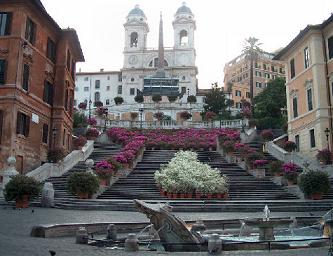
The Spanish Steps cascade down the Pincian Hill in a waterfall of travertine and blooming azaleas, each landing filled with Romans and travellers alike sitting shoulder to shoulder in the late afternoon sun. At the foot, the Fontana della Barca sinks into the piazza, a boat half submerged in clear water, a reminder that the Tiber once flooded this very spot. Artists set up easels along the parapets. Couples share gelato on the steps. From the top, the rooftops of Rome stretch toward St Peter’s dome, ochre and terracotta under a deepening sky. Piazza di Spagna is not a destination. It is a pause, a breath, a meeting of worlds.
Piazza di Spagna is a square situated at the foot of the hill Pincio in Rome, Italy. Originally, only the southern part of the square had such name. The northern part was called the Piazza di Francia. This name was given according to Palazzo di Spagna, which since the 17th century was the seat of the Bourbon Spanish embassy to the Holy See (embassy is now located in Palazzo Monaldeschi in the piazza below).
In front of the palace you can see a column of the Immaculate, which was built in 1856 by Pope Pius IX to commemorate the dogma of the immaculate conception. The column dates back to the ancient times, it was found in excavations in 1777, under a monastery. It is now topped with a statue of Virgin Mary.
View Piazza di Spagna – one of the most popular meeting points in Rome Italy in a larger map
On the south side of the Piazza di Spagna there is the Palazzo di Propaganda Fide, the seat of the Congregation for the Evangelization of Peoples.
In the middle of the Piazza di Spagna rises Fontana della Barcaccia built in 1629 by Pietro Bernini. From this fountain you can step up Baroque Scalinata della Trinita dei Monti (the Spanish Steps), which were built in the years 1723-1726 at the request of a French diplomat Stephen Gouffiera. The architects were Francesco de Sanctis and Alessandro Specchi. The elegant staircase consists of 137 steps and has an irregular albeit symmetric structure. It is beautiful especially in May, when it is decorated with azaleas. The steps are usually very crowded; it attracts tourists as well as locals who use it as a gathering place.
Stairs lead to the French church Trinita dei Monti, built from 1495 to 1585 with the support of the French kings. In front of the church you can see the obelisk of 1788 which is the smallest of Rome’s obelisks. It is an ancient copy of Egyptian original, which formerly stood in the Gardens of Sallust.
View Piazza di Spagna – one of the most popular meeting points in Rome Italy in a larger map
History of the Spanish Steps and the Barcaccia Fountain
The Spanish Steps, designed by Francesco de Sanctis in 1725, climb 135 steps from Piazza di Spagna to the Trinità dei Monti church. The staircase was funded by a bequest from the French diplomat Étienne Gueffier, intended to link the French church above with the Spanish-controlled piazza below. The name Spanish Steps refers to the Spanish embassy to the Holy See, which has stood on the piazza since the 17th century. At the base of the steps, the Fontana della Barcaccia (Fountain of the Old Boat) is one of Rome’s most charming fountains. Designed by Pietro Bernini in 1627, it depicts a half-sunken boat, inspired by a legend that a boat was carried here by floodwaters of the Tiber. The fountain operates on low water pressure, explaining its gentle flow. Nearby, the Keats-Shelley Memorial House, at the right of the steps, preserves the rooms where the poet John Keats died in 1821. The museum houses a collection of Romantic-era manuscripts and memorabilia, and entry costs 6 euros.
Shopping on Via Condotti and the Trinità dei Monti Church
At the foot of the Spanish Steps, Via Condotti is one of Rome’s most prestigious shopping streets. Lined with historic cafes and luxury boutiques including Gucci, Prada, and Bulgari, the street has been a centre of Roman high society since the 19th century. The Antico Caffè Greco, founded in 1760, is the oldest cafe in Rome and has hosted artists including Goethe, Byron, and Liszt. At the top of the steps, the church of Trinità dei Monti was built between 1495 and 1585 with French royal funding. Its twin bell towers and Gothic facade are unusual for Rome, reflecting the French architectural influence. The church interior contains frescoes by Daniele da Volterra and an altarpiece of the Deposition. In front of the church stands the Sallustian Obelisk, a Roman copy of an Egyptian original, placed here in 1789. From the terrace behind the church, visitors enjoy one of the finest panoramic views of Rome, with the dome of St. Peter’s visible on the horizon.
Which public square in Europe feels most alive to you? 🏛️
Explore all our Italy travel guides, from the Dolomites to Sicily.
Explore More
If you enjoyed this article, you might also like:

I have sent this article to several friends planning trips. Piazza di Spagna deserves more attention than it gets. Everyone rushes to the famous spots but places like this have so much more character. Great writing.