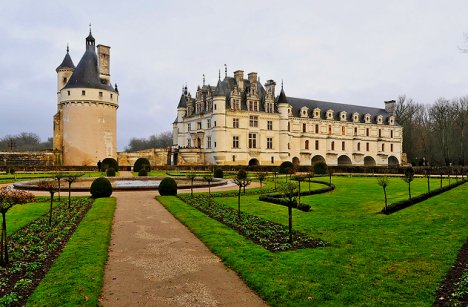
The castle that stretches across the River Cher on a graceful arcade of white stone is a masterpiece of French Renaissance architecture. Chenonceau was shaped not by kings but by the women who owned it: Catherine Briçonnet, Diane de Poitiers, and Catherine de Medici. Each left her mark on the galleries, gardens, and apartments. The long gallery that spans the river served as a ballroom, a hospital during wartime, and a secret passage between the two riverbanks. Light floods through the tall windows, reflecting off the polished stone floors and the slow green water below. Chenonceau feels more like a palace of peace than a fortress.
\n\n
Château de Chenonceau is one of the most elegant castles in France. It is situated in the Loire valley, approximately 240 km southwest of Paris. It is popular among visitors for its magnificent architecture and beautiful surroundings.
\n
\nPhoto licensed under the Creative Commons, created by Gilles Messian
\n
Château de Chenonceau, in comparison to the other castles of the Loire, has a very calm and majestic appearance. It may be surprising that the castle is the work of women (was built and reconstructed according to the wishes of several noble women), therefore the castle is also known as the “Château des Dames” (Castle of women). For example, Catherine de Medici added amazing yew maze and a rose garden. Madame Dupin changed the castle to a center of fashion in the 18th century.
\n
In This Article
The Women Who Built Chenonceau: A History in Architecture
\n
The story of Chenonceau begins in 1513 with Catherine Briçonnet, who worked alongside her husband Thomas Bohier to build the original château on the foundations of a medieval mill. It was Catherine who insisted on the graceful proportions and the innovative arrangement of rooms that make the château so distinctive. After the Bohiers’ debts forced the crown to seize the property, King Henry II gave Chenonceau to his mistress, Diane de Poitiers. Diane added the bridge across the Cher River and created the formal gardens on the right bank, complete with a fountain and parterres. When Henry II died in 1559, his widow Catherine de Medici forced Diane to accept the lesser Château de Chaumont in exchange for Chenonceau. Catherine then built the magnificent two-storey gallery on top of Diane’s bridge, creating the famous long gallery that spans the river. The gallery measures 60 metres by 6 metres, with a polished chequerboard floor of limestone and slate. Catherine added the left-bank gardens, the yew maze, and expanded the estate to its current extent. Later, Louise de Lorraine, wife of Henry III, spent her widowhood in mourning at Chenonceau, dressing in white and filling the rooms with religious objects.
\n
The Gardens and the Rivalry Behind Them
\n
Two women who shaped Chenonceau also shaped its gardens, and their competing visions survive today side by side. Diane de Poitiers, mistress of King Henry II, created her garden in 1551 on the right bank. It covers one hectare with five triangular beds arranged around a central fountain, designed in the French Renaissance style with box hedges, lavender borders, and rose trellises. In spring, 30,000 tulips bloom in ordered rows. After the king’s death, Catherine de Medici forced Diane to leave Chenonceau and built her own garden on the left bank. Catherine’s garden covers 1.5 hectares with a more formal design featuring a central pond, yew topiary, and a grove of lime trees. The two gardens separated by the river are visible from the upper windows of the château, a living representation of the rivalry that defined the estate.
\n
Marques Tower and Practical Visiting Information
\n
The Marques Tower, or Tour des Marques, stands at the entrance to Chenonceau as a medieval survivor from the original fortified mill that occupied the site before the Renaissance château was built. The round tower dates from the 12th century and contains a small exhibition on the history of the estate. Château de Chenonceau is standing on the site of the former water mill. It has been built between the years of 1513 and 1521. The current form of the castle dates back to the 16th century. In the years of 1556 – 1559 its typical bridge arches were added to the castle and connected the banks of the river. In the castle you can admire the beautiful tapestries, magnificent paintings and original tile floors. No wonder that after Versailles it is the second most visited castle in France. The castle is open to the public, and features the magnificent interiors and beautiful gardens. There are even restaurants and galleries. It is also home to various regular exhibitions and concerts. Visitors should allow 2 to 3 hours for the full experience. The château is open daily year-round except Christmas Day and New Year’s Day. The best time to visit is early morning before 10 AM or late afternoon after 4 PM. Chenonceau is 35 kilometres east of Tours. The nearest train station is Chenonceaux, served by local trains from Tours with a journey time of 30 minutes. Entry costs 14.50 euros for adults. Before visiting you can download an audio guide from the official website of Château de Chenonceau.
\n
View Château de Chenonceau – the second most visited castle in France in a larger map
\n
\n
Which French château would you love to spend a night in? 🏰
\n
Explore all our France travel guides, from Parisian boulevards to Provence lavender.
Explore More
If you enjoyed this article, you might also like:
