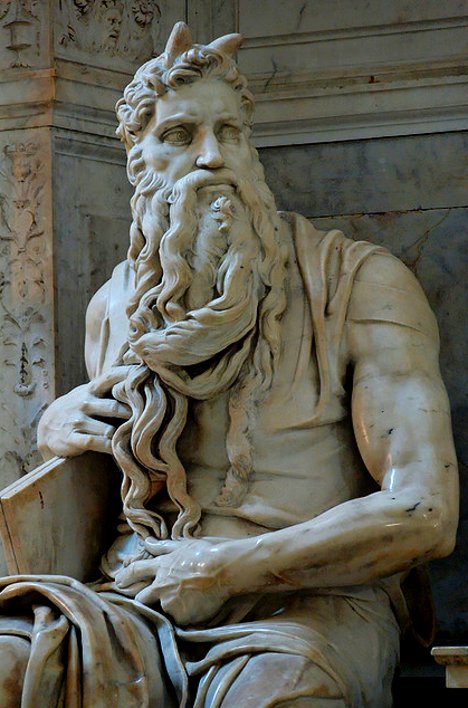
Few churches in Rome hide their masterpiece quite so unassumingly. San Pietro in Vincoli sits on the Esquiline Hill, its simple brick facade giving no hint of the artistic treasure waiting inside. Visitors come for one thing: Michelangelo’s Moses, carved from a single block of Carrara marble. The prophet sits with horns on his head, a translation error from the Latin Vulgate that has become iconic.
\n\n
San Pietro in Vincoli (Saint Peter in Chains) is a three-aisled basilica located in Rome, Italy. It is supported by twenty ancient columns and was founded in 442. Over the centuries has undergone many reconstructions and modifications. The building itself would not be so interesting, but it houses magnificent statue of Moses made by famous Michelangelo.
\n
\nPhoto licensed under the Creative Commons, created by Sebastian Bergmann
\n
The church was built on the site, where according to legend, was St. Peter sentenced to death, 400 years before. At that time, the Emperor Nero, persecuted all Christians. The people started to build a church originally only as a place where they could store “Vincoli” – the chains that St. Peter was bound with in Jerusalem.
\n
In This Article
Michelangelo’s Moses: Horns, Muscles, and hidden Meaning
\n
Michelangelo completed the Moses for the tomb of Pope Julius II between 1513 and 1515, though the full tomb project was never finished. The prophet sits on a Carrara marble throne, his right arm clutching the Tablets of the Law while his left hand grips his flowing beard with knotted tension. The horns atop Moses’ head arose from Saint Jerome’s 4th-century Latin translation of the Hebrew word karan, meaning “radiant” or “shining” after Moses descended from Mount Sinai. Jerome rendered it as cornuta, meaning “horned,” and this interpretation became fixed in Christian iconography for over a thousand years. Michelangelo sculpted the horns as small rounded nubs emerging from the hairline, visible only from the side. The muscular anatomy of the figure is extraordinary: the biceps bulge with visible veins, the knees press through the marble drapery, and the seated pose suggests a figure on the verge of rising. Art historians debate weather the tense, half-turned posture shows Moses reacting to the Israelites worshipping the Golden Calf, the moment when the Tablets are about to be dashed. The statue stands 235 cm tall, and Michelangelo carved the entire figure from a single block of marble, leaving the base roughly finished to suggest unfinished divine purpose. Michelangelo was supposed to create a total of 42 sculptures for the tomb of Pope Julius II, but finally only this one statue was completed in its entirety. The pope gave Michelangelo also another work in the Sistine Chapel, so he didn’t have much time to complete his tomb. After his death, no one had an interest in wasting money for the celebration, so Michelangelo decided to create at least the first sculpture as a powerful and soulful figure of Moses.
\n
The Chains of Saint Peter and the basilica’s History
\n
The basilica’s namesake relics, the chains of Saint Peter, are displayed in a bronze and glass reliquary beneath the main altar. According to tradition, the chains that bound Peter during his imprisonment in Jerusalem were brought to Constantinople by Empress Eudocia in the 5th century and later sent to Rome. When the Jerusalem chains were placed beside the Roman chains used during Peter’s imprisonment in the Mamertine Prison, the two sets miraculously fused together. The current reliquary, designed by Giovanni Battista Montano in the 17th century, preserves the connected links under an arched glass case. A scientific analysis in the 20th century dated the metal to the 1st century AD. The basilica itself dates from 442 AD, built by Empress Eudoxia to house the chains. The 20 ancient columns dividing the nave were salvaged from earlier Roman structures, and the coffered ceiling bears the Borromean coat of arms. The church also contains important paintings by artists including Domenichino and Guercino, and the tomb of Cardinal Niccolò Forteguerri designed by Andrea Bregno.
\n
Visiting San Pietro in Vincoli: Location and Tips
\n
basilica San Pietro in Vincoli is located in the centre of Rome, just few steps from Colosseum. Walk up the hill towards the park and you are there. However this church is not in every city guide, you certainly should not miss this great piece of art. If you will be stressed from all those crowds, this is the best place you can relax. The church sits on the Esquiline Hill, a 10-minute walk from the Colosseum, and entry is free. The quiet atmosphere offers a welcome respite from Rome’s crowds, with the best light for viewing Moses falling between 10am and 12pm when the morning sun illuminates the statue directly. The church is open daily from 8am to 12:30pm and from 3pm to 7pm. Photography without flash is permitted. While the Moses statue is the main attraction, take time to also appreciate the 7th-century mosaic fragments in the crypt and the carved wooden choir stalls. The church is accessible by metro from the Colosseo station on line B, or by bus routes 75, 84, and 87.
\n
View San Pietro in Vincoli – home of Michelangelo’s statue of Moses Rome, Italy in a larger map
\n
View San Pietro in Vincoli – home of Michelangelo’s statue of Moses Rome, Italy in a larger map
\n
\n
Have you ever stood before a piece of art that made time stand still? 🗿
\n
Explore all our Italy travel guides, from the Dolomites to Sicily.
Explore More
If you enjoyed this article, you might also like:

First visited San Pietro in Vincoli back in 2013 and returned twice since. Each time it feels different — different season, different discoveries, different perspectives. This article makes me want to book another trip right now.