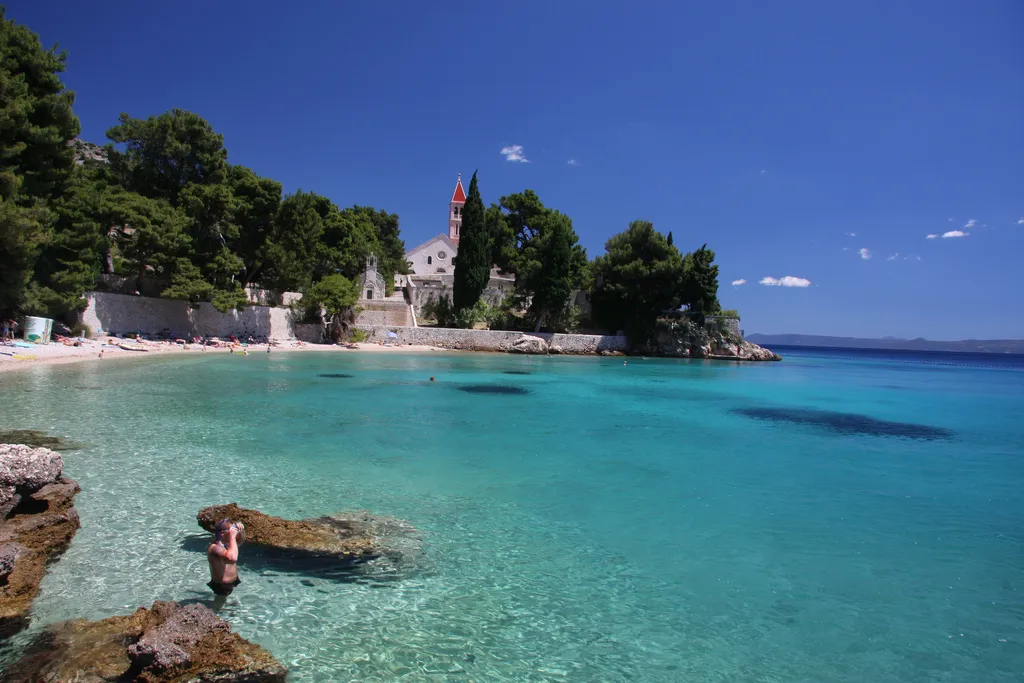
The Adriatic Sea shimmers in shades of turquoise and sapphire along the Dalmatian coast, where the island of Brac rises from the water like a green jewel set in blue silk. White pebble beaches slope gently into crystalline water, the most famous being Zlatni Rat, a tongue of land that shifts shape with the currents and winds. Inland, olive groves and vineyards cover the terraced hillsides, and the scent of pine and sage drifts through the air. The town of Bol, with its stone houses and harbourfront restaurants, provides a perfect base for exploring the island by foot, bike, or boat.
In This Article
Zlatni Rat: The Golden Horn That Moves
Zlatni Rat, also called the Golden Horn, is the most photographed beach on the Croatian Adriatic. This 580-metre-long pebble spit extends into the sea and shifts its shape with the wind and currents, so no two visits are exactly the same. The beach faces open water and catches the Maestral, a summer wind that makes it the finest windsurfing destination on the entire Adriatic Sea. Surfers from Germany, Austria, and Italy arrive each summer to ride the consistent waves. Families claim patches of pebbles shaded by the Aleppo pine forest that runs right to the beach edge. The water sports on offer include scuba diving, parachute rides, jet-skiing, and beach volleyball, all available from rental kiosks along the shoreline. If sitting and relaxing is your preference, the pine forest offers a cool retreat from the midday sun, the air thick with the scent of resin and salt. The beach can barely accommodate the influx of thousands of tourists who arrive each summer, so arrive early, ideally before 9 am, to find a good spot near the water. The beach bar sells grilled fish and local wine at reasonable prices, and the sun loungers cost about EUR 15 per day.
Island Life: Villages, Vineyards, and Mount St. Vid
Island Brac is the largest island in Dalmatia with an average population of around 13,000 people living mostly in scattered stone settlements across the interior. At 778 metres, Mount St. Vid is the highest island point in the entire Adriatic Sea. The climb from Bol takes roughly two hours on a marked trail that winds through pine forest and opens onto a summit with a 360-degree view. From the top, Zlatni Rat appears as a white tongue lapping at the turquoise sea, the ferry routes trace lines across the channel toward Split, and the neighbouring islands of Hvar and Korcula sit on the southern horizon. The island produces olive oil and wine on terraced hillsides that have been cultivated since Greek times. Brac stone, a type of limestone used in the construction of Diocletian Palace in Split and the White House in Washington DC, is still quarried on the northern side of the island. The town of Bol, with its 15th-century Dominican monastery and waterfront promenade lined with tamarisk trees that filter the afternoon sun, is the tourism hub. Supetar, on the northern coast, is the ferry port and the largest settlement, where daily catamarans connect to Split in under one hour.
A History Written by Empires That Left It Alone
Brac was never conquered for its wealth. It was never rich or strategic enough to justify full invasion, and that obscurity preserved its character across two millennia. The Greeks visited in the 4th century BC and traded with the Illyrian tribes who already lived there, but they never colonised it. The Romans conquered Dalmatia in 9 AD and built a road network connecting Salona to the Adriatic islands, but Brac remained a rural backwater of little interest to the imperial administration. From 1268 to 1357, the Republic of Venice ruled the island, followed by the Kingdom of Hungary, and briefly the Bosnian King Tvrtko Kotromanic in 1390. Through every change of power, the island retained its local autonomy and its traditional social structures. The population declined sharply in the 20th century due to mass emigration, mostly to Latin America, with entire villages in Chile and Argentina founded by Brac families. New Zealand and Australia also received significant numbers. Today, returning descendants and a growing tourism economy have brought new life to the stone villages. The island is no longer a place people leave. It is a place they come back to, generation after generation.
Would you spend your Dalmatian vacation on Brac or hop between the Croatian islands? 🏝️
Explore all our Croatia travel guides, from Dubrovnik walls to Dalmatian islands.
Explore More
If you enjoyed this article, you might also like:
