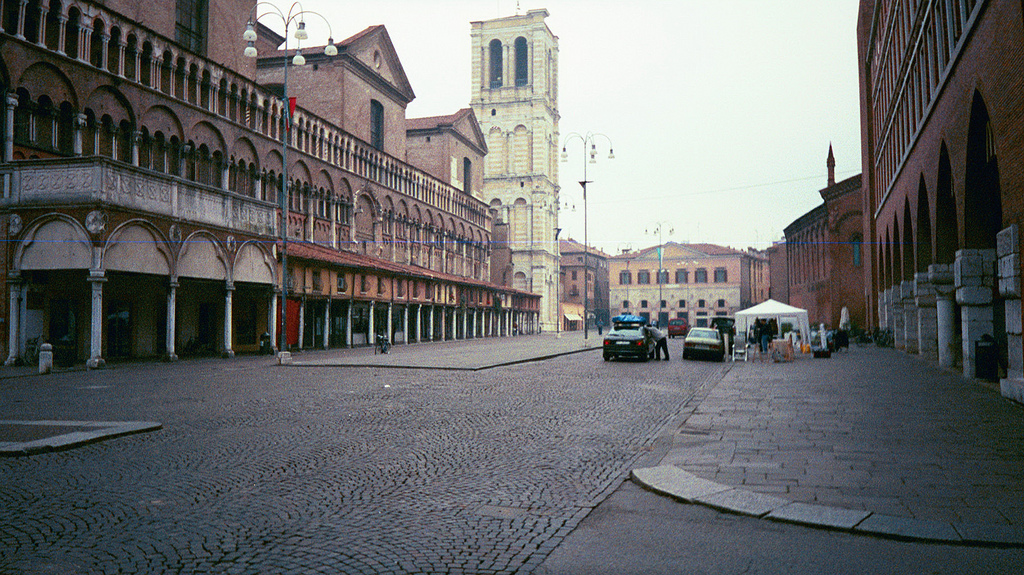
The whir of bicycle wheels on cobblestones is the soundtrack of Ferrara. In this Renaissance city, bicycles outnumber cars, and locals glide through medieval streets and across wide piazzas with practiced ease. The massive Estense Castle sits at the city center, its moated walls and turrets a reminder of the d’Este dynasty that shaped Ferrara into a cultural capital. The wide avenues of the Addizione Erculea, one of Europe’s first planned urban expansions, offer straight lines and open skies.
In This Article
The Estense Castle and City History
The Castello Estense, or Estense Castle, dominates the centre of Ferrara with its four imposing towers and water-filled moat. Construction began in 1385 as a defensive fortress for the Este family, who ruled Ferrara from the 13th to the 16th centuries and transformed the city into a major Renaissance cultural centre. The castle is surrounded by a moat fed by the Po River and accessed by drawbridges that once provided security against popular uprisings. Today, the castle is open to the public, with tours visiting the noble apartments, the frescoed Salone dei Giochi, and the basement prison where inmates were held in damp cells beneath the water level, an experience that reveals the harsh justice of the Renaissance era. The castle still serves as the political seat of the city, with parts of the building reserved for municipal offices and therefore closed to visitors. The Este family’s patronage attracted artists, scholars, and writers to Ferrara, making it one of the most important cultural centres of the Italian Renaissance, a status recognised by UNESCO when the city was inscribed as a World heritage site. The poet Ludovico Ariosto, author of the epic poem “Orlando Furioso”, spent much of his career in Ferrara, and his statue stands in the Piazza Ariostea, a large square built in the 16th century as part of the city’s urban expansion and now used for the annual Palio horse race.
Renaissance Urban Planning and Architecture
In 1492, Duke Ercole I d’Este commissioned one of the first planned urban expansions in Europe, known as the Addizione Erculea. This extension to the north doubled the size of the city and introduced wide, straight streets laid out on a grid pattern, a revolutionary concept at a time when most European cities consisted of narrow, winding medieval lanes. The centrepiece of the expansion is the Palazzo dei Diamanti, or Palace of Diamonds, named for its distinctive facade covered with over 8,500 diamond-shaped stone blocks that catch the light at different angles throughout the day. The palace houses the National Art Gallery of Ferrara, with works by Cosmè Tura, Ercole de’ Roberti, and other masters of the Ferrara School, as well as the Museum of Modern and contemporary Art. The Corso Ercole I d’Este, the main avenue of the Addizione Erculea, is lined with elegant palaces and leads directly to the Porta degli Angeli, one of the surviving gates in the city walls. The walls themselves, extending for 9 kilometres around the historic centre, are among the best-preserved Renaissance fortifications in Italy and are open to walkers and cyclists, offering a unique perspective on the city’s layout from above.
Cycling Culture and Local Life
Ferrara is widely regarded as the most bicycle-friendly city in Italy, with dedicated cycle lanes throughout the historic centre and flat terrain that makes cycling effortless. The city’s compact size means that any point within the old town can be reached by bicycle in under 15 minutes. Bike rental shops are plentiful, with prices starting at around 10 euros per day for a standard city bicycle. The daily rhythm of Ferrara revolves around the bicycle: school children ride to class, professionals pedal to meetings in suit jackets, and elderly couples cycle to the market with baskets full of vegetables. The covered market in the Piazza delle Erbe, near the cathedral, is the heart of local commerce, selling fresh produce, cheese, cured meats, and the famous Ferrara bread known as coppia ferrarese, a twisted bread roll with a UNESCO Intangible Cultural heritage designation. The city’s culinary traditions include cappellacci di zucca, pumpkin-filled pasta served with butter and sage, and salama da sugo, a spiced pork sausage typically served with mashed potatoes. The nearby Cathedral of San Giorgio, with its Romanesque-Gothic facade and the Museo della Cattedrale displaying the 1408 sculpture of the Madonna by Jacopo della Quercia, completes the historic centre’s major landmarks and offers visitors a window into Ferrara’s rich artistic heritage.
Would you explore Ferrara by bicycle? 🚲
Explore all our Italy travel guides, from the Dolomites to Sicily.
Explore More
If you enjoyed this article, you might also like:
