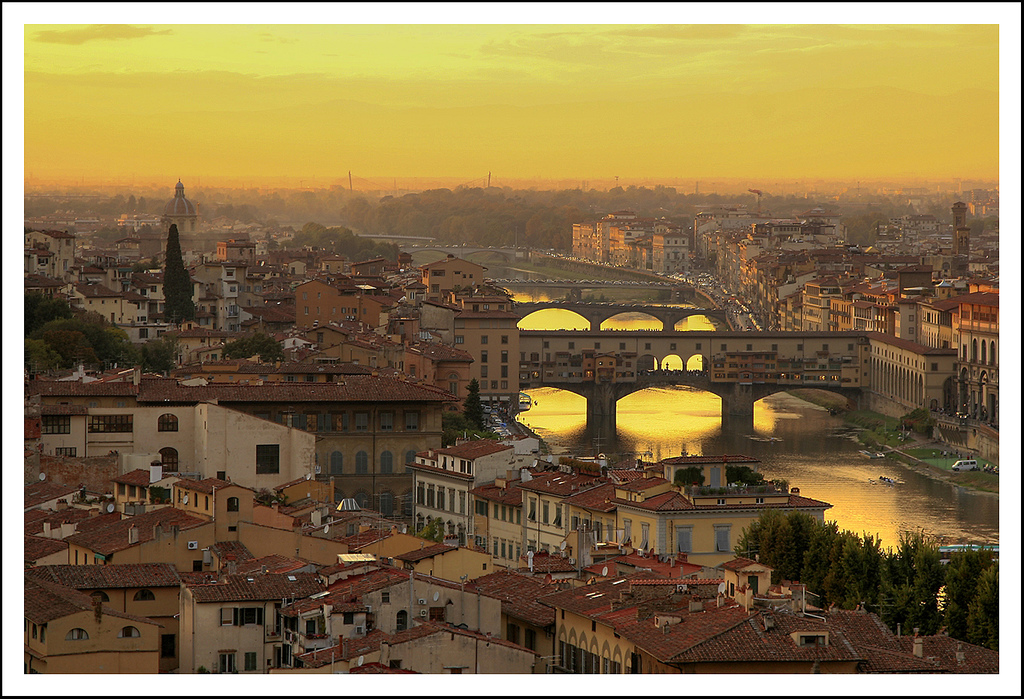
The dome of Santa Maria del Fiore dominates the Florence skyline, its terracotta tiles glowing warm in the Tuscan sun. Florence is the birthplace of the Renaissance, a city where every street corner reveals another masterpiece. Michelangelo’s David stands in the Accademia, Botticelli’s Birth of Venus glows in the Uffizi, and the Ponte Vecchio spans the Arno with shops that have traded jewellery for centuries. The cathedral complex, with Giotto’s Campanile and the Baptistery’s Gates of Paradise, forms one of the most extraordinary collections of art and architecture anywhere on earth.
In This Article
The Duomo and the historic Centre
The Cathedral of Santa Maria del Fiore, with its iconic red-brick dome engineered by Filippo Brunelleschi, remains the heart of Florence both geographically and historically. Completed in 1436, the dome was the largest of its kind in the world at the time and remains the largest brick dome ever constructed. Visitors who climb the 463 steps to the summit are rewarded with panoramic views across the city’s terracotta rooftops to the hills of Fiesole beyond. Directly adjacent stands Giotto’s Campanile, a soaring Gothic bell tower clad in white, green, and pink marble, and the Baptistery of San Giovanni, whose magnificent bronze doors were dubbed the Gates of Paradise by Michelangelo himself. The Piazza del Duomo also houses the Museo dell’Opera del Duomo, where original artworks from the cathedral complex are preserved, including Ghiberti’s original Baptistery panels and Donatello’s hauntingly beautiful Penitent Magdalene. Together, these monuments form one of the most significant religious and artistic complexes anywhere in Europe. The area around the Piazza del Duomo is also home to numerous cafes and restaurants where visitors can rest and admire the architecture while enjoying authentic Tuscan cuisine. The sheer density of beauty in this small area can be overwhelming, and many visitors find themselves returning day after day to simply sit and absorb the atmosphere.
World-Class Museums and Galleries
Florence’s reputation as an artistic treasure house is built on its extraordinary museums. The Uffizi Gallery, housed in a former Medici administrative building, contains one of the finest collections of Renaissance art in existence. Works by Botticelli, Leonardo da Vinci, Raphael, and Caravaggio line its corridors, and the sheer density of masterpieces can be overwhelming. Advance booking is essential during peak season, as queues can stretch for hours. The Accademia Gallery, purpose-built in the 18th century, was expanded specifically to house Michelangelo’s David, which has resided here since 1873. Beyond David, the gallery contains Michelangelo’s unfinished Slaves, which reveal his working process, and a collection of musical instruments from the Medici era. The Palazzo Pitti, once the residence of the Grand Dukes of Tuscany, now houses several museums including the Palatine Gallery with its collection of Raphael and Titian works, and the Gallery of Modern Art. The Boboli Gardens, stretching behind the palace, offer a green retreat with fountains, sculptures, and carefully manicured hedges that have inspired garden designers across Europe for centuries. Art lovers should also visit the Bargello, which houses one of the finest collections of Renaissance sculpture in the world, including works by Donatello, Michelangelo, and Cellini.
Essential Florentine Experiences
The Uffizi Gallery requires advance booking weeks in advance during peak season, with tickets at 20 euros. The Accademia Gallery, home to Michelangelo’s David, has similar demand. A Firenze Card at 85 euros grants priority access to over 70 museums. The Brancacci Chapel features Masaccio frescoes, considered the first masterpieces of the Renaissance, entry 8 euros. The Boboli Gardens behind Palazzo Pitti offer a green escape with fountains and sculptures for 10 euros. Beyond the major attractions, Florence rewards those who wander its lesser-known corners. The church of Santa Croce, with its frescoes by Giotto and the tombs of Michelangelo, Galileo, and Machiavelli, offers a quieter alternative to the crowded galleries. The Oltrarno district, across the river, is home to artisan workshops, traditional trattorias, and the magnificent Brancacci Chapel, where Masaccio’s frescoes revolutionised Western painting with their use of perspective and naturalistic human forms. For a different perspective on the city, take the short bus ride up to Piazzale Michelangelo at sunset, when the entire historic centre glows golden in the fading light. The view from this hilltop square is arguably the most photographed panorama in all of Italy, and for good reason. Florence is a city that demands multiple visits, each one revealing new layers of its extraordinary cultural heritage.
Which Renaissance masterpiece would you queue to see first in Florence? 🎨
Explore all our Italy travel guides, from the Dolomites to Sicily.
Explore More
If you enjoyed this article, you might also like:
