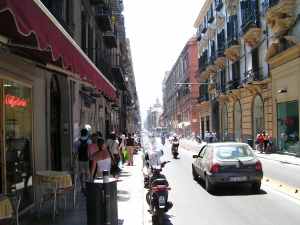
The market of Ballaro hits every sense at once. Vendors shout prices in Sicilian dialect, the smell of grilled sardines and frying arancini fills the air, and the colors of piled citrus and wild herbs blur into a dizzying mosaic. Palermo does nothing by halves. Decaying Norman palaces stand next to bustling street food stalls. Baroque churches reveal Arabic arches hidden within. The city is a chaotic collision of every culture that ever ruled Sicily: Phoenician, Greek, Roman, Arab, Norman, Spanish.
In This Article
The historic Heart of Palermo
The imaginary centre of Palermo is Piazza Vigliena, better known as Quattro Canti, where the city’s two main arteries, Via Maqueda and Via Vittorio Emanuele, intersect. Designed in the 17th century by the Florentine architect Giulio Lasso, the octagonal square is surrounded by four nearly identical Baroque buildings, each with three tiers of statues representing the four seasons, the four Spanish kings of Sicily, and the city’s patron saints. From here, the majestic Cathedral of Palermo is just a short stroll away. Built in the 12th century on the site of a former Byzantine basilica and earlier mosque, the cathedral reflects the layered history of the city. The exterior is a striking blend of Norman, Gothic, and Baroque elements, while the interior houses the tombs of Norman kings and emperors. The cathedral’s roof terrace offers superb views over the city and nearby Monte Pellegrino. Nearby, the Palazzo dei Normanni and the Palatine Chapel showcase the finest surviving example of Arab-Norman-Byzantine architecture in Sicily, with glittering gold mosaics that rival those of Ravenna and Istanbul. The palace is still used for political functions, as it houses the Sicilian Regional Assembly, adding a layer of living history to its ancient walls. The Cappella Palatina, with its dazzling fusion of Islamic muqarnas ceilings and Christian mosaics, is widely regarded as one of the most beautiful chapels in the world.
Street Food Culture in Palermo
Palermo’s street food scene is legendary across Italy and beyond, representing a culinary tradition that spans centuries and cultures. The historic markets of Ballaro, Vucciria, and Capo are the best places to experience this vibrant food culture. Here, vendors hawk arancini, golden fried rice balls stuffed with ragù, mozzarella, or pistachio; panelle, crispy chickpea fritters served in soft bread rolls; and sfincione, a thick Sicilian pizza topped with tomato, onions, anchovies, and caciocavallo cheese. The most famous Palermitan street food is perhaps the pani ca meusa, a sesame bun filled with sliced veal spleen and lung, a dish that dates back to the Arab occupation. For the less adventurous, grilled sardines, stuffed squid, and fresh seafood are available at every turn. The Vucciria market in particular comes alive in the evening as the food stalls give way to bars and the streets fill with locals drinking wine and eating at communal tables. Palermo’s food culture is not just about sustenance, it is a living expression of the city’s identity and history. Food tours have become increasingly popular in recent years, offering visitors a guided introduction to the city’s culinary traditions and the opportunity to taste a wide variety of dishes in a single afternoon. The markets themselves are a feast for the senses, with their vibrant colours, intense aromas, and the constant banter of vendors and customers creating an atmosphere unmatched anywhere else in Europe.
Catacombs, Cathedrals and Cultural Layers
One of Palermo’s most unusual attractions is the Capuchin Catacombs, an underground burial complex housing approximately 8,000 mummified bodies dating from the 16th to early 20th centuries. The mummies, arranged by social status and gender along subterranean corridors, provide a macabre but fascinating glimpse into Palermo’s social history. The preservation is extraordinary, with many bodies still wearing their original clothing. For a less morbid experience, the hill of Monte Pellegrino offers spectacular panoramic views of the city, the Conca d’Oro plain, and the Tyrrhenian Sea. The sanctuary of Santa Rosalia, Palermo’s patron saint, is carved into the mountainside and is a peaceful retreat from the city’s chaotic streets. The city also boasts numerous churches and palaces that reveal different layers of its history. The church of San Giovanni degli Eremiti, with its distinctive five red domes, is a pure example of Arab-Norman architecture. The Martorana church is famous for its 12th-century Byzantine mosaics. And the Teatro Massimo, the largest opera house in Italy, is a stunning monument to 19th-century ambition and elegance. Guided tours of the Teatro Massimo reveal its lavish interiors and fascinating history, including its role in the filming of The Godfather Part III. For those with more time, the Zisa Palace, built by Norman kings in the 12th century with clear Arab influences, offers yet another window into the extraordinary cultural layering that makes Palermo unique.
Would you brave Palermo’s chaotic street food scene? 🍝
Explore all our Italy travel guides, from the Dolomites to Sicily.
Explore More
If you enjoyed this article, you might also like:
