Lucca hides behind Renaissance walls so thick that a park now runs along their crest. Inside those walls, the city unfolds as a perfectly preserved medieval grid where Giacomo Puccini composed his operas. The streets are wide by Tuscan standards, paved in smooth stone and lined with towers that once belonged to rival noble families. You can cycle the ramparts under plane trees, peering down into gardens that have grown for centuries. The cathedral holds a Volto Santo, a wooden crucifix said to have been carved by Nicodemus himself. Lucca is music and stone and silence.<\/strong><\/p>
Captivating ancient Italian city of Lucca<\/strong> lies in Tuscany. It is surrounded by massive walls and attracts visitors with its great historical city center, which includes attractive square, small churches, museums, galleries and cobbled streets. The city abounds with tranquility and elegance and became a popular tourist site.<\/p>
<\/a>
Lucca, Tuscany, Italy by Myrabella<\/a><\/p>
The Renaissance Walls and Tree-Lined Ramparts<\/h2>
Lucca’s Renaissance walls are among the best-preserved fortifications in Europe, a complete circuit of brick ramparts stretching approximately 4.2 kilometres around the historic city centre. What makes them truly unique is their transformation from military defence to public park. In the 19th century, the walls were converted into a tree-lined promenade, and today they form a green belt that encircles the old city. The walls are wide enough to accommodate a pedestrian walkway and a bicycle path along their entire length, shaded by centuries-old plane trees. Walking or cycling the ramparts is perhaps the quintessential Lucca experience, offering elevated views into the city’s gardens and across the rooftops of the historic centre. The walls are punctuated by 11 bastions and 6 monumental gates, each with its own history and architectural character. Porta San Donato, the main western gate, leads directly to Piazza San Michele, while Porta Santa Maria provides access from the north. The walls never saw significant military action, which is why they survive in such remarkable condition, a testament to the diplomatic skill of Lucca’s rulers who maintained the city’s independence through negotiation rather than warfare.<\/p>
Piazza dell’Anfiteatro and the Medieval Core<\/h2>
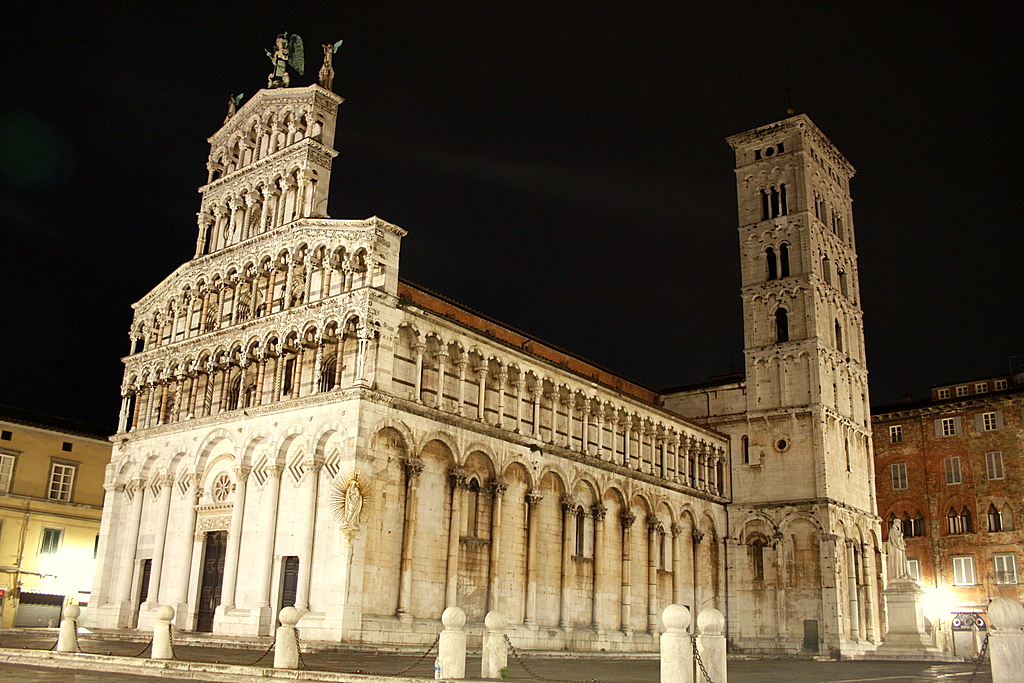
At the heart of Lucca’s medieval core lies the extraordinary Piazza dell’Anfiteatro, an elliptical public square built on the foundations of a Roman amphitheatre. The square’s oval shape follows exactly the outline of the ancient arena, and medieval buildings rise directly from the amphitheatre’s walls, creating a unique urban space that blends Roman antiquity with medieval life. Four gates open into the piazza, corresponding to the original entrances to the arena, and the square is now filled with cafes, restaurants, and shops. Close by, the Piazza San Michele marks the site of the old Roman forum, dominated by the magnificent Church of San Michele in Foro. This church features a striking facade of striped marble, with miniature loggias, blind arcades, and twisted columns that create a sense of vertical energy. The church of San Michele dates from the 11th century but was modified over subsequent centuries, reflecting the evolving architectural tastes of Lucca’s ruling families. The Duomo di San Martino, Lucca’s cathedral, stands in Piazza San Martino and houses the Volto Santo, a wooden crucifix said to have been carved by Nicodemus, who assisted in Christ’s burial. The cathedral’s facade is a masterpiece of Romanesque architecture, with intricate carvings and a distinctive asymmetrical campanile.<\/p>
Giacomo Puccini and Lucca’s Musical heritage<\/h2>
Lucca’s most famous cultural son is Giacomo Puccini, the composer of La Bohème, Tosca, and Madama Butterfly, among other beloved operas. Puccini was born in Lucca in 1858, and his family home, located near the Church of San Michele in Foro, has been converted into a museum dedicated to his life and work. The museum contains original manuscripts, personal belongings, and the piano on which he composed some of his most famous works. Lucca’s musical heritage extends far beyond Puccini, however. The city has a long tradition of musical excellence, and the Lucca Summer Festival attracts world-class performers to its concerts held in Piazza Napoleone and other historic venues throughout the summer months. The Luigi Boccherini Music Institute, named after another famous Luccan composer, continues the city’s tradition of musical education. The annual Puccini Festival, held at the Teatro del Giglio and other venues, celebrates the composer’s legacy with performances of his operas. For music lovers, Lucca offers the rare opportunity to walk the same streets where Puccini walked, to visit the churches where he worshipped, and to experience the Tuscan city that shaped one of the greatest composers in the history of opera.<\/p>
Have you ever cycled along a city wall for a view like this? 🚲<\/strong><\/p>
Explore more Italy travel guides<\/a>.<\/em><\/p>
Explore all our Italy travel guides, from the Dolomites to Sicily.
Explore More
If you enjoyed this article, you might also like:
