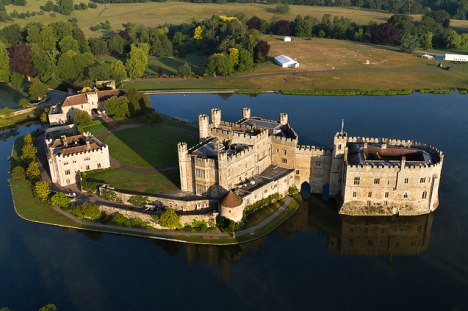
Swans glide across the moat in perfect formation, their reflections rippling against the honey-coloured stone of the gatehouse. Leeds Castle rises from its island like a watercolour brought to life, its twin towers framing a causeway that has welcomed visitors for nearly a thousand years. Inside, the rooms tell stories of queens and kings, of Henry VIII and Catherine of Aragon, of banquets and bargains struck in candlelit chambers. Outside, the surrounding parkland stretches into the Kentish Weald, where a maze of yew leads toward a grotto of shells and mirrors. This is not a fortress. It is a palace dreaming on the water.
England has lots of ancient castles which form the character of the landscape. There are about a thousand in the country. The reason why so many lie in England is the fact that the island empire has not been occupied by foreign troops since 1066, so they were not conquered, nor destroyed.
Photo licensed under the Creative Commons, created by Marc Evans
Among the most beautiful castles – not only in Britain but also in Europe – we can find the Leeds Castle in Kent, UK. It was built back in 1119 as a Norman fortress on the spot where the manor house stood already two hundred years before.
During its long existence, Leeds Castle served as the residence (also as the refuge) for the kings, deluxe residences for six medieval English Queens, exhibition of Henry VIII and much more. The interesting fact is that the castle was inhabited up to the 1980s of the last century.
In This Article
A Royal Residence Through the Centuries
Leeds Castle’s history as a royal residence began in 1278 when King Edward I acquired it from the de Crevecoeur family. He transformed the Norman fortress into a comfortable palace for his queen, Eleanor of Castile, and the castle subsequently became a favoured property of English queens consort. Six medieval queens called Leeds Castle home, including Catherine of Valois, wife of Henry V, and Catherine de Aragon, the first wife of Henry VIII. The castle’s royal apartments reflect the tastes of its various occupants, with Tudor fireplaces, Renaissance tapestries, and Georgian furnishings layered over the medieval structure. Henry VIII visited frequently with his court, and the castle’s banqueting hall still contains a fireplace carved with his coat of arms. The king is said to have particularly enjoyed hunting in the surrounding parkland. In the 20th century, the castle found its most dedicated custodian in Lady Olive Baillie, an Anglo-American heiress who purchased Leeds Castle in 1926 and spent the next four decades restoring and embellishing it. She added a private cinema, a cocktail bar, and central heating, blending modern comforts with historical authenticity. Lady Baillie’s bedroom, library, and sitting room are preserved exactly as she left them, offering a glimpse into the lifestyle of 1930s high society. The castle remained in her family until 1974, when the Leeds Castle Foundation took over management and opened it to the public.
Castle Gardens, Maze, and Aviary
Beyond the castle’s stone walls, the grounds offer attractions spread across 500 acres of parkland. The most famous is the yew maze, planted in 1988 with 2,400 yew trees covering nearly half a hectare. At its centre, a raised viewing platform overlooks the surrounding hedges. More surprising is the grotto beneath, decorated with seashells, fossilised coral, and mirrored glass. The castle’s aviary houses over 100 species of rare birds, including parrots, toucans, and waterfowl. Lady Baillie, a passionate ornithologist, began the collection, now one of the finest in Britain. The parkland includes a Culpeper garden with herbaceous borders and a vegetable plot, plus walking trails through ancient woodlands and along the River Len. The views of the castle reflected in the still moat, especially in autumn when the trees turn gold and crimson, are among the most photographed scenes in Kent.
Visitor Experience and Practical Information
Visitors to Leeds Castle can expect a full day of exploration. Standard admission includes access to the castle interior, the grounds, the maze and grotto, the aviary, and the exhibition spaces in the Maiden’s Tower. The Maiden’s Tower, built in Tudor times as the castle’s bakery and brewhouse, now hosts rotating exhibitions on subjects ranging from castle history to contemporary art. Audio guides are available in multiple languages and provide detailed commentary on the castle’s rooms and their contents. The castle restaurant, named after Henry VIII, serves traditional British fare in a setting adorned with Tudor-style decor. For younger visitors, a playground, adventure golf, and seasonal events such as jousting tournaments and falconry displays ensure that the castle appeals to families as well as history enthusiasts. The castle is open year-round, with reduced hours in winter. Special events include open-air concerts on the lawn in summer, a Christmas market in December, and a spectacular fireworks display on New Year’s Eve. The nearest railway station is Bearsted, about five miles away, with connecting buses running during peak season. Parking is free and ample. A visit to Leeds Castle is a journey into England’s layered past, where each room and each path reveals another chapter of a story that spans nearly a millennium.
View Leeds Castle – one of the most beautiful and romantic castles in Europe United Kingdom in a larger map
What is the most beautiful castle you have ever visited? \u{1F3DB}\u{FE0F}
Explore all our United Kingdom travel guides, from London landmarks to the Scottish Highlands.
Explore More
If you enjoyed this article, you might also like:
- A Weekend in Cool Brighton – United Kingdom
- Glen Coe – a narrow valley with towering mountains on either side | Scotland, UK – United Kingdom
- Gower Peninsula – Amazing Natural Beauty You’ll Never Forget | Wales, UK – United Kingdom
