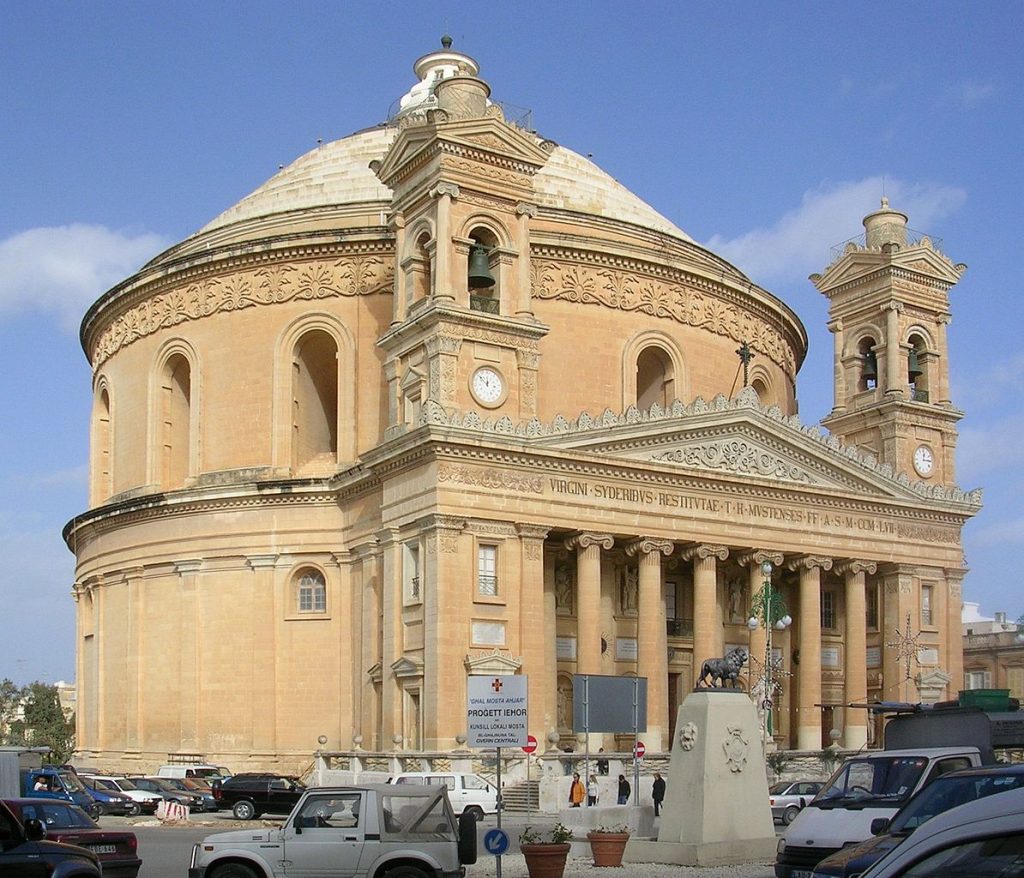
The Mosta Dome is one of the largest unsupported domes in the world. Only the Pantheon in Rome and St. Peter’s basilica surpass it in span. The church was built in the 19th century by local architect Giorgio Grognet de Vasse, inspired by the Pantheon. The dome rises an impressive thirty-seven metres above the floor. During World War Two, a German bomb pierced the dome during Mass but failed to explode, a miracle that the town still celebrates. The church interior is vast and flooded with natural light from the oculus above. Mosta itself is a lively market town in central Malta. The Dome is its proudest landmark, visible from kilometres away.
In the heart of the island of Malta you can find city of Mosta, which is one of the areas with the longest history. It is a small and very nice city with just 17,000 inhabitants and full of historical monuments. Since it is not overcrowded with tourists, you can enjoy a clean and unspoiled Maltese culture here.
Mosta Dome, Malta by Vask
Mosta is a peaceful city where you should spend at least few days of your holidays. Although it’s far away of the sea, this “lack” is replaced by the great number of monuments, the city look, nice atmosphere, many restaurants, shopping and entertainment centres. Mosta can be regarded as a quiet place, perfect for relaxing. On the streets you meet mainly Maltese, therefore the life here is not adapted to the hectic tourist style. Mosta is famous for a popular Beer Festival, which is regularly organized each summer. On the streets you can hear modern music and see the people dancing and the whole atmosphere is really unforgettable.
The Architecture and Construction of Mosta Dome
The Mosta Dome, formally known as the Parish Church of the Assumption of Our Lady, is a masterpiece of neoclassical architecture and an extraordinary feat of 19th-century engineering. The church was designed by Giorgio Grognet de Vasse, a Maltese architect of French descent who drew his inspiration directly from the Pantheon in Rome. Construction began in 1833 and took nearly forty years to complete, with the church finally being consecrated in 1871. The building process was fraught with challenges, the most significant being the circular ground plan, which many locals disliked because they felt the round shape resembled a pagan temple or a mosque rather than a Christian church. Remarkably, the new church was built as a shell around the older 17th-century church, which continued to operate normally during construction until 1860. The dome itself, with an inner diameter of 37 metres, was built without scaffolding due to chronic funding shortages, an engineering gamble that paid off magnificently. The dome rests on a circular drum pierced by sixteen windows that flood the interior with natural light. The exterior is simple and restrained, faced in local limestone that has weathered to a warm golden hue, while the interior is richly decorated with marble, gold leaf, and paintings by the renowned Maltese artist Giuseppe Cali, whose works adorn the main altar and side chapels.
The Wartime Miracle and Mosta’s Modern Character
The Mosta Dome’s most extraordinary story dates to 9 April 1942, during the darkest days of World War Two in Malta. As the island endured relentless aerial bombardment by German and Italian forces, a congregation of more than 300 people had gathered for evening Mass. A German bomb, weighing approximately 200 kilogrammes, pierced the dome, passed through the roof, and landed on the floor of the packed church. The bomb did not explode. No one was injured, and the only damage was a hole in the dome and a cracked floor tile. This event is widely regarded as a miracle by the Maltese people, and the unexploded bomb, now a replica, is displayed in the sacristy as a reminder of that day. An annual commemoration service is held every April to mark the miracle. Beyond its famous dome, Mosta is a lively market town that offers visitors an authentic taste of Maltese life away from the tourist crowds of Valletta and Sliema. The town’s main square, Misrah il-Belt, is lined with cafes and bars, while the weekly market fills the streets with stalls selling fresh produce, local cheeses, olive oil, and handmade crafts. The town also hosts an annual beer festival in summer that draws visitors from across the island, with live music, dancing, and local food creating an atmosphere of genuine Maltese hospitality. For those interested in Malta’s prehistoric heritage, the near by Skorba Temples and Ta’ Hagrat Temples, both UNESCO World heritage sites, are just a short drive away and offer a glimpse into the island’s ancient past.
The symbol of Mosta is monumental parish Church of the Assumption of Our Lady known as Mosta Dome or simply Rotunda. It is the work of George Grognet de Vasse – the Maltese architect of French origin, who was inspired by the Roman Pantheon. The building is clearly visible from almost all parts of the island. It is the fourth largest dome in Europe and the third largest unsupported dome in the World.
Construction of Mosta Dome on main square began in 1833 and was completed about forty years later. The building was associated with many problems – perhaps the biggest problem and the most hated by the people was its circular ground plan, because the church looked like a pagan or a mosque. Mosta Dome began to be built as a shell over the older church, which was during the construction normally in operation until 1860. Another problem was lack of funding, therefore cupola was established without scaffolding.
At the entrance to the Mosta Dome you will be amazed of richly decorated interior. Ceiling is very similar, and similarly impressive as in the Roman Pantheon. Very beautiful is especially the main altar and paintings by renowned Maltese painter Giuseppe Cali.
