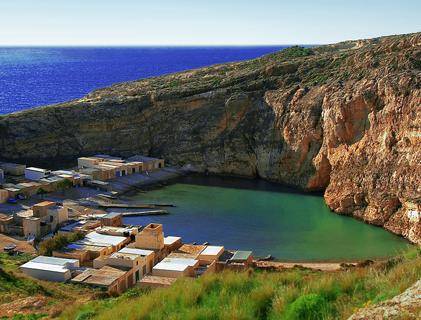
Turquoise water fills a natural rock pool so perfectly enclosed by limestone cliffs that it feels like a secret swimming pool carved by nature itself. The Dwejra Inland Sea on the western coast of Malta connects to the open Mediterranean through a narrow tunnel in the rock, where fishermen guide small boats through the darkness into the bright expanse beyond. Sunlight dances on the water in shifting patterns of blue and white, creating a scene of serene beauty.
The Inland Sea and Azure Window Legacy
Lake Dwejra, also known as the Inland Sea, is located on the western coast of the Maltese island of Gozo. It is separated from the sea by steep cliffs but connected by a narrow natural rock tunnel that cuts through the limestone headland. Dwejra is a popular natural swimming pool with salt water and an equally popular place for divers, who are drawn by the clarity of the water and the dramatic underwater scenery. This magnificent lagoon is one of the most beautiful places for scuba diving in the world, and once you get there you will certainly find out why, with visibility often exceeding 30 metres in calm conditions. In good weather you can ask local fishermen or use any boat service to take you through the tunnel, where you can see the caves, dramatic cliffs, and two other natural attractions: The Azure Window and Fungus Rock. Azure Window was the famous natural rock arch that towered majestically over the coast until its collapse in March 2017, a moment that was mourned around the world. The Maltese people called this hundred-metre-long stone slab, which lay on two pillars, Tiega Zerga, and it featured in films and television shows including Game of Thrones. The collapse of the Azure Window was a profound loss for Malta, as this natural limestone arch had stood for centuries and was one of the country’s most recognisable landmarks. The arch crumbled into the sea during a storm, leaving behind a pile of rubble visible beneath the waves that has since become a new habitat for marine life. Visitors still come to the site to see the dramatic coastline and to reflect on the fragility of Malta’s soft limestone heritage, which is constantly reshaped by the forces of wind and water.
Fungus Rock and Coastal Exploration
Another natural attraction is Fungus Rock, a cylindrical block of limestone that rises from the Mediterranean just a few hundred metres from the Inland Sea. Fungus Rock is currently uninhabited by humans, but in the 17th century it was an extremely important site because there grows a specific parasitic plant with the Latin name Cynomorium coccineum, which was believed by the Knights of St John to have remarkable medicinal effects. The plant comes from North Africa, and this is the only place in Europe where it grows naturally, making it a unique botanical curiosity. It was used by the Knights to help in the treatment of stomach problems and haemorrhoids, was used as an aphrodisiac and diminished bleeding, and had powerful disinfectant effects that made it valuable for treating battlefield wounds. The Knights of St John guarded this rare plant very carefully, and anyone who tried to steal it was often sentenced to death, so highly did they value its supposed properties. Between the rock and the mainland there were ropes, and the fungus was transported to the mainland by cable car to protect it from theft. The Qawra coast guard tower was built on the island just to protect this site, and it still stands today as a reminder of the island’s extraordinary history. Between the Inland Sea and Azure Window there is the small Chapel of St Anne, built in 1963 on the original site of the old church, offering a place of quiet contemplation. If you continue further south along the coast, you will find Crocodile Rock, another distinctive limestone formation shaped by erosion into the likeness of the reptile, adding to the geological wonders of this remarkable coastline. With its combination of natural pools, dramatic rock formations and fascinating history, the Dwejra area offers a uniquely Maltese experience that rewards those who take the time to explore beyond the main attractions.
View Dwerja Lake – Inland Sea in Malta in a larger map
Would you swim through a tunnel into the open sea? 🏊
Explore all our Malta travel guides, from Valletta bastions to Gozo cliffs.
Explore More
If you enjoyed this article, you might also like:
