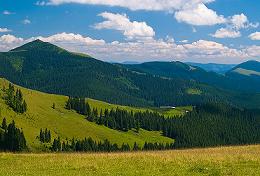
Primeval beech forests stretch across the border between Slovakia and Ukraine, their canopies forming a green cathedral that has stood for centuries. The Protected Landscape Area of the Eastern Carpathians preserves one of Europe’s last remaining virgin forests, where fallen trees are left to rot naturally and wolves still roam freely. Walking the trails, you pass through layers of vegetation: wild garlic carpets the forest floor in spring, mushrooms push through the leaf litter in autumn, and the calls of black storks and eagles echo above the treetops. This is Europe as it looked before human industry shaped the continent.
In This Article
Geography and Establishment of the Protected Area
The Protected Landscape Area of the Eastern Carpathians (Chránená krajinná oblasť Východné Karpaty) borders the north-western part of the original territory of Poloniny National Park. The area is built of flysch formations, mainly sandstones and claystone, which create the characteristic rounded ridges and deep valleys of the region. Established on July 9, 1977, the protected area originally covered 96,810 hectares. When Poloniny National Park was created in 1997, the remaining 25,307 hectares continued as the Protected Landscape Area, with the best-preserved sections designated as national nature reserves. The area stretches from southeast to northwest along the border with Poland, lying in the Low Beskydy range. Its rich forests serve as a major eco-stabilising component for the entire region and provide a suitable environment for flora and fauna bound to the forest ecosystem. The natural fir-beech forests preserved on the flysch slopes of the Laborecká highlands are among the most valuable in Central Europe.
Primeval Beech Forests and UNESCO heritage
The Eastern Carpathians protect over 30,000 hectares of forest, including the Havešová and Rožok primeval beech forests, which are UNESCO World heritage sites. These forests have never been logged, with beech trees exceeding 250 years in age. Europe’s largest complex of virgin beech forests stretches across this region, creating an ecosystem that has remained untouched for centuries. Fallen timber is left to decompose naturally, enriching the soil and supporting a complex web of fungi, insects, and decomposers that are absent from managed forests. Walking through these ancient woodlands, you notice a profound stillness broken only by the rustle of leaves and the distant call of a bird. The forest floor is a layered carpet of mosses, ferns, and wildflowers that change with the seasons, from the white carpets of wood anemones in spring to the rich golds and browns of autumn.
The area is home to 175 bird species including the golden eagle, Ural owl, black stork, and lesser spotted eagle. Large mammals such as the wolf, brown bear, and Eurasian otter find refuge here. The hiking trail to the Veľký Bukovec summit takes approximately three hours each way from the village of Runina. Guesthouse accommodation in Nová Sedlica starts at 25 euros per night, offering a base for multi-day exploration of this wilderness. Wildlife watching requires patience and early starts, but the chance to spot a brown bear or hear the howl of a wolf pack echoing through the valleys makes the effort worthwhile for dedicated nature enthusiasts.
Key Attractions and Local Culture
Several outstanding natural and cultural landmarks make the Eastern Carpathians a rewarding destination. Snina Stone (Sninský kameň), at 1,005 metres above sea level, provides spectacular panoramic views of the surrounding countryside. Below it lies Marine Eye (Morské oko), the largest volcanic lake in Slovakia and one of the country’s most beautiful natural lakes, formed in a volcanic crater and surrounded by dense beech forest. The Astronomical Observatory in Kolonica village houses the largest astronomical telescope in Slovakia and offers public viewing nights during clear weather, giving visitors a chance to observe the pristine night sky far from urban light pollution.
For cultural experiences, the Podvihorlatský Folklore Festival under Sninský kameň takes place at the turn of August and September, presenting traditional music, dance, and costumes from the region. The Snina Fair is held annually in September on the anniversary of the town’s first written mention. The area’s greatest cultural treasures are its wooden churches, scattered throughout the mountain villages and representing the distinctive architectural traditions of the Carpathian region. These UNESCO-listed churches, built without a single metal nail, feature intricate iconostasis screens and colourful frescoes that blend Byzantine and local folk traditions. Activities such as hiking, biking, fishing, horseback riding, and cross-country skiing make the Eastern Carpathians a year-round destination for outdoor enthusiasts of all ages and abilities.
View Protected Landscape Area of the Eastern Carpathians in Slovakia in a larger map
Would you hike through Europe’s last remaining virgin forest? 🌲
Explore all our Slovakia travel guides, from the High Tatras to Bratislava charm.
Explore More
If you enjoyed this article, you might also like:
