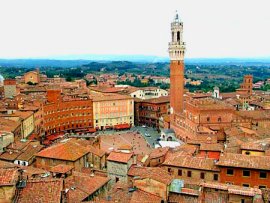
The sun-baked bricks of the Piazza del Campo hold the heat long after the crowds have gone home, radiating warmth into the cool Tuscan evening as the shadows of the Torre del Mangia stretch across the sloping shell-shaped square. You can feel the centuries beneath your feet. This is where Siena’s medieval soul lives, in the stone, in the narrow streets that spiral outward like a labyrinth, and in the fierce loyalty of its seventeen contrade, the neighbourhood districts that have defined civic life here since the thirteenth century. The Palio is the spectacle, but Siena itself is the story.
In This Article
The Seventeen Contrade: A City of Rival Neighbourhoods
Every Sienese child is born into a contrada, and that allegiance never fades. Each contrada has its own church, its own museum, its own fountain, and its own flag. When the Palio approaches, these seventeen miniature nations sharpen their rivalries. You can identify which contrada a street belongs to by the coloured flags hanging from windows and the small statues at the corners: the she-wolf for Lupa, the turtle for Tartuca, the porcupine for Istrice. The contrade are not just sporting clubs. They are extended families, mutual aid societies, and the reason Siena feels more like a federation of villages than a single city. Walk into the Contrada della Torre museum and you will see ceremonial costumes from the 1600s, still used today.
The Palio: More Than a Horse Race
The Palio di Siena is a bareback horse race around the Piazza del Campo lasting about ninety seconds, but those ninety seconds are the culmination of months of strategy, bribery, and prayer. Each contrada selects a jockey and a horse, and alliances shift daily. What looks like chaos to an outsider is a ritual as formalised as a coronation. The race itself is dangerous. The track is compacted dirt laid over the cobblestones, the corners are sharp, and horses sometimes finish without their riders. Ten horses run, representing ten of the seventeen contrade. The winner receives the Palio, a painted silk banner, and the losing contrada endures a year of mockery. The passion is real, the emotion overwhelming, and the entire city holds its breath twice each summer.
The Cathedral Marble: Black and White Sermon in Stone
Siena’s Duomo is a theological argument rendered in striped marble. The black and white bands that alternate across its facade and interior represent the black and white horses of the city’s legendary founders, Senius and Aschius. But the real spectacle is the floor. The marble intarsia panels covering the entire nave took two centuries to complete and depict scenes from the Old Testament, the Sibyls, and allegories of fortune and salvation. The Libreria Piccolomini houses frescoes by Pinturicchio so vivid that you expect the figures to step out of their frames. The Piccolomini family, who produced Pope Pius II, commissioned this space as a monument to their own humanist learning. The cathedral was meant to be even larger. In the 1300s, Siena planned an extension that would have made it the largest church in Christendom. The Black Death of 1348 ended that ambition.
Sienese Cuisine: Eating Like a Local
Siena’s food is earthy, generous, and built around local ingredients. Pici, the thick hand-rolled pasta, comes with cacio e pepe (pecorino and black pepper) or with ragù di cinghiale (wild boar sauce from the Maremma hills). Panforte, the dense fruit and nut cake that dates back to the Crusades, is Siena’s most famous export. Ricciarelli, the almond cookies dusted with powdered sugar, are softer and more elegant than their appearance suggests. For the full experience, eat in a trattoria off the main tourist routes. Try Osteria Le Logge or Trattoria La Torre. The wine list should feature Brunello di Montalcino from the nearby hills and Vernaccia di San Gimignano for something lighter.
When the Crowds Leave: Siena After Dark
Most visitors arrive at 10 am and leave by 5 pm, shuttled in by bus from Florence. They miss Siena’s best moments. At dusk, the Piazza del Campo fills with Sienese families. Children kick footballs across the brick slope. Couples sit on the stone edge drinking spritz. The streetlights cast a warm amber glow across the palaces. The cafes at the square’s edge serve the best people-watching in Tuscany. The quiet of Siena after the day-trippers depart is a reminder that this city is not a museum. It is someone’s home, someone’s contrada, someone’s entire world.
Would you rather watch the Palio from the packed centre of the Piazza del Campo or from a quiet window overlooking the race from above?
Published in: Italy. Updated June 11 2026.
Explore all our Italy travel guides, from the Dolomites to Sicily.
Explore More
If you enjoyed this article, you might also like:
