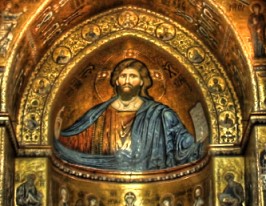
Gold covers nearly every surface inside Monreale Cathedral. Six thousand four hundred square metres of Byzantine mosaics tell stories from the Old and New Testaments. The figures stare down from the walls with enormous eyes, their robes shimmering in the dim light. King William II built this cathedral in the twelfth century to outshine the archbishop of Palermo. He succeeded. The cloister outside pairs 228 columns, each carved differently, surrounding a garden with a central fountain. Monreale sits on a hillside overlooking the Conca d’Oro valley, and the view alone justifies the journey up from the city below.
Not far from Palermo, in a small obscure town of Monreale, you can find one of the most famous monuments of the old Norman kingdom – The Cathedral of Monreale (Santa Maria la Nuova). It was built in the 12th century by the most powerful Norman King William II of Sicily, also known as William The Good. The Cathedral of Monreale was built as a token of his great power.
The Mosaics of Monreale: A Bible in Gold and Glass
The interior of Monreale Cathedral is dominated by one of the largest and most complete cycles of Byzantine mosaics in the world, covering nearly every available wall surface with scenes from the Bible. The mosaics were executed by skilled artisans brought from Constantinople, working between 1176 and 1185, and they cover more than 6,000 square metres. In the central apse, the colossal figure of Christ Pantocrator blesses the congregation with his right hand while holding the Gospels in his left, his enormous dark eyes gazing down from the golden background. Below him, the Virgin Mary and the apostles occupy the lower registers, while scenes from the life of Christ unfold along the nave walls. The Old Testament narratives line the side aisles, beginning with the Creation and continuing through the stories of Adam and Eve, Noah, Abraham, and Moses. The sheer scale of the programme is overwhelming: 130 separate scenes containing more than 2,000 individual figures, each rendered in brilliant glass tesserae set into a gold ground. The mosaics served not only as decoration but as a visual scripture for a largely illiterate population, teaching biblical stories through images that glow with an otherworldly radiance when the Sicilian sun streams through the cathedral windows. The workmanship is finest in the main apse, where the gold tesserae are set at slightly different angles so that the surface shimmers as the light changes throughout the day.
Architecture, Cloister, and the Legacy of Norman Sicily
The cathedral building itself is 102 metres long, a massive three-nave basilica that appears surprisingly modest from the outside. The west facade is restrained, relieved only by the ornate main portal and the bronze doors dating from 1186, which are decorated with 42 biblical scenes and feature the lion and griffin that served as symbols of the Norman royal house. On the left side of the church, another bronze door from 1179 shows stronger Byzantine influences. The construction began in 1172 under the patronage of King William II, who intended the cathedral to serve as his tomb and as a statement of Norman power that would surpass the cathedral of Palermo. The architecture blends Norman, Arab, and Byzantine traditions in a way that is unique to Sicily: pointed arches and geometric patterns reflect Islamic influence, while the basilica floor plan and apse arrangement follow Western Christian models. Attached to the cathedral is one of the finest cloisters in Italy, a square arcaded courtyard with 228 columns, each one carved with different patterns and scenes, paired in a rhythmic procession around the garden. The columns were decorated by skilled artisans from the Campania region, featuring intricate inlay work that combines gold, glass, and stone. At the centre of the cloister garden stands a fountain, fed by a channel of running water that creates a peaceful atmosphere. The town of Monreale, with around 25,000 inhabitants, has almost become a suburb of Palermo, but the cathedral remains its crowning glory and one of the greatest treasures of the Italian island.
The town of Monreale has today around 25 thousand inhabitants. Thanks to its location near the Sicilian capital city, Monreale has almost become one of the turbulent suburbs of Palermo. But if you visit this site, you should definitely visit The Cathedral of Monreale, which is thanks to its mosaics one of the greatest treasures of this Italian island.
View Cathedral of Monreale on the Larger Map
So if you’re interested in art and history, the Cathedral of Monreale should really be included on the your must-see list.
View The Cathedral of Monreale – one of the greatest treasures and most important attractions of Sicily, Italy in a larger map
Which Sicilian treasure would you visit first: Monreale or the Valley of the Temples? ✨
Explore all our Italy travel guides, from the Dolomites to Sicily.
Explore More
If you enjoyed this article, you might also like:
