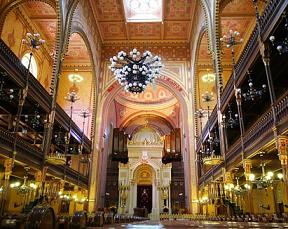
The Great Synagogue in Budapest stands as the largest synagogue in Europe and the second largest in the world, a monumental testament to the once thriving Jewish community of Hungary. Designed by Ludwig Forster and completed in 1859, the building synthesises Moorish, Byzantine, and Gothic styles into a richly ornamented structure seating three thousand worshippers. The interior dazzles with gilded details and a magnificent ark. The synagogue sits in the Jewish Quarter of Pest, home to a Holocaust Memorial Park with the poignant Tree of Life sculpture, a weeping willow whose metal leaves bear the names of victims. The Raoul Wallenberg Memorial honours the diplomat who saved tens of thousands of Hungarian Jews.
The Great Synagogue in Budapest, Hungary is the largest synagogue in Europe and after the synagogue in New York it is also the second largest synagogue in the world outside of Israel. It was built between 1854 – 1859 in the Byzantine – Moorish style, led by the Viennese architect Ludwig Förster.
Architecture and Design of the Dohany Street Synagogue
The Dohany Street Synagogue is a masterpiece of 19th-century religious architecture that reflects the aspirations of Budapest Jewish community during the era of emancipation. The building stretches 75 metres long and 27 metres wide, with a seating capacity of 3,000 worshippers across three chambers. The Viennese architect Ludwig Förster drew inspiration from Moorish architecture, notably the Alhambra in Granada, creating a design that asserted Jewish cultural identity through its distinctive Orientalist style. The facade is immediately recognisable for its large rosette window flanked by two octagonal towers crowned with onion-shaped domes, a motif commonly associated with Eastern European synagogue architecture. Above the rosette, a Hebrew inscription from the Second Book of Moses adorns the brickwork. The facade is composed of alternating strips of white and red brick, creating a striking polychrome effect that sets the building apart from its surroundings. Inside, the ornate decoration was the work of Hungarian architect Frigyes Feszl, who blended Byzantine and Moorish motifs with Reform Jewish liturgical requirements. According to Orthodox tradition, the synagogue provides a separate gallery for women, while the placement of the stage for Torah readers reflects clear Reform Judaism influences. The magnificent ark, crafted from gilded wood and marble, houses the Torah scrolls and dominates the eastern wall, while the central bimah allows the reader to face the congregation during services.
The Jewish Quarter, Holocaust Memorial, and Museum
The synagogue stands at the heart of Budapest historic Jewish Quarter, a district that was once home to more than 200,000 Jews before the Second World War. The area around Dohany Street formed the boundary of the Budapest Ghetto, established in 1944 by the Nazi regime, where tens of thousands of Jews were confined in appalling conditions before being deported to concentration camps. The Holocaust Memorial Park, located in the synagogue courtyard, is dominated by the Tree of Life sculpture, a striking metal weeping willow whose leaves bear the names of Hungarian Jewish victims inscribed on metal plaques. The tree reflects as a shadow on the ground, and the number 600,000 appears in the paving stones, representing the Hungarian Jews who perished in the Holocaust. Nearby stands the Raoul Wallenberg Memorial, honouring the Swedish diplomat whose courageous efforts saved approximately 100,000 Hungarian Jews by issuing protective passports and establishing safe houses. The synagogue grounds also contain the grave of Theodor Herzl, the Austro-Hungarian Jewish journalist born nearby who became the founder of modern political Zionism and the spiritual father of the State of Israel. His birthplace house, now the Jewish Museum, opened in 1931 and houses an extensive collection of religious artefacts, everyday objects, and historical documents spanning from ancient Roman times to the present, including the valuable Burial Society Chevra Kaddisha registry from 1792. One room is dedicated entirely to Holocaust memory, preserving the testimony of survivors and the names of those who were lost. The museum complex also includes the Garden of Remembrance, where visitors from around the world come to pay their respects and to learn about the vibrant Jewish culture that once flourished in this historic neighbourhood.
The Great Synagogue in Budapest is one of the most venerated synagogues in Europe.
View The Great Synagogue – the biggest synagogue in Europe Hungary in a larger map
Have you ever visited a synagogue or Holocaust memorial on your travels? 🕍
Explore all our Hungary travel guides, from Budapest baths to the Great Plain.
Explore More
If you enjoyed this article, you might also like:
