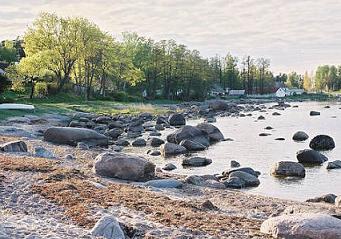
Bog pools mirror the pale northern sky like scattered coins on a blanket of moss. A wooden boardwalk trails through the silent Viru Bog, where dwarf pines and cloudberries cling to the thin layer of peat that floats above dark, tannin-stained water. In the deep forest, elk tracks press into mud beside trails that lead to manor houses half hidden by birch and spruce. The Baltic coast gnaws at the park s northern edge, where granite boulders left by retreating glaciers rest among juniper and sea thrift. Lahemaa is Estonia s wild heart, where wolves still roam and the only sound at dusk is the call of a crane.
In northern Estonia at an area less than 700 km2 lies the largest and oldest national park in the country – Lahemaa National Park. The park was established in 1971, as the first national park in the former USSR, in order to preserve many local natural places, but also a number of historical, archaeological and cultural sites.
Protected area in this region existed long before the establishment of the park, but the Soviet authorities were afraid of leading Estonians to nationalist ideas. Only after years of preparation and lobbying they have finally reached an agreement. After this, also Latvia and Lithuania in the years 1973 and 1974 declared their national parks.
In translation, the Lahemaa National Park means “Land of Bays.” At present it is one of the most popular tourist sites in Estonia, with about 300,000 tourists a year. Most of them come here in high season. But the park has a unique atmosphere also during off-season, it is then transformed into a magical and unspoilt countryside. Lahemaa National Park is a home to 838 kinds of plants and 50 species of mammals. You can meet here brown bears, American mink or lynx. In the trees there are 222 kinds of birds and in the rivers you can find salmon or trout.
The Viru Bog and Lahemaa’s Unique Landscapes
The Viru Bog is the most accessible and most visited of Lahemaa’s several bog complexes, and it offers a truly otherworldly experience. A 3.5-kilometre wooden boardwalk loops across the bog, allowing visitors to walk over the spongy, rust-coloured landscape without damaging the fragile ecosystem. The bog is a raised peatland, where the centre is higher than the edges, and the surface is dotted with pools of dark, tea-coloured water that mirror the sky. The peat here is up to seven metres deep in places, a record of thousands of years of plant growth and decay preserved in layers. Dwarf pines, some more than a century old but barely waist-high, cling to the nutrient-poor peat, while cloudberries, cranberries, and sundews add splashes of colour in summer. The boardwalk leads to a viewing platform that extends over one of the larger pools, offering a panoramic view of the bog that stretches to the horizon, punctuated only by distant tree lines. Beyond the bog, Lahemaa’s coastline is equally dramatic, with granite boulders deposited by retreating glaciers strewn along the shore. The park’s four peninsulas – Juminda, Parispea, Vergi, and Kasmu – jut into the Gulf of Finland, creating a deeply indented coastline of bays, cliffs, and sandy coves. The Altja coast, in particular, features distinctive erratic boulders, some the size of houses, that were carried here by ice sheets from Finland and Sweden.
Manor Houses and Cultural heritage
Lahemaa National Park is as rich in cultural heritage as it is in natural beauty, with a network of historic manor houses that tell the story of Estonia’s Baltic German aristocracy. The most impressive is Palmse Manor, a restored baroque estate dating from the 13th century that served as the seat of the von der Pahlen family for more than 200 years. The manor complex includes a main building with period interiors, a distillery, a greenhouse, and landscaped grounds with ponds and avenues of linden trees. Visitors can tour the elegantly furnished rooms, learn about the daily life of the nobility, and explore the surrounding parkland. Sagadi Manor, another well-preserved estate, houses the Estonian Forest Museum, which explores the relationship between Estonians and their forests through interactive exhibits. Kasmu, a former fishing village and now a charming coastal settlement, is home to the Kasmu Maritime Museum, housed in a 19th-century customs building. The museum tells the story of Estonia’s maritime traditions, including the tragic shipwrecks that litter the coast of what was once known as the “shipbreaker’s coast.” The village of Altja features a restored 19th-century tavern that serves traditional Estonian cuisine, including elk soup and juniper-smoked fish, in a rustic setting that transports visitors back in time.
Lahemaa National Park is situated at the coast of the Gulf of Finland, where several deep incisions create one bay after another. Sea coast is very rugged. National park icludes also four major peninsulas and the series of islands. About 480 km2 of the land is covered by forests, remaining 220 km2 are the waters of the Gulf of Finland.
Lahemaa National Park is a typical example of the Estonian countryside, it is mostly flat or slightly wavy to a maximum height of 115 meters above sea level. A large part of the park is occupied by marshes, moors and forests. Travelers will find fourteen lakes and several waterfalls that drop down from the rock cliffs from a height of about 60 meters. Lakes are either coastal or ice type. The park offers a lot of interesting places, however, one of the most attractive are typical stone fields, which were brought here by Scandinavian melting glaciers.
The area is very quiet and populated mainly with rural population. Apart from the natural scenery there are also many historical and cultural monuments. Near the eastern end of the park you can find a renovated castle in Palmse dating from the 13th century. In the years of 1677-1923 the entire territory belonged to the Baltic German family von der Pahlen. But the castle was later nationalized and used as a recreational facility for Estonian National Guard called Kaitseliit. The reconstruction works on the castle began after the establishment of a national park in 1971.
View Lahemaa National Park (Land of Bays) – the largest and oldest national park in Estonia in a larger map
Have you ever walked through a bog or peatland landscape? 🏔
Explore all our Estonia travel guides, from Tallinn old town to Baltic islands.
Explore More
If you enjoyed this article, you might also like:
- Tartu – the oldest city in Estonia – Estonia
- Valaste Waterfall – the highest waterfall in Estonia – Estonia
- Pärnu – Estonia’s Summer Capital – Estonia
