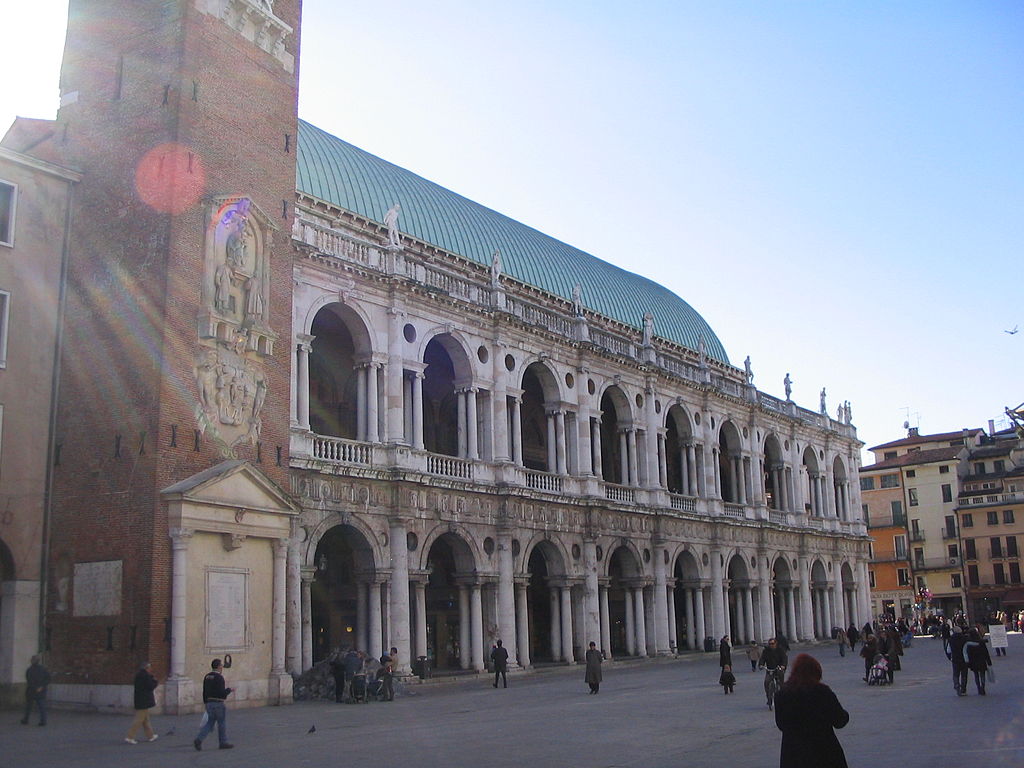
The stone of Vicenza glows golden in the afternoon light, a city shaped by the vision of one man. Andrea Palladio transformed this Veneto town into a Renaissance masterpiece, leaving behind a collection of palaces, villas, and the iconic basilica Palladiana that would influence architecture across Europe and America. Walking through Piazza dei Signori, you pass under the loggia of the basilica, where the rhythm of columns and arches creates a harmony that feels both ancient and modern. The Teatro Olimpico, Palladio’s final work, replicates an ancient Roman theatre inside a converted prison.
In the northeastern part of Italy, one can find the city of Vicenza. The city of Vicenza has a rich and colorful history and an amazing culture. There are countless museums and art galleries located throughout the city. Situated only 60 kilometers west of the canals of Venice, Vicenza is part of a bustling metropolis that is home to more than 250,000 residents.
Vicenza – basilica Palladiana at Piazza dei Signori, Italy by Wanblee
The area where Vicenza sits today was first settled back in the 3rd century B.C. by the Italic Euganei tribes. A century later, the area would also become home to the Paleo-Veneti tribes. As the Celtics made their way into Italy during the 2nd century B.C., the tribes of Vicenza would seek the help of the Romans and by 157 B.C., the city would become part of the Roman Empire.
Vicenza was first designated as a UNESCO heritage site. Two years later, the surrounding lands which are home to many Palladian Villas would be included as part of the UNESCO designation. One of the more popular villas near Vicenza is that of Veneto which is home to the ancient Teatro Olimpico which has attracted millions of visitors since its construction back in 1580.
In This Article
Palladio’s Urban Masterpieces
In and around the city of Vicenza you will also find a number if buildings that have also become quite famous over the years. Near the town center you will find the Villa Almerico Capra which is known locally as the La Rotonda.
There are many plazas in Vicenza as well. The Museo Palladio can be found in the Palazzo Barbaran da Porto. The Palazzo del Capitaniato is the current home to the Town council of Vicenza. The unfinished Palazzo Porto in Piazza Castello is also a very popular destination for those who visit the city. In all, there are a total of 23 sites in Vicenza that were built by Palladio.
The basilica Palladiana is the centrepiece of Palladio’s urban work. With its distinctive white stone loggia wrapping around the medieval Palazzo della Ragione, the building is instantly recognizable. Palladio applied a classical solution to an existing Gothic structure, creating a double order of columns topped by a striking ship keel roof that resembles an overturned hull. The building’s upper loggia offers one of the best panoramic views of the city. Directly across the Piazza dei Signori stands the Palazzo del Capitaniato, another of Palladio’s creations, which now houses the town council. Its massive unplastered brick facade with white stone columns gives it a monumental presence that contrasts with the more delicate basilica opposite. The Loggia del Capitaniato, with its four great columns, was designed to host public ceremonies and continues to serve as a gathering place for civic events.
Exploring Palladio’s Villas in the Countryside
Beyond the city walls, the rolling hills of the Veneto are dotted with Palladian villas that represent the architect’s genius at its most idyllic. Villa Almerico Capra, better known as La Rotonda, is perhaps the most famous of them all. This perfectly symmetrical building with a central dome and four identical porticoes, each facing a cardinal direction, was designed as a retreat for a retired Vatican official. The villa influenced Thomas Jefferson’s design for Monticello and countless neoclassical buildings around the world. Visitors can tour the interior on Wednesday and Saturday mornings, admiring the frescoed rooms and the harmonious relationship between building and landscape.
Other notable villas in the region include Villa Barbaro at Maser, decorated with stunning frescoes by Paolo Veronese, and Villa Emo, a working farm estate that demonstrates Palladio’s practical side. The Villa Poiana and Villa Pisani at Bagnolo also showcase variations on Palladio’s signature themes of symmetry, proportion, and integration with the natural environment. Many of these villas are still privately owned and maintained, offering a more intimate glimpse into the lifestyle of the Venetian nobility. Cycling routes connect several of the villas, making for an excellent day trip from Vicenza through the picturesque countryside of the Veneto region.
Palladian Architecture Beyond the basilica
Vicenza UNESCO listing protects over 20 Palladian buildings. The Teatro Olimpico, Palladio final work, features the oldest surviving stage set in the world, creating the illusion of a Roman street. Entry costs 13 euros. The Palazzo Chiericati houses paintings by Tiepolo, Veronese, and Tintoretto. Outside the city, the Villa Rotonda is Palladio most famous villa, with four identical porticos, open Wednesday and Saturday mornings for 10 euros.
Have you ever visited a city shaped by a single architect’s vision?
Explore all our Italy travel guides, from the Dolomites to Sicily.
Explore More
If you enjoyed this article, you might also like:
