L’Oceanogràfic is the largest aquarium in Europe, holding 42 million litres of water across 14 separate ecosystems, and its lotus-flower-shaped roof, designed by architect Félix Candela, has become the defining image of Valencia’s futuristic City of Arts and Sciences complex. Located in the dry riverbed of the former Turia River in the heart of Valencia, the aquarium complex opened in 2003 and houses over 45,000 animals representing 500 species from the world’s major marine ecosystems. The experience is structured as a journey through different aquatic environments, from the Mediterranean to the Arctic, the tropics to the Antarctic, with the two largest tanks, the dolphinarium and the shark-themed ocean viewing tunnel, acting as the dramatic centrepieces. The architecture, a series of hyperbolic paraboloid shells in white concrete, creates a building that appears to float on the water surface, and the surrounding pools, lagoons, and gardens integrate the aquarium seamlessly into the landscape.
\n\n
In This Article
Quick Facts: L’Oceanogràfic Valencia
\n
- \n
- Location: Carrer d’Eduardo Primo Yúfera, 1B, 46013 Valencia, within the City of Arts and Sciences. Accessible by metro (Lines 3 and 5, Alameda station, then a 15-minute walk), bus (Lines 13, 14, 15, and 95), or car with ample paid parking on site
- Best time to visit: Tuesday to Friday for smaller crowds. Weekends and Spanish public holidays are very busy. Arrive at opening time (10am) and head directly to the dolphinarium for the first show (check schedule on arrival as timings vary seasonally). Allow 4-5 hours to see everything properly
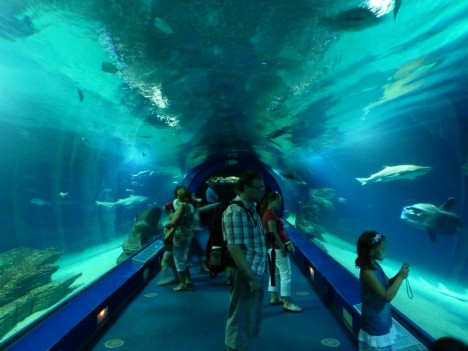
- Key exhibits: The dolphinarium (the largest in Europe, with 24 million litres of water and capacity for 2,000 spectators); the shark tunnel (a 30-metre acrylic tunnel through a 7-million-litre tank with sand tiger sharks, bull rays, and grouper); the Arctic pavilion (beluga whales and walruses); the Antarctic pavilion (king penguins, gentoo penguins, and a climate-controlled environment maintained at -2°C); and the Mediterranean tanks (featuring local species in a reconstruction of the Medes Islands marine reserve)
- Combined tickets: A combined ticket covering the City of Arts and Sciences complex, including the Hemisfèric (IMAX cinema), the Museu de les Ciències (interactive science museum), and L’Oceanogràfic, costs approximately €40 for adults (as of 2026). Booking online in advance saves approximately 10% and allows priority entry
\n
\n
\n
\n
\n\n
When it comes to visiting aquariums in Europe, the most popular and largest in the entire continent can be found in Valencia, Spain. It is here in Valencia where you will be able to experience the L’ Oceanogràfic of the City of Arts and Sciences which is said to contain a representation of the entire world’s marine ecosystem within the large complex.
\n
There are multiple buildings that are part of the L’ Oceanogràfic of the City of Arts and Sciences. Each one of these are identified with a different type of aquatic environment. These environments include the Mediterranean, temperate, wetlands, tropical seas, Antarctica, Arctic, oceans, Islands as well as the Red Sea.
\n
\nDolphinarium L’Oceanografic, Valencia, Spain / Photo by Claire (Europe Explored)
\n
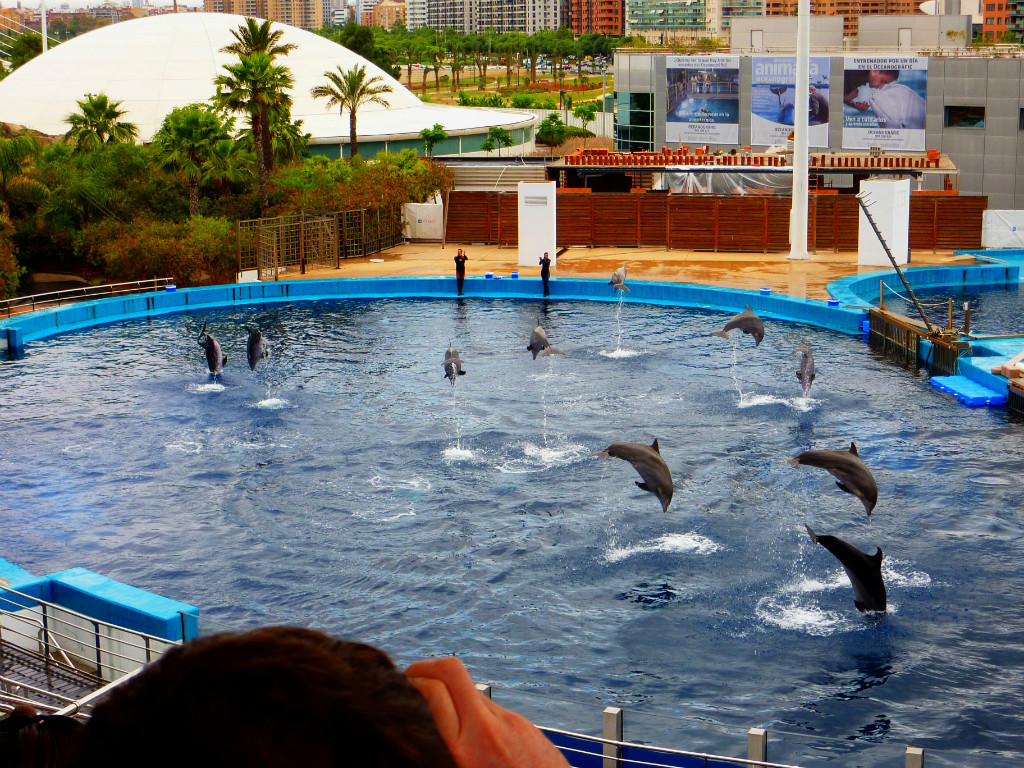
However, perhaps the biggest and most popular attraction in the L’ Oceanogràfic is that of the Dolphinarium. There are more than 24 million liters of water in the Dolphinarium which boasts gaps of more than 10 1/2 meters. There is also an underwater restaurant where one can sit down and eat while watching tens of thousands of fish swim all around. The Dolphinarium truly is a very unique eating experience the matter how you choose to look at.
\n
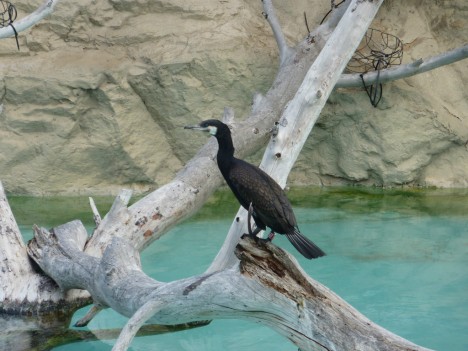
Today, there are more than 500 different species of dolphins, walruses, belugas, sea lions, penguins, seals, sharks, turtles, rays, jellyfish, sawfish, starfish, crustaceans as well as sea urchins of all different kinds. All in all, there are more than 45,000 individual animals that call the L’ Oceanogràfic their home. Furthermore the aquarium is not just home to marine life, it is also home to a number of bird species who are crucial to ensuring that the ecosystem stay as strong as it can possibly be.
\n
\nAquarium, L’Oceanografic, Valencia, Spain / Photo by Claire (Europe Explored)
\n
It was back in 2003 when the L’ Oceanogràfic of the City of Arts and Sciences first opened its doors to the public. Since that grand opening, more than 12 million people from all over the world have made their way to the aquarium in order to see the flora and fauna as well as to attend the numerous lectures and other activities that are continuously held on the campus by numerous scientific bodies from all over the world.
\n
A lot of time and effort was put into the design and development of the L’ Oceanogràfic of the City of Arts and Sciences to ensure that its architecture was of the latest, and most popular styles; and to ensure that any barriers within the aquarium were virtually invisible. There are countless faults, underground tunnels and tanks of all sizes that can be found throughout the park. It truly is an extraordinary destination which is home to one of the largest and most exotic biodiversed ecosystems on the planet.
\n
\nBird in L’Oceanografic, Valencia, Spain / Photo by Claire (Europe Explored)
\n
L’ Oceanogràfic is open all year round, opening hours depend on the season, and the basic admission is 27.90 €. For more information visit Official site of L’ Oceanogràfic\n
