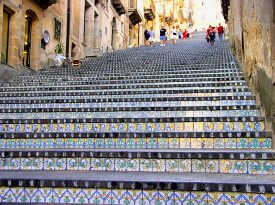
The Scala di Santa Maria del Monte in Caltagirone is not merely a staircase. It is a work of art, a feat of engineering, and a symbol of the city’s identity all rolled into one. This monumental staircase, consisting of 142 steps, climbs the hillside from the Piazza del Municipio to the Church of Santa Maria del Monte. Each step is decorated with hand-painted ceramic tiles in the traditional Caltagirone style, featuring intricate geometric patterns, floral motifs, and vibrant colours that reflect the city’s long history as a centre of ceramic production. The effect is breathtaking: a cascade of colour rising through the heart of the city, best viewed from the bottom on a sunny day when the tiles seem to glow.
In This Article
The Ceramic Tradition of Caltagirone
Caltagirone has been a centre of ceramic production since the time of the ancient Greeks, who colonised this part of Sicily and introduced the potter’s wheel. The city’s location on a hillside provided abundant clay, and the tradition has been passed down through generations of artisans ever since. The Museum of Ceramics, housed in the former Bourbon prison, displays an extensive collection of ceramics from prehistoric times to the present day, documenting the evolution of styles and techniques over three millennia. The museum’s collection includes Greek vases, Roman amphorae, Arab-influenced plates, and Baroque altarpieces, as well as contemporary works by modern Sicilian ceramicists. Visitors can watch skilled artisans at work in the workshops that line the streets of the historic centre, where the potter’s wheel has been turning for over 2,500 years.
The Staircase and Its Festivals
The 142 steps of the Scala di Santa Maria del Monte are decorated with different ceramic patterns, each one a variation on the traditional Caltagirone style. The steps are divided into sections that correspond to different historical periods, creating a chronological journey through the city’s artistic heritage. The staircase is illuminated at night, creating a magical effect as the coloured tiles catch the light. During the annual Scalinata dell’Infiorata festival in May, the steps are covered with elaborate floral arrangements that transform the staircase into a carpet of flowers. On July 24 and 25, the feast of Saint James, the steps are lit with thousands of small oil lamps arranged in intricate patterns, a tradition known as the Scala Illuminata. The photographs from these events are among the most iconic images of Sicily.
Exploring Caltagirone and Practical Tips
Beyond the staircase, Caltagirone offers a beautifully preserved historic centre with Baroque churches, aristocratic palaces, and quiet piazzas. The Cathedral of San Giuliano, rebuilt after the 1693 earthquake, features a striking facade and a bell tower with seven bells. The city’s ceramic shops are concentrated around the Piazza del Municipio and the streets leading up the hill, offering everything from traditional Sicilian plates and tiles to contemporary art pieces. Caltagirone is located in the province of Catania, approximately 70 kilometres southwest of Catania city. The best way to reach it is by car, as public transport connections are limited. The best time to visit is during the spring or autumn festivals. Allow at least half a day to explore the historic centre and the ceramic museum.
Have you climbed the 142 ceramic-covered steps of Caltagirone and admired the craftsmanship of each hand-painted tile? Which step or pattern caught your eye?

68 km from Catania at 608 meters above the sea level, there is one of the Sicilian pearls Caltagirone.
Caltagirone is famous for the production of hand-made ceramics, particularly maiolica and terra-cotta wares. Production of grapes, olives and peaches is also typical for this region.
In the city you can visit Museum of Pottery which is dedicated to the history of pottery, where you can see a collection of ancient and modern pottery and terra-cotta, dating back to the Magna Grecia period.
The biggest attraction of the city is 142-step monumental Staircase of Santa Maria del Monte, built from 1608 in the old part of the town. The speciality is that each stair is decorated with different hand-made ceramics, using styles and figures derived from the millennial tradition of pottery making.
During the summer there are lots of concerts in Caltagirone, theater performances and dance celebrations, but the most important event is on 24 and 25 July each year called La Luminaria – feast of San Giacomo, saint patron of the city. The staircase is illuminated with candles of different colours arranged in order to reconstruct an artistic drawing of several tens of meters.
During the winter Caltagirone is much more picturesque thanks to the temperature differences between day and night, that often rise to a dense fog, familiarly called “A Paisana“.
The historical center of Caltagirone extends along two main streets: Via Roma and Corso Vittorio Emanuele. Here you can see beautiful baroque buildings, including Palazzo Gravina, and the norman basilica di San Giacomo which houses precious works of art.
However the city offers much more and it really worth to see it.
View Caltagirone – the stairs to heaven in Sicily, Italy in a larger map
Have you explored the natural wonders and historic treasures described here? Share your favourite European travel memory in the comments below!
Explore all our Italy travel guides, from the Dolomites to Sicily.
Explore More
If you enjoyed this article, you might also like:
