Segesta is one of Sicily’s most hauntingly beautiful ancient sites, a perfectly preserved 5th-century BC Doric temple standing in solitary splendour on a remote hillside in the Sicilian interior, its 36 columns silhouetted against the sky with no modern development in sight. Built by the Elymians, one of Sicily’s three indigenous peoples, this unfinished temple is all the more evocative for its isolation and its mysterious backstory. The nearby mountaintop Greek theatre offers panoramic views extending to the Gulf of Castellammare on clear days.
In This Article
Quick Facts: Segesta, Sicily
- Best time to visit: Spring and autumn for comfortable temperatures and golden light on the temple; summer is hot but the elevated site catches cooling breezes
- Top attraction: The Doric temple, one of the best-preserved in the Greek world, and the 4,000-seat Greek theatre on Monte Barbaro
- How to get there: ~1 hour from Palermo by car (A29 to Segesta exit) or ~45 minutes from Trapani; accessible by bus from Palermo
- Entry fee: ~€6 (adult); shuttle bus to the theatre ~€2
- Combine with: The Zingaro Nature Reserve and the medieval hill town of Erice, both within 30 minutes
The Unfinished Temple: Architecture and Mystery
The temple at Segesta is one of the most enigmatic ancient structures in the Mediterranean. Built between 430 and 420 BC by the Elymian people, the Doric temple was never completed. The 36 columns, 6.1 metres tall and 1.8 metres in diameter, remain unfluted. The cella was never built, and there is no evidence of a roof. Archaeologists debate weather it was left unfinished as a political statement, abandoned due to war, or never intended as a religious building. The prevailing theory is that Segesta began construction to demonstrate Hellenisation to Greek neighbours, but Peloponnesian War tensions interrupted the project, and the destruction of Selinunte in 409 BC made completion unnecessary. This unfinished state reveals more about Greek construction techniques than any completed temple could.
The Greek Theatre and Its Panoramic Views
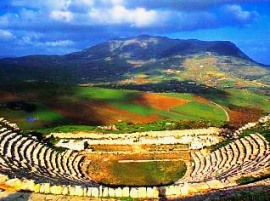
At the summit of Monte Barbaro, a 15-minute walk from the temple, lies the 3rd-century BC Greek theatre cut into natural rock. The theatre originally seated 4,000 spectators in 20 rows divided into seven sections. What makes it extraordinary is its setting: from the top rows, the view stretches across the valley to the Gulf of Castellammare, with the temple below and the Tyrrhenian Sea on the horizon. In summer, the theatre hosts classical Greek dramas at dusk, when the setting sun paints the ruins gold. Tickets cost 20 to 30 EUR and must be booked in advance for popular shows.
Combining Segesta with Erice and the Zingaro Reserve
Segesta sits within 30 minutes of two world-class attractions. Erice, a medieval hill town 751 metres above sea level on Mount Erice, features winding cobblestone streets, a Venus Castle, and breathtaking coastal views. Try the genovesi pastries at Maria Grammatico, a former nun whose almond pastries are internationally celebrated. The Zingaro Nature Reserve, Sicily first protected reserve established in 1981, stretches 7 kilometres along unspoiled coastline with crystal-clear coves accessible only on foot. The main trail takes 4 hours one way past hidden beaches and rocky headlands. For a shorter visit, Cala dell Uzzo is a 20-minute walk from the car park with excellent swimming in turquoise water.
Segesta is a town located in the northwestern part of Sicily, in the province of Trapani, approximately 70km southwest of Palermo. It is former center of Elymian people – one of the three indigenous peoples of Sicily. They built Doric temple here in the 5th century BC at the edge of a deep canyon, however the temple has never been completed.
The ancient town is really well preserved. The monument complex contains also a smaller ancient theater, located on the hill of Monte Barbaro, from which you can enjoy the beautiful views of the Castellammare del Golfo.
At Segesta’s archaeological park, there’s a shuttle bus to take you from the parking area to the amphitheatre and urban excavations. The nearest locality is Calatafimi. During Summer, several classical Greek dramas are performed at Segesta’s ancient amphitheatre, but many of these productions feature actors and actresses wearing casual clothes instead of classical costumes.
View Segesta – ancient town in Sicily, Italy in a larger map
Have you explored the temple of Segesta or discovered Sicily’s ancient Greek heritage? Share your Sicilian travel highlights in the comments! 🏛️
Explore all our Italy travel guides, from the Dolomites to Sicily.
Explore More
If you enjoyed this article, you might also like:
